

9Z9K image
Deposition Date 2025-11-18
Release Date 2026-10-07
Last Version Date 2026-10-14
Entry Detail
PDB ID:
9Z9K
Title:
Cryo-EM structure of Leishmania tarentolae respiratory complex III (cytochrome bc1 complex)
Biological Source:
Source Organism(s):
Method Details:
Experimental Method:
Resolution:
3.02 Å
Aggregation State:
PARTICLE
Reconstruction Method:
SINGLE PARTICLE
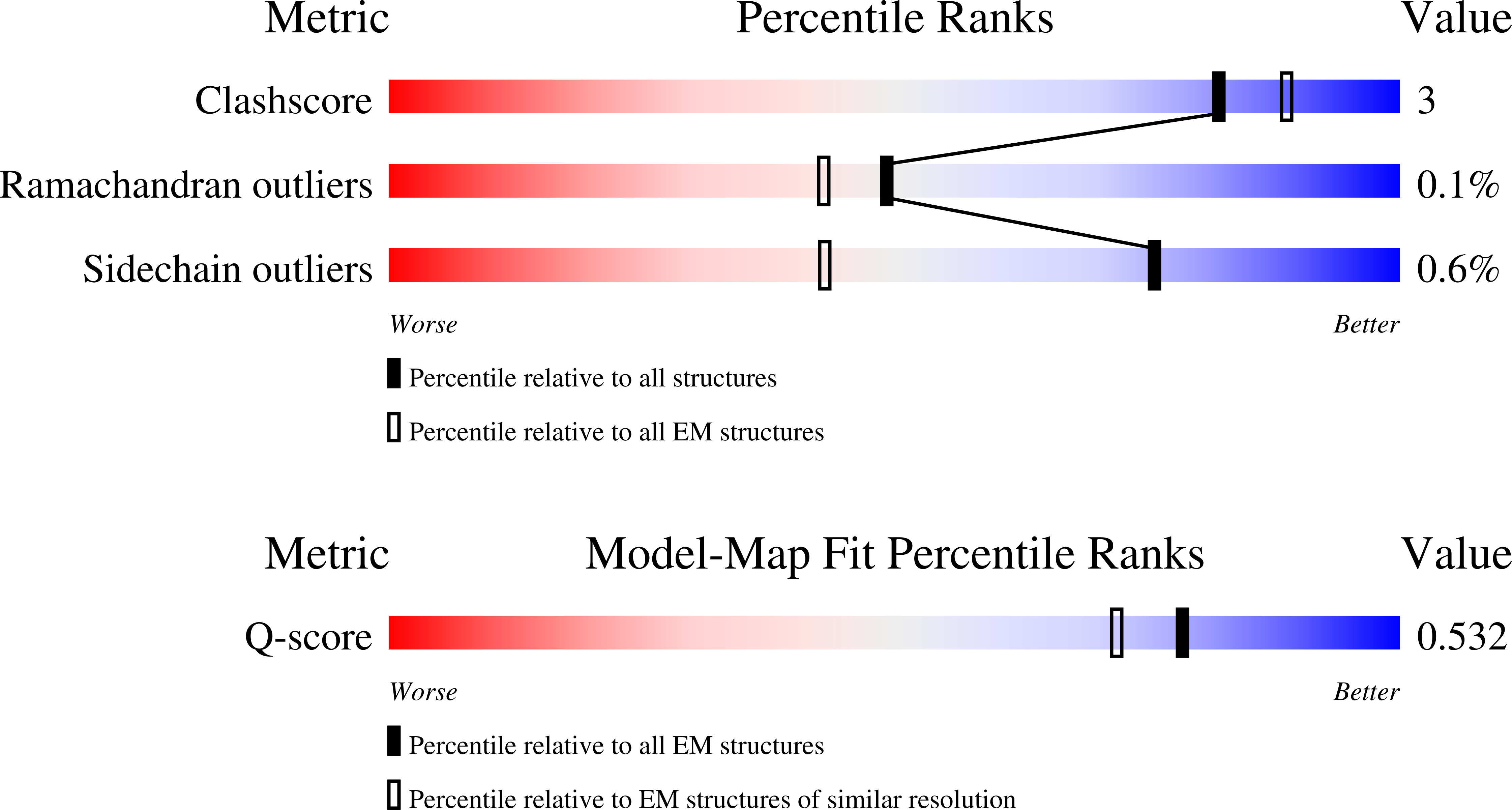
Macromolecular Entities
Polymer Type:polypeptide(L)
Molecule:Mitochondrial processing pept
Gene (Uniprot):LtaPh_1307700
Chain IDs:A, L (auth: a)
Chain Length:479
Number of Molecules:2
Biological Source:Leishmania tarentolae
Polymer Type:polypeptide(L)
Molecule:Mitochondrial processing pept
Gene (Uniprot):LtaPh_3514500
Chain IDs:B, M (auth: b)
Chain Length:490
Number of Molecules:2
Biological Source:Leishmania tarentolae
Polymer Type:polypeptide(L)
Molecule:Ubiquinol-cytochrome c reduct
Gene (Uniprot):LtaPh_3502100
Chain IDs:C, N (auth: c)
Chain Length:191
Number of Molecules:2
Biological Source:Leishmania tarentolae
Polymer Type:polypeptide(L)
Molecule:Cytochrome b
Gene (Uniprot):MT-CYB
Chain IDs:D, O (auth: d)
Chain Length:371
Number of Molecules:2
Biological Source:Leishmania tarentolae
Polymer Type:polypeptide(L)
Molecule:Cytochrome c1, heme protein,
Gene (Uniprot):LtaPh_0700600
Chain IDs:E, P (auth: e)
Chain Length:258
Number of Molecules:2
Biological Source:Leishmania tarentolae
Polymer Type:polypeptide(L)
Molecule:LtaP17.1410, Hypothetical pro
Gene (Uniprot):LtaPh_1714100
Chain IDs:F, Q (auth: f)
Chain Length:67
Number of Molecules:2
Biological Source:Leishmania tarentolae
Polymer Type:polypeptide(L)
Molecule:LtaP32.3800, Hypothetical pro
Gene (Uniprot):LtaPh_3238000
Chain IDs:G, R (auth: g)
Chain Length:147
Number of Molecules:2
Biological Source:Leishmania tarentolae
Polymer Type:polypeptide(L)
Molecule:Rieske iron-sulfur protein, p
Gene (Uniprot):LtaPh_3515900
Chain IDs:H, S (auth: h)
Chain Length:279
Number of Molecules:2
Biological Source:Leishmania tarentolae
Polymer Type:polypeptide(L)
Molecule:LtaP35.0250, Hypothetical pro
Gene (Uniprot):LtaPh_3502500
Chain IDs:I, T (auth: i)
Chain Length:107
Number of Molecules:2
Biological Source:Leishmania tarentolae
Polymer Type:polypeptide(L)
Molecule:Ubiquinol-cytochrome-c reduct
Gene (Uniprot):LtaPh_3130100
Chain IDs:J, U (auth: j)
Chain Length:70
Number of Molecules:2
Biological Source:Leishmania tarentolae
Polymer Type:polypeptide(L)
Molecule:LtaP27.0110, Hypothetical pro
Gene (Uniprot):LtaPh_2701100
Chain IDs:K, V (auth: k)
Chain Length:75
Number of Molecules:2
Biological Source:Leishmania tarentolae
Polymer Type:polypeptide(L)
Molecule:unassigned helix
Chain IDs:W (auth: L), X (auth: l)
Chain Length:24
Number of Molecules:2
Biological Source:Leishmania tarentolae
Ligand Molecules
Primary Citation
Conserved and divergent mitochondrial assemblies in kinetoplastid parasites.
Mol.Cell 86 4043 ? (2026)
PMID: 42822418 DOI: 10.1016/j.molcel.2026.08.031

Abstact

The mitochondrial proteomes of Leishmania tarentolae and Trypanosoma brucei contain approximately 1,700 proteins, most of which lack homologs in higher eukaryotes. Here, we integrate complexome profiling and cryo-electron microscopy to define conserved and lineage-specific macromolecular assemblies that support mitochondrial functions in these kinetoplastid protozoa. Comparative analyses reveal species- and life-stage-dependent differences in the abundance and composition of respiratory, metabolic, RNA processing, and other complexes, refining and expanding current annotations. Structures of L. tarentolae respiratory complex III(2) (CIII(2)), complex IV(2) (CIV(2)), and complex V (CV) identify nine previously unrecognized nuclear-encoded subunits and resolve five mitochondrially encoded proteins, including products of pan-edited mRNAs. These reconstructions uncover architectural innovations: a subunit 8 of ubiquinol cytochrome-c reductase (QCR8) N-terminal extension that plugs the vestigial mitochondrial processing peptidase (MPP)alpha/beta cavity in CIII(2), a CIV(2) dimer stabilized by an extensive clade-restricted interface, and a CV dimer containing the mitochondrially encoded ATP6 subunit. Together, our findings reveal how kinetoplastids assemble specialized mitochondrial machinery while incorporating diverged components into core modules shared across eukaryotes.

Legend

Protein

Chemical

Disease

Primary Citation of related structures
Feedback Form
Name
Email
Institute
Feedback