

9Z7A image
Deposition Date 2025-11-16
Release Date 2026-06-03
Last Version Date 2026-07-01
Entry Detail
PDB ID:
9Z7A
Title:
Cryo-EM structure of Secreted extracellular protein A (SepA) from Shigella flexneri complexed with the fragment antigen binding domain of monoclonal antibody 40
Biological Source:
Source Organism(s):
Method Details:
Experimental Method:
Resolution:
1.99 Å
Aggregation State:
PARTICLE
Reconstruction Method:
SINGLE PARTICLE
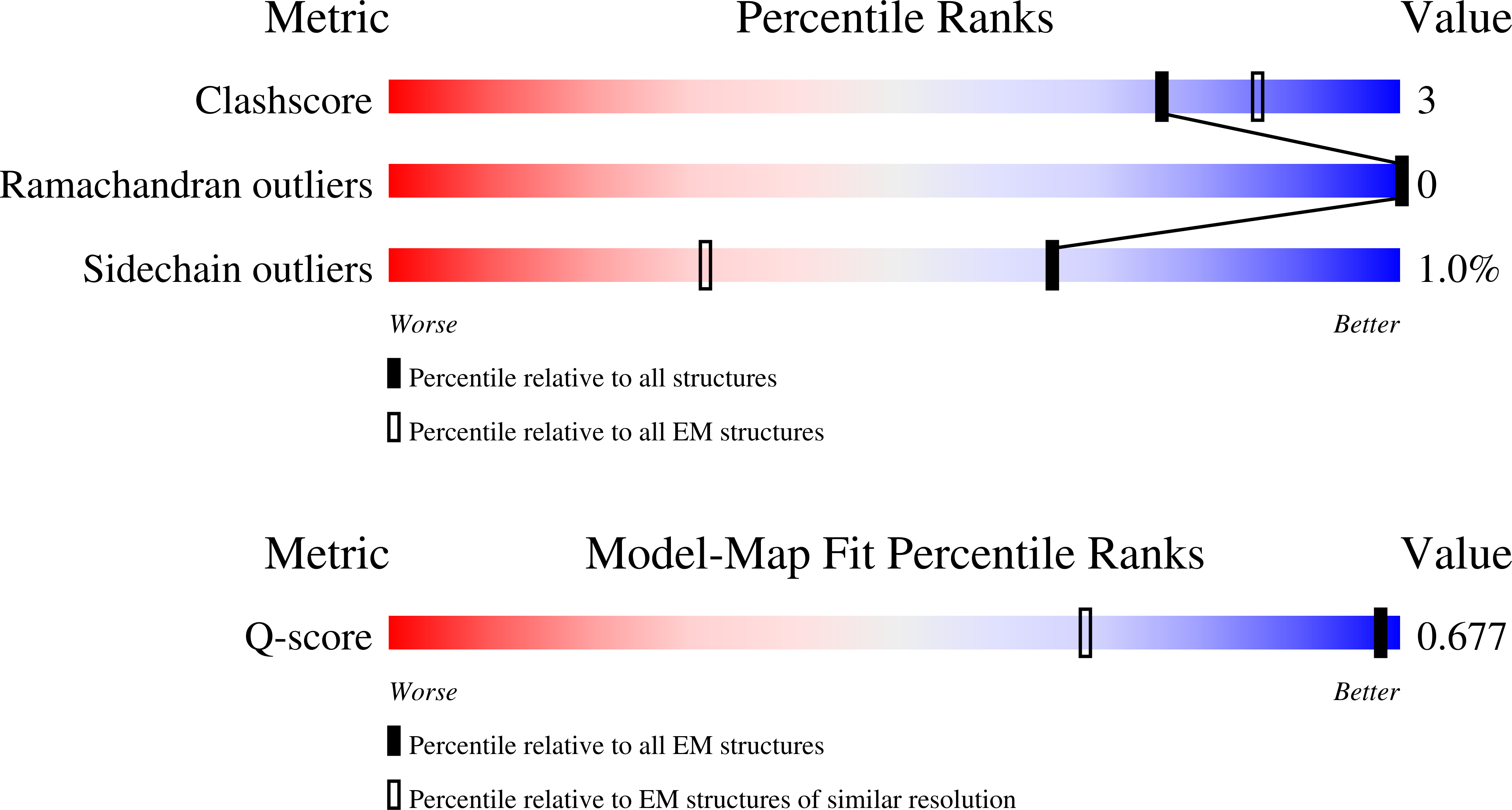
Macromolecular Entities
Polymer Type:polypeptide(L)
Molecule:Serine protease SepA autotran
Gene (Uniprot):sepA
Mutagens:F684S natural variant compared to Q8VSL2 UniProt entry (F740 in UniProt)
Chain IDs:A
Chain Length:1033
Number of Molecules:1
Biological Source:Shigella flexneri 2a str. 2457T
Structural Superimposition Protein Blast
Polymer Type:polypeptide(L)
Molecule:Heavy chain of the fragment a
Chain IDs:B
Chain Length:224
Number of Molecules:1
Biological Source:Homo sapiens
Structural Superimposition Protein Blast
Polymer Type:polypeptide(L)
Molecule:Light chain of the fragment a
Chain IDs:C
Chain Length:215
Number of Molecules:1
Biological Source:Homo sapiens
Ligand Molecules
Primary Citation
Human enterotoxigenic Escherichia coli (ETEC) infections elicit antibodies that broadly neutralize mucinases of pathogenic Escherichia coli and Shigella.
Proc.Natl.Acad.Sci.USA 123 e2614012123 e2614012123 (2026)
PMID: 42296351 DOI: 10.1073/pnas.2614012123

Abstact

Enterotoxigenic Escherichia coli (ETEC) and Shigella are the most common bacterial diarrheal pathogens among young children of low-middle income regions. Enteric pathogens must overcome formidable host defenses, including the protective barrier formed by intestinal mucus. ETEC produce a virulence protein called EatA, a member of the Serine Protease Autotransporter of the Enterobacteriae (SPATE) family, where the secreted passenger domain (EatA(p)) specifically degrades MUC2, the major mucus secreted by goblet cells of the human intestine. Notably, some Shigella spp., as well as other diarrheagenic E. coli pathovars, secrete homologues of EatA known as SepA, and Pic. Here, we demonstrate that EatA, SepA, and Pic are functionally redundant MUC2 mucinases and that recombinant monoclonal antibodies (mAbs) derived from plasmablasts of ETEC-infected humans can inhibit MUC2 degradation by all three proteases. We present cryo-EM structures of EatA and the related SPATE proteins, SepA, and Pic, complexed to fragment antigen-binding portions of these mAbs to demonstrate that those targeting a core beta-helix epitope shared by all three SPATE molecules broadly neutralize the capacity to degrade MUC2. These mAbs effectively prevent MUC2 degradation by each SPATE as well as mucus penetration by ETEC, Shigella flexneri, and Pic-producing enteroaggregative E. coli (EAEC). We anticipate that these studies could facilitate rational design of vaccines that broadly protect against major enteric pathogens by targeting a shared virulence feature.

Legend

Protein

Chemical

Disease

Primary Citation of related structures
Feedback Form
Name
Email
Institute
Feedback