

9Z1X image
Deposition Date 2025-11-04
Release Date 2026-06-17
Last Version Date 2026-06-24
Entry Detail
PDB ID:
9Z1X
Title:
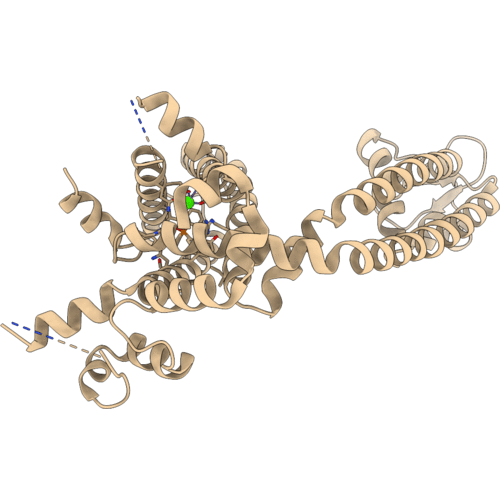
Cryo-EM structure of human TRPM4 channel in the warm conformation in complex with calcium and TPPO at 37 degrees Celsius (monomeric TMD-focused map with best-resolved TPPO density)
Biological Source:
Source Organism(s):
Homo sapiens (Taxon ID: 9606)
Expression System(s):
Method Details:
Experimental Method:
Resolution:
3.00 Å
Aggregation State:
PARTICLE
Reconstruction Method:
SINGLE PARTICLE
Macromolecular Entities
Structures with similar UniProt ID
Protein Blast
Polymer Type:polypeptide(L)
Molecule:Transient receptor potential
Gene (Uniprot):TRPM4
Chain IDs:A
Chain Length:1214
Number of Molecules:1
Biological Source:Homo sapiens
Primary Citation
Temperature and intrinsic Ca 2+ reshape TRPM4 pharmacology.
Nat.Struct.Mol.Biol. ? ? ? (2026)
PMID: 42265346 DOI: 10.1038/s41594-026-01818-3

Abstact

Proteins operate in dynamic environments where ions, lipids and temperature collectively define their properties, yet most studies rely on simplified conditions that overlook these intrinsic variables. Here we show two such factors-temperature and Ca(2+)-remodel the function and pharmacology of TRPM4, an ion channel implicated in cardiac conduction, immune regulation, cancer and intestinal-fluid homeostasis. At physiological temperature and Ca(2+), TPPO-previously considered a selective TRPM5 inhibitor inactive toward TRPM4-potently activates TRPM4, revealing strong synergy among temperature, Ca(2+) and ligand binding. By contrast, Necrocide-1, a necroptotic activator targeting the same binding pocket, defies this logic: it opens TRPM4 without Ca(2+) but is antagonized by Ca(2+). Meanwhile, the inhibitors NBA and CBA engage a nearby pocket, locking the channel in a non-conductive pre-open state. Our findings highlight that even rigid binding pockets can exhibit temperature-dependent ligand recognition, revealing hidden pharmacology and informing selective, environment-aware therapeutic strategies.

Legend

Protein

Chemical

Disease

Primary Citation of related structures
Feedback Form
Name
Email
Institute
Feedback