

9YXY image
Deposition Date 2025-10-27
Release Date 2026-03-18
Last Version Date 2026-03-25
Entry Detail
PDB ID:
9YXY
Title:
Crystal structure of EEPD1 EEP domain dimer at pH 5.5
Biological Source:
Source Organism(s):
Homo sapiens (Taxon ID: 9606)
Expression System(s):
Method Details:
Experimental Method:
Resolution:
2.00 Å
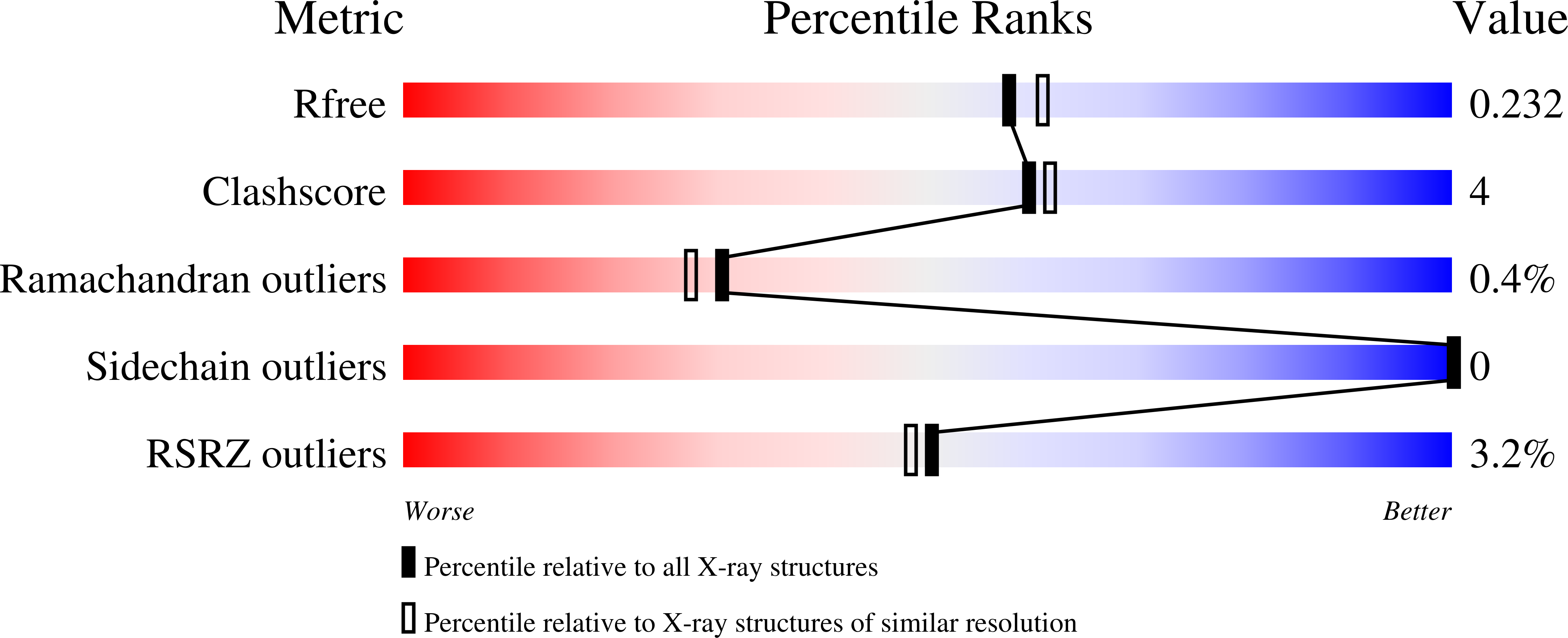
R-Value Free:
0.23
R-Value Work:
0.19
R-Value Observed:
0.19
Space Group:
P 21 21 21
Macromolecular Entities
Structures with similar UniProt ID
Protein Blast
Polymer Type:polypeptide(L)
Molecule:Endonuclease/exonuclease/phos
Gene (Uniprot):EEPD1
Chain IDs:A, B
Chain Length:302
Number of Molecules:2
Biological Source:Homo sapiens
Primary Citation
EEPD1 evolved a unique DNA clamping dimer protecting reversed replication forks.
Nucleic Acids Res. 54 ? ? (2026)
PMID: 41830330 DOI: 10.1093/nar/gkag188

Abstact

Exonuclease/endonuclease/phosphatase (EEP)-fold hydrolases are canonically monomeric phosphodiesterases exemplified by APE1, DNase I, and TDP2 nucleases. While EEP family domain containing protein 1 (EEPD1) acts in DNA stress responses, its proposed nuclease activities are enigmatic. Here, we integrate hybrid structural methods, evolution, biochemistry, cancer genomics, plus molecular and cell biology to define EEPD1 structure, assembly, and function at stalled DNA replication forks. Results imply EEPD1 surprisingly requires both unique EEP domain dimer and distinctive tandem Helix-hairpin-Helix [(HhH)2] domains to clamp double-stranded (ds) DNA at reversed DNA replication forks for fork protection. Small-angle X-ray Scattering (SAXS), crystal, and cryo-EM structures unveil an unprecedented tryptophan handshake dimer, conserved interface di-Trp-Pro pocket, and adjustable "wrist" enabling an open-closed conformational switch. EEPD1 dimer cooperatively binds complex dsDNA replication fork intermediates but alone lacks nuclease activity due to loss of key EEP catalytic residues during Metazoan evolution and atmospheric oxygen buildup. Instead, EEPD1 prevents nucleolytic degradation of reversed replication forks by MRE11. Furthermore, cancer bioinformatics support oxidative damage-dependent EEPD1 association as a significant modulator of overall patient survival. Collective findings uncover unexpected EEP dimer and fork protection function in clamping, not cleaving, reversed replication forks for metazoan oxidative stress responses controlling genome stability and cancer outcomes.

Legend

Protein

Chemical

Disease

Primary Citation of related structures
Feedback Form
Name
Email
Institute
Feedback