

9YXM image
Deposition Date 2025-10-27
Release Date 2026-06-10
Last Version Date 2026-06-10
Entry Detail
PDB ID:
9YXM
Keywords:
Title:
10-23 DNAzyme in complex with T7 RNA Polymerase
Biological Source:
Source Organism(s):
Expression System(s):
Method Details:
Experimental Method:
Resolution:
4.62 Å
Aggregation State:
PARTICLE
Reconstruction Method:
SINGLE PARTICLE
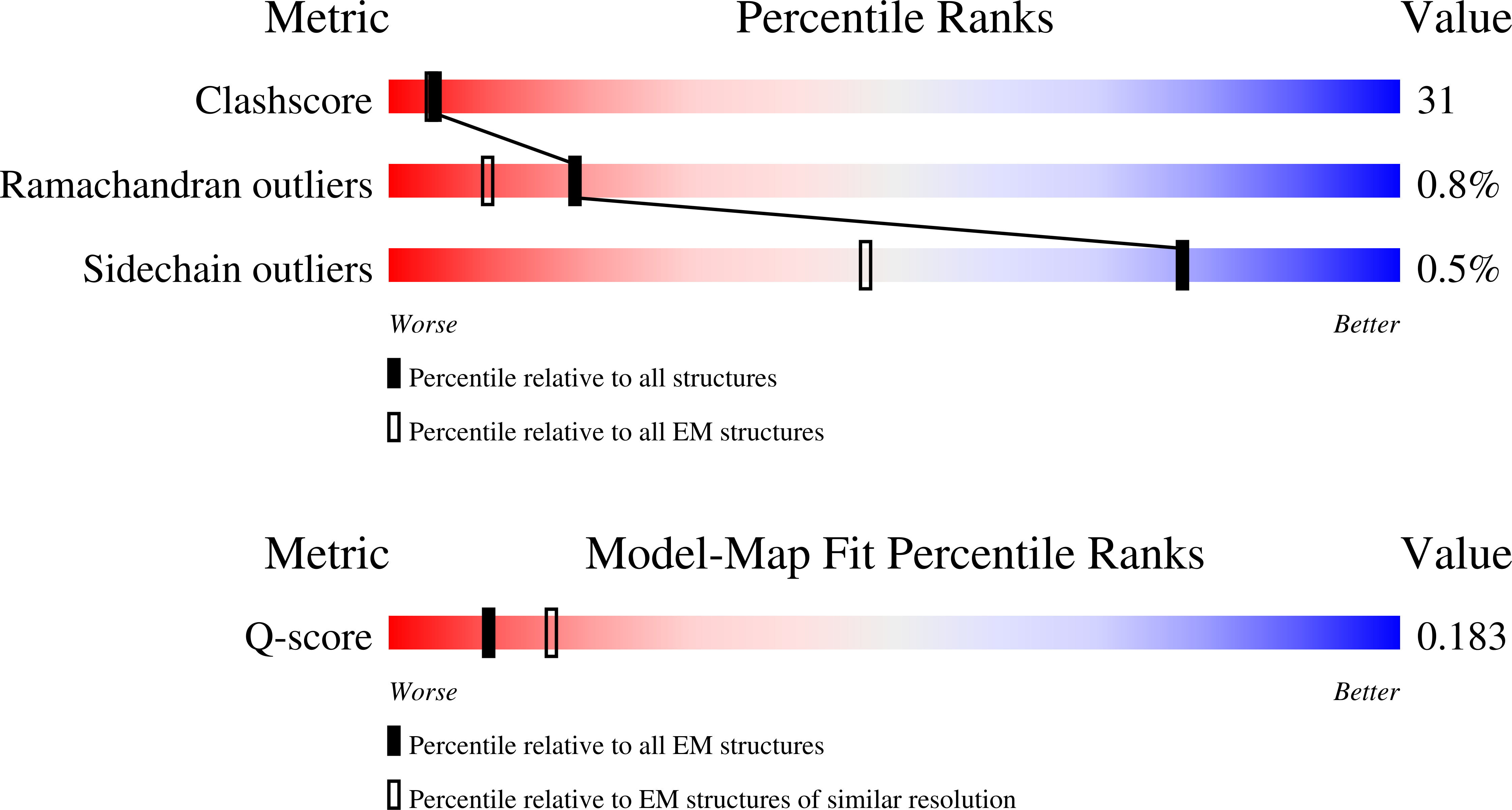
Macromolecular Entities
Structures with similar UniProt ID
Protein Blast
Polymer Type:polypeptide(L)
Molecule:RNA polymerase
Gene (Uniprot):1
Chain IDs:A
Chain Length:889
Number of Molecules:1
Biological Source:Escherichia phage T7
Polymer Type:polydeoxyribonucleotide
Molecule:DNA (44-MER)
Chain IDs:B
Chain Length:44
Number of Molecules:1
Biological Source:synthetic construct
Polymer Type:polydeoxyribonucleotide/polyribonucleotide hybrid
Molecule:DNA/RNA (5'-D(P*TP*AP*GP*TP*G
Chain IDs:C
Chain Length:35
Number of Molecules:1
Biological Source:synthetic construct
Ligand Molecules
Primary Citation
Mapping the Structure and Conformational Landscape of the 10-23 DNAzyme.
Acs Chem.Biol. ? ? ? (2026)
PMID: 42179229 DOI: 10.1021/acschembio.6c00184

Abstact

Deoxyribozymes (DNAzymes) are programmable DNA catalysts with therapeutic and diagnostic potential. The RNA-cleaving 10-23 DNAzyme was the first DNAzyme shown to function using common bioavailable metal ion cofactors, establishing the potential for DNA-based RNA knockdown in vivo. Despite extensive biochemical characterization, structural knowledge on the 10-23 DNAzyme is limited, hindering efforts to rationally improve its activity for physiological applications. To address this need, we developed a T7 RNA polymerase-based protein scaffold that enables cryo-EM visualization of the 10-23 DNAzyme. Using this approach, we obtained a 4.5 A reconstruction of the DNAzyme-substrate complex and used dimethyl sulfate (DMS) labeling to further examine DNAzyme dynamics. Our structural work supports a model in which the palindromic core folds into a pseudoknot stabilized by guanine stacking, creating a rigid element that organizes subsequent folding of the catalytic core and active site. DMS probing further indicates that magnesium binding collapses a flexible A9-A15 loop onto the pseudoknot, compacting the catalytic core. Together, these findings provide insight into 10-23 DNAzyme dynamics through a proposed metal-dependent hinged activation mechanism. The protein scaffolding approach may also serve as a broadly applicable framework for further structural investigations of DNAzymes.

Legend

Protein

Chemical

Disease

Primary Citation of related structures
Feedback Form
Name
Email
Institute
Feedback