

9YX1 image
Deposition Date 2025-10-26
Release Date 2025-11-26
Last Version Date 2026-04-01
Entry Detail
PDB ID:
9YX1
Keywords:
Title:
Structure of the long chain acyl-CoA carboxylase complex from Mycobacterium smegmatis
Biological Source:
Source Organism(s):
Method Details:
Experimental Method:
Resolution:
3.50 Å
Aggregation State:
PARTICLE
Reconstruction Method:
SINGLE PARTICLE
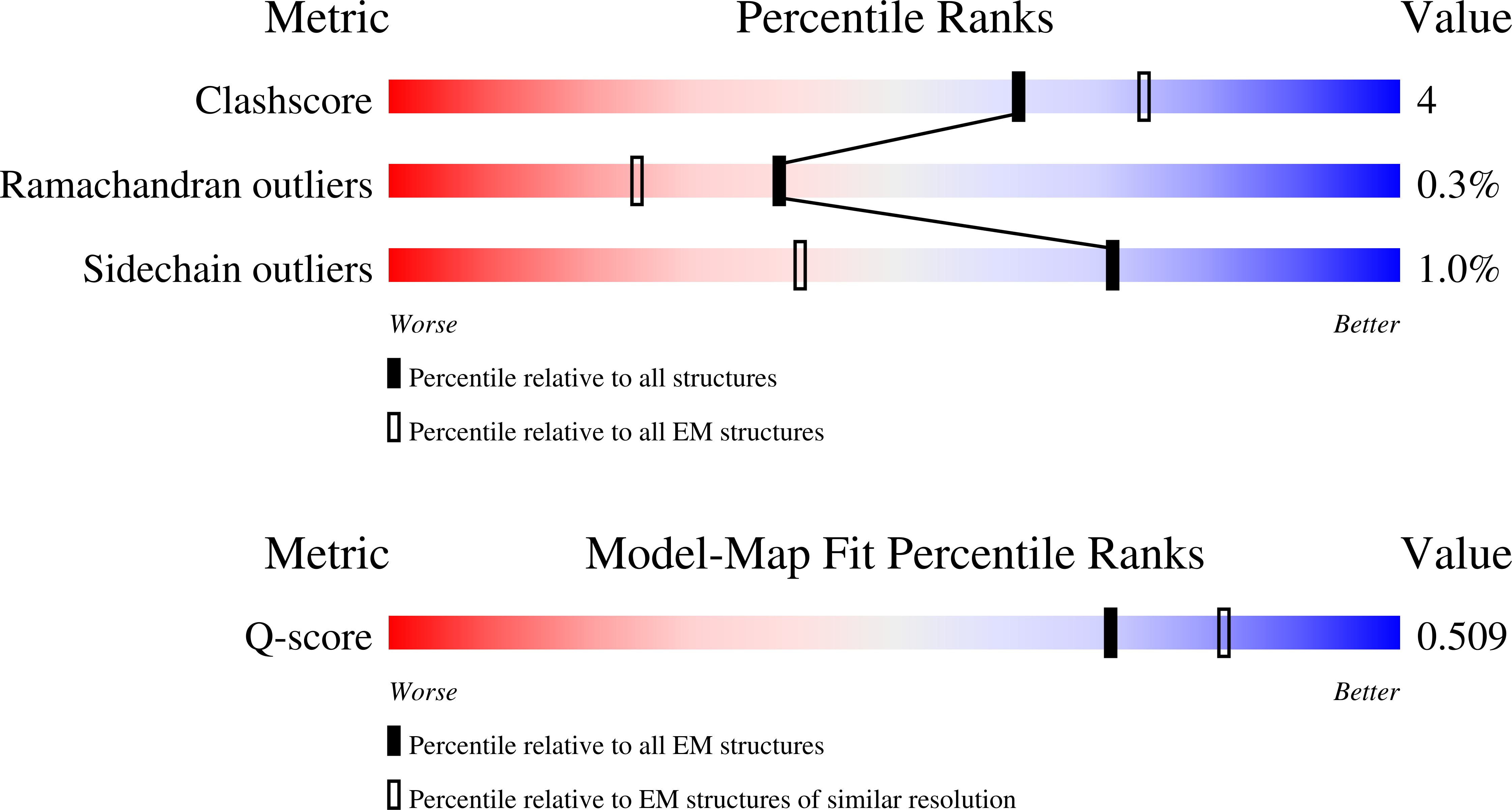
Macromolecular Entities
Structures with similar UniProt ID
Protein Blast
Polymer Type:polypeptide(L)
Molecule:Acetyl-/propionyl-coenzyme A
Gene (Uniprot):MSMEG_1812
Chain IDs:O (auth: E), T (auth: P)
Chain Length:94
Number of Molecules:2
Biological Source:Mycolicibacterium smegmatis MC2 155
Structures with similar UniProt ID
Protein Blast
Polymer Type:polypeptide(L)
Molecule:Propionyl-CoA carboxylase bet
Gene (Uniprot):MSMEG_6391
Chain IDs:A (auth: F), G (auth: O)
Chain Length:517
Number of Molecules:2
Biological Source:Mycolicibacterium smegmatis MC2 155
Structures with similar UniProt ID
Protein Blast
Polymer Type:polypeptide(L)
Molecule:Propionyl-CoA carboxylase bet
Gene (Uniprot):MSMEG_1813
Chain IDs:B (auth: G), C (auth: H), E (auth: M), F (auth: N)
Chain Length:542
Number of Molecules:4
Biological Source:Mycolicibacterium smegmatis MC2 155
Structures with similar UniProt ID
Protein Blast
Polymer Type:polypeptide(L)
Molecule:Biotin-dependent acyl-coenzym
Gene (Uniprot):MSMEG_1807
Chain IDs:D (auth: K), H (auth: I), I (auth: J), J (auth: L), K (auth: A), L (auth: D), M (auth: B), N (auth: C), P (auth: Q), Q (auth: S), R, S (auth: T)
Chain Length:598
Number of Molecules:12
Biological Source:Mycolicibacterium smegmatis MC2 155
Primary Citation
Structural basis for substrate specificity and MSMEG_0435-0436 binding by the mycobacterial long-chain acyl-CoA carboxylase complex.
Proc. Natl. Acad. Sci. U.S.A. 123 e2530575123 e2530575123 (2026)
PMID: 41843674 DOI: 10.1073/pnas.2530575123

Abstact

The presence of mycolic acid is a defining feature of the mycobacterial cell wall, which provides a highly impermeable barrier to many antibiotics. Biosynthesis of this fatty acid, as well as tuberculostearic acid, requires precursor molecules produced by the essential long-chain acyl-coenzyme A (CoA) carboxylase (LCC) complex. The LCC complex catalyzes carboxylation of the alpha-carbon of long-chain acyl-CoA, but also short-chain acetyl-CoA and propionyl-CoA. The complex includes the subunits AccA3, which contains a biotin carboxylase (BC) domain and a biotin carboxyl carrier protein (BCCP) domain, the long-chain acyl-CoA carboxyltransferase AccD4, the short-chain acyl-CoA carboxyltransferase AccD5, and the incompletely characterized protein AccE. We used electron cryomicroscopy (cryo-EM) to determine structures of the LCC complex from Mycobacterium smegmatis. In the structures, two AccE subunits tether eight AccA3 subunits to an AccD4(2)AccD5(4) heterohexamer core. Cryo-EM of the enzyme during catalysis reveals how AccD4 and AccD5 achieve substrate specificity, with AccD5 binding tightly to CoA and AccD4 binding long acyl chains. The BCCP domains of AccA3 undergo long-distance translocation to transfer a carboxyl group from the BC domain of AccA3 to the acyl-CoA substrate bound in AccD5. Further, we find that two copies of a protein complex formed from MSMEG_0435 and MSMEG_0436 can bind the LCC complex, sequestering the biotin moiety of BCCP domains near AccD5 and decreasing propionyl-CoA carboxylase activity. Rv0263c, the Mycobacterium tuberculosis ortholog of MSMEG_0435, has a role in bacterial survival during transmission, suggesting that these proteins may regulate production of branched fatty acid precursors for the mycobacterial cell wall.

Legend

Protein

Chemical

Disease

Primary Citation of related structures
Feedback Form
Name
Email
Institute
Feedback