

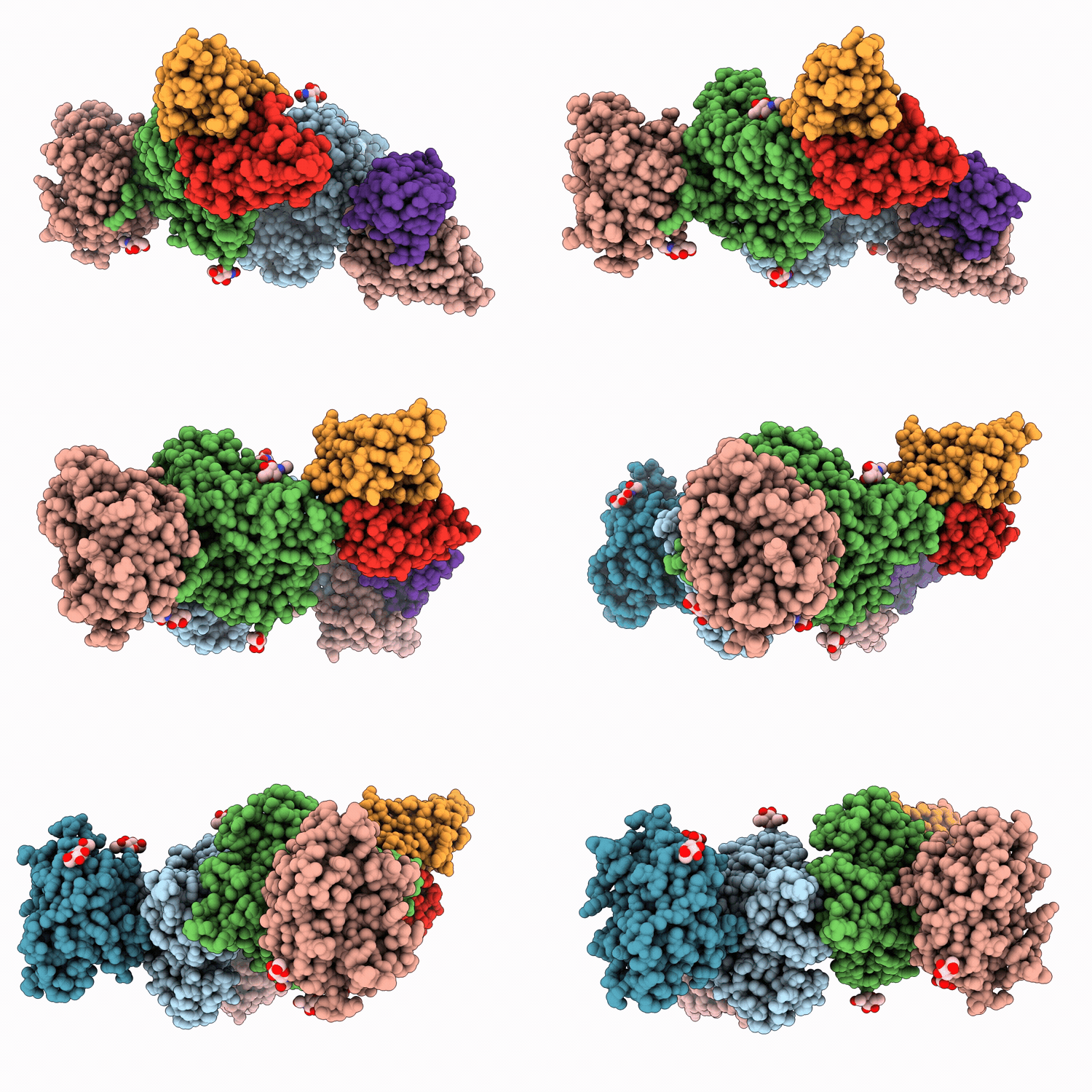
9YRQ image
Deposition Date 2025-10-17
Release Date 2026-06-24
Last Version Date 2026-06-24
Entry Detail
PDB ID:
9YRQ
Keywords:
Title:
Factor XIa in complex with Fab fragment of REGN9933-A2
Biological Source:
Source Organism(s):
Homo sapiens (Taxon ID: 9606)
Expression System(s):
Method Details:
Experimental Method:
Resolution:
3.20 Å
Aggregation State:
PARTICLE
Reconstruction Method:
SINGLE PARTICLE
Macromolecular Entities
Structures with similar UniProt ID
Protein Blast
Polymer Type:polypeptide(L)
Molecule:Coagulation factor XI
Gene (Uniprot):F11
Chain IDs:A, D (auth: C), G (auth: B), H (auth: D)
Chain Length:625
Number of Molecules:4
Biological Source:Homo sapiens
Protein Blast
Polymer Type:polypeptide(L)
Molecule:REGN9933 Fab Heavy Chain
Chain IDs:B (auth: H), E (auth: F)
Chain Length:239
Number of Molecules:2
Biological Source:Homo sapiens
Protein Blast
Polymer Type:polypeptide(L)
Molecule:REGN9933 Light Chain
Chain IDs:C (auth: L), F (auth: E)
Chain Length:215
Number of Molecules:2
Biological Source:Homo sapiens
Ligand Molecules
Primary Citation
Anticoagulation with mechanistically distinct FXI/FXIa antibodies amrecibart (REGN9933A2) and cenvacibart (REGN7508Cat).
Blood ? ? ? (2026)
PMID: 42275249 DOI: 10.1182/blood.2025032276

Abstact

Thrombosis is a major contributor to global morbidity and mortality. Current standards of care target the extrinsic and/or common pathways of coagulation, effectively inhibiting thrombosis but also increasing bleeding risk, highlighting the unmet need for additional treatment options. Genetic deficiency in factor XI (FXI), a component of the intrinsic pathway, reduces thrombosis risk without spontaneous bleeding. We generated 2 FXI monoclonal antibodies (mAbs) with distinct profiles to provide new approaches to anticoagulation. Cenvacibart (REGN7508Cat) targets the catalytic domain to completely block FXI activity (induced by FXIIa or FXIa in the intrinsic pathway or thrombin in an intrinsic/common pathway amplification loop), thereby maximizing anticoagulation; amrecibart (REGN9933A2) targets the apple 2 domain of FXI/FXIa to specifically prevent FXI activity induced by FXIIa-delivering perhaps less anticoagulation but with potentially lower bleeding risk. We evaluated the anticoagulant effects of both mAbs in vitro in human/non-human primate plasma, in vivo in non-human primates, and healthy volunteers. Both mAbs inhibited intrinsic pathway-triggered coagulation, assessed by activated partial thromboplastin time (aPTT); cenvacibart exhibited a greater increase in aPTT versus amrecibart or other FXI-targeted inhibitors. Neither amrecibart nor cenvacibart affected the extrinsic pathway, assessed by prothrombin time (PT). In non-human primates, both mAbs prevented thrombosis without increasing bleeding. In first-in-human studies, both mAbs were generally well tolerated and dose-dependently inhibited intrinsic pathway-triggered coagulation, with durable aPTT prolongation without affecting PT. Amrecibart and cenvacibart may offer tailored therapies for patients with different bleeding risk profiles. The trials are registered at www.clinicaltrials.gov as #NCT05102136 and #NCT05603195.

Legend

Protein

Chemical

Disease

Primary Citation of related structures
Feedback Form
Name
Email
Institute
Feedback