

9YKV image
Deposition Date 2025-10-07
Release Date 2026-08-12
Last Version Date 2026-08-12
Entry Detail
PDB ID:
9YKV
Title:
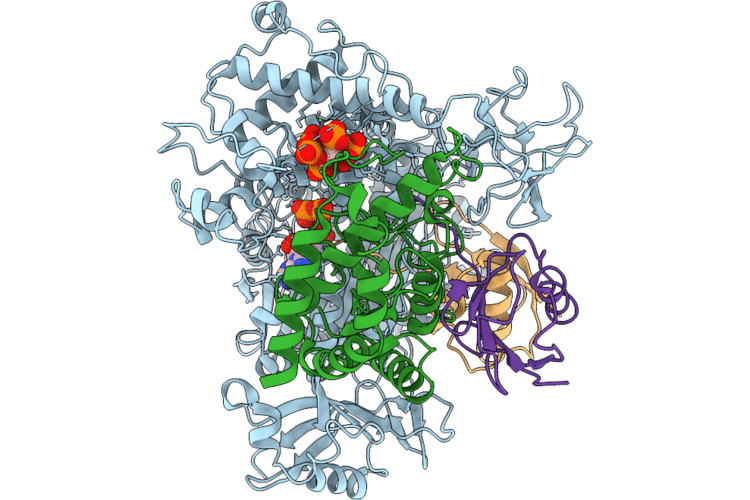
Cryo-EM structure of double-loaded human UBA6-UBE2Z-FAT10(t)/FAT10(a) thioester mimetic complex.
Biological Source:
Source Organism(s):
Homo sapiens (Taxon ID: 9606)
Expression System(s):
Method Details:
Experimental Method:
Resolution:
2.73 Å
Aggregation State:
PARTICLE
Reconstruction Method:
SINGLE PARTICLE
Macromolecular Entities
Polymer Type:polypeptide(L)
Molecule:Ubiquitin-like modifier-activ
Gene (Uniprot):UBA6
Chain IDs:A
Chain Length:0
Number of Molecules:1
Biological Source:Homo sapiens
Polymer Type:polypeptide(L)
Molecule:Ubiquitin-conjugating enzyme
Gene (Uniprot):UBE2Z
Mutagens:C100S, K130R, K166R, Y182K, K186R, C261S, C263S
Chain IDs:B
Chain Length:0
Number of Molecules:1
Biological Source:Homo sapiens
Polymer Type:polypeptide(L)
Molecule:Ubiquitin D
Mutagens:C7T, C9T,C134L,C160S,C162S
Chain IDs:C, D
Chain Length:0
Number of Molecules:2
Biological Source:Homo sapiens
Primary Citation
Cryo-EM structures of UBA6 reveal mechanisms of E1-E2 specificity and dual FAT10/ubiquitin thioester transfer.
Nat Commun 17 ? ? (2026)
PMID: 41764162 DOI: 10.1038/s41467-026-69882-3

Abstact

UBA1 and UBA6 define parallel ubiquitin (Ub) activation systems that perform non-overlapping roles in Ub and ubiquitin-like protein (Ubl) signaling. Whereas UBA1 supports the canonical Ub pathway, UBA6 also activates the Ubl FAT10, linking Ub signaling to immune-regulated proteostasis. In addition to selective Ub/Ubl activation, UBA1 and UBA6 engage distinct sets of E2s, yet how these enzymes achieve selective E2 engagement has remained unclear. Using chemical trapping and high-resolution cryo-EM, we determine four structures of UBA6-E2 complexes representing the thioester-transfer step with either FAT10 or Ub, revealing how this E1 distinguishes its cognate partners. UBA6 achieves E2 specificity through coordinated contributions of the UFD and SCCH domains, a dual-domain mechanism that contrasts with the UFD-dominated selectivity of UBA1. The structures further show that an existing inositol hexakisphosphate (InsP(6))-binding site, unique to UBA6, stabilizes an expanded SCCH cleft that pre-organizes the enzyme for selective engagement of UBA6-specific E2s. These findings define principles for E1-E2 recognition and identify InsP(6) as a cofactor shaping specificity within the Ub-like conjugation network.

Legend

Protein

Chemical

Disease

Primary Citation of related structures
Feedback Form
Name
Email
Institute
Feedback