

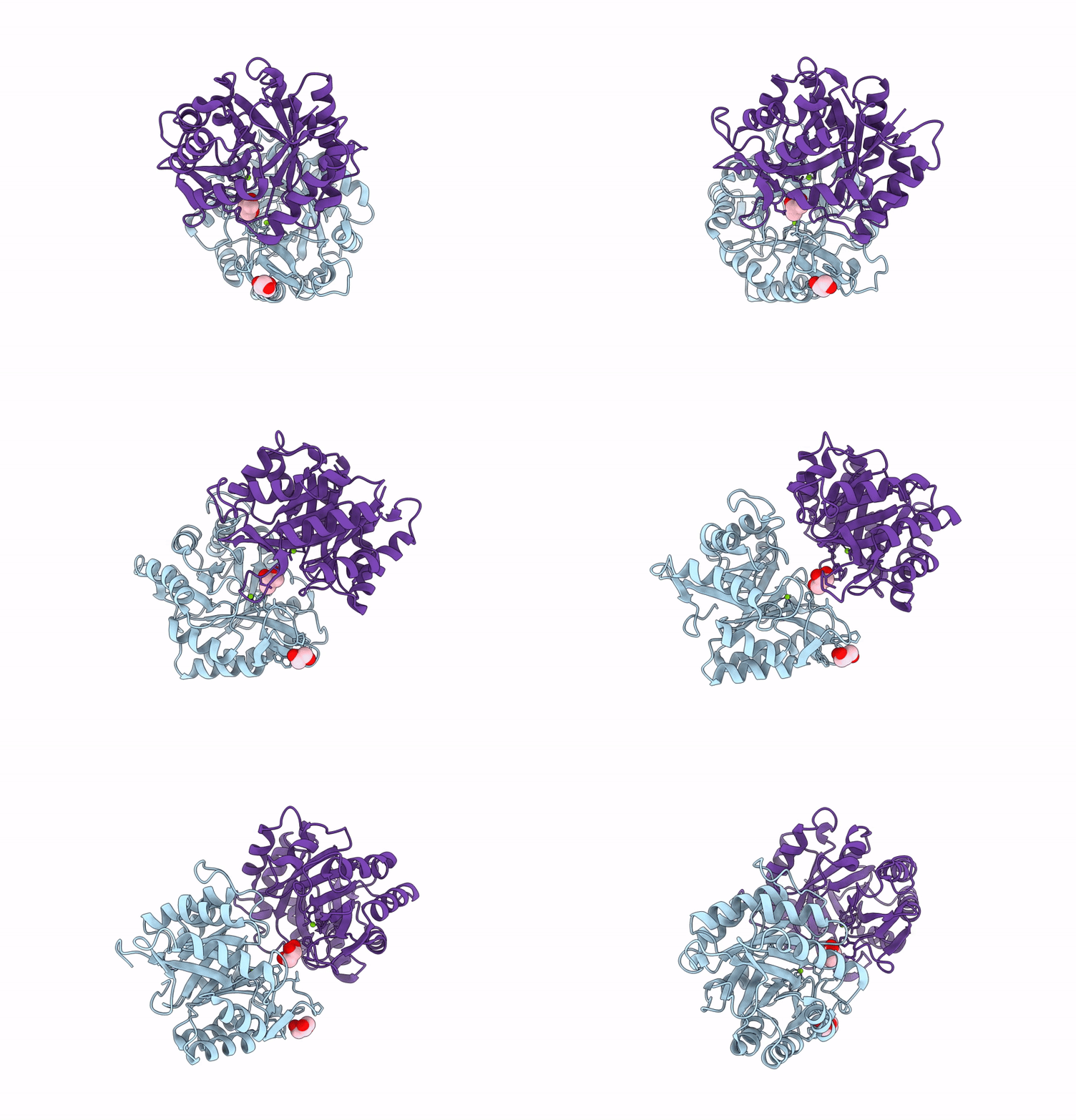
9YD8 image
Deposition Date 2025-09-22
Release Date 2025-10-15
Last Version Date 2026-06-17
Entry Detail
PDB ID:
9YD8
Keywords:
Title:
Crystal structure of Phospholipase D (PLD) from Arcanobacterium haemolyticum
Biological Source:
Source Organism(s):
Expression System(s):
Method Details:
Experimental Method:
Resolution:
2.45 Å
R-Value Free:
0.29
R-Value Work:
0.22
R-Value Observed:
0.23
Space Group:
P 21 21 2

Macromolecular Entities
Structures with similar UniProt ID
Protein Blast
Polymer Type:polypeptide(L)
Molecule:Phospholipase D
Gene (Uniprot):pld
Chain IDs:A, B
Chain Length:296
Number of Molecules:2
Biological Source:Arcanobacterium haemolyticum
Primary Citation
Crystal Structure of PLD From Arcanobacterium haemolyticum Identifies a Novel Class IIa-alpha Variant With Unusual Thermostability.
J.Mol.Biol. 438 169880 169880 (2026)
PMID: 42203030 DOI: 10.1016/j.jmb.2026.169880

Abstact

Arcanobacterium haemolyticum, an emerging human pathogen, expresses phospholipase D (PLD(AH)), a multifunctional virulence factor capable of cleaving sphingomyelin and lysophospholipids from plasma membranes, in addition to promoting host cell adhesion and necrosis. Here, we report the first crystal structure of PLD(AH), determined at 2.45 A resolution, which reveals a canonical (alpha/beta)(8) TIM-barrel fold typical of glycerophosphodiester phosphodiesterase (GDPD)-like PLD enzymes, but with distinct structural features. PLD(AH) contains two disulfide bonds arranged in a unique pattern not observed in homologous brown spider PLDs, defining a new structural variant within the GDPD-like PLD family, designated class IIa-alpha. Comparative structural analysis with PLD from Loxosceles intermedia (PLD(LI)) revealed differences in loop architecture and local amino acid composition in the vicinity of the active site, including point substitutions that modulate cavity volume and flexibility. Despite exhibiting a melting temperature (Tm) between 45 and 51 degrees C, PLD(AH) retained residual enzymatic activity up to 95 degrees C, indicating exceptional thermostability among GDPD-like PLDs. Molecular dynamics simulations showed that increasing temperature selectively enhanced the flexibility of specific loops (C and G) without perturbing the catalytic core, suggesting that localized structural adaptability contributes to thermal resilience. These findings establish PLD(AH) as a structurally distinct GDPD-like sphingomyelinase D enzyme and provide insights into the molecular features underlying its multifunctional activity and thermostability.

Legend

Protein

Chemical

Disease

Primary Citation of related structures
Feedback Form
Name
Email
Institute
Feedback