

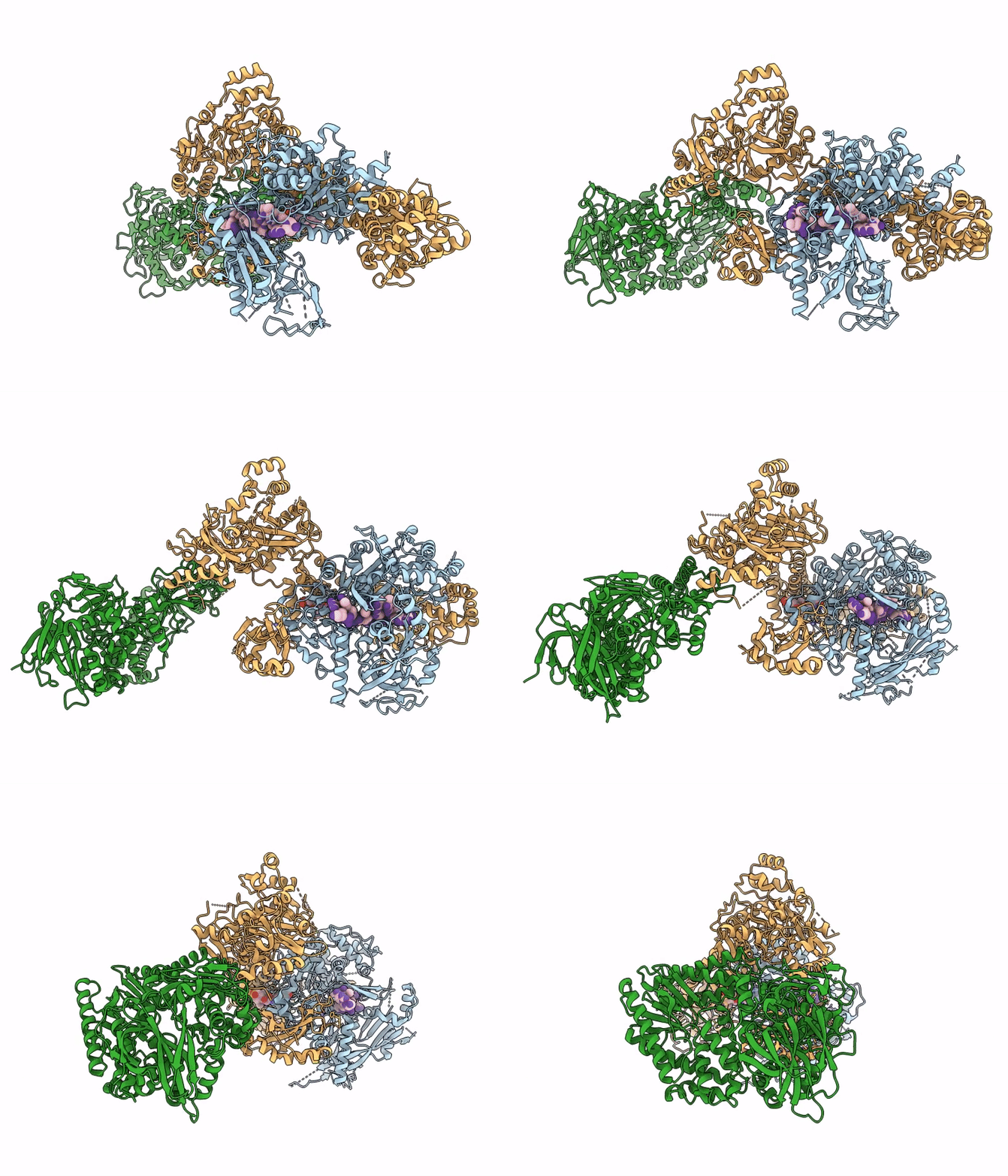
9YCV image
Deposition Date 2025-09-19
Release Date 2025-12-31
Last Version Date 2026-07-15
Entry Detail
PDB ID:
9YCV
Keywords:
Title:
HSV Helicase-primase complex bound to amenamevir
Biological Source:
Source Organism(s):
Expression System(s):
Method Details:
Experimental Method:
Resolution:
2.80 Å
Aggregation State:
PARTICLE
Reconstruction Method:
SINGLE PARTICLE
Macromolecular Entities
Polymer Type:polypeptide(L)
Molecule:UL5
Gene (Uniprot):UL5
Chain IDs:C (auth: A)
Chain Length:882
Number of Molecules:1
Biological Source:Human alphaherpesvirus 1 strain R-15
Polymer Type:polypeptide(L)
Molecule:UL8
Gene (Uniprot):UL8
Chain IDs:D (auth: B)
Chain Length:750
Number of Molecules:1
Biological Source:Human alphaherpesvirus 1 strain R-15
Polymer Type:polypeptide(L)
Molecule:UL52
Gene (Uniprot):UL52
Chain IDs:B (auth: C)
Chain Length:1058
Number of Molecules:1
Biological Source:Human alphaherpesvirus 1 strain R-15
Polymer Type:polydeoxyribonucleotide
Molecule:DNA (5'-D(*TP*TP*TP*TP*TP*T)-
Chain IDs:A (auth: D)
Chain Length:6
Number of Molecules:1
Biological Source:Human alphaherpesvirus 1 strain R-15
Primary Citation
Mechanisms of HSV-1 helicase-primase inhibition and replication fork complex assembly.
Cell 189 478 494.e18 (2026)
PMID: 41468884 DOI: 10.1016/j.cell.2025.11.041

Abstact

Herpesviruses are widespread double-stranded DNA viruses that establish lifelong latency and cause various diseases. Although DNA-polymerase-targeting antivirals are effective, increasing drug resistance underscores the need for alternatives. Helicase-primase inhibitors (HPIs) are promising antivirals, but their mechanisms of action are poorly defined. Furthermore, how the helicase-primase (H/P) complex and DNA polymerase coordinate genome replication is not well understood for herpesviruses. Here, we report cryo-electron microscopy (cryo-EM) structures of the herpes simplex virus 1 H/P complex bound to HPIs, showing that these lock the H/P complex in an inactive state. Single-molecule assays reveal that HPIs cause H/P complexes to pause in unwinding activity on DNA. The structure of an HPI-bound replication fork complex, comprising the H/P complex (UL5, UL52, and UL8) and the polymerase holoenzyme (UL30 and UL42), reveals a previously uncharacterized interface bridging these complexes. These findings provide a structural framework for understanding herpesvirus replisome assembly and advancing inhibitor development.

Legend

Protein

Chemical

Disease

Primary Citation of related structures
Feedback Form
Name
Email
Institute
Feedback