

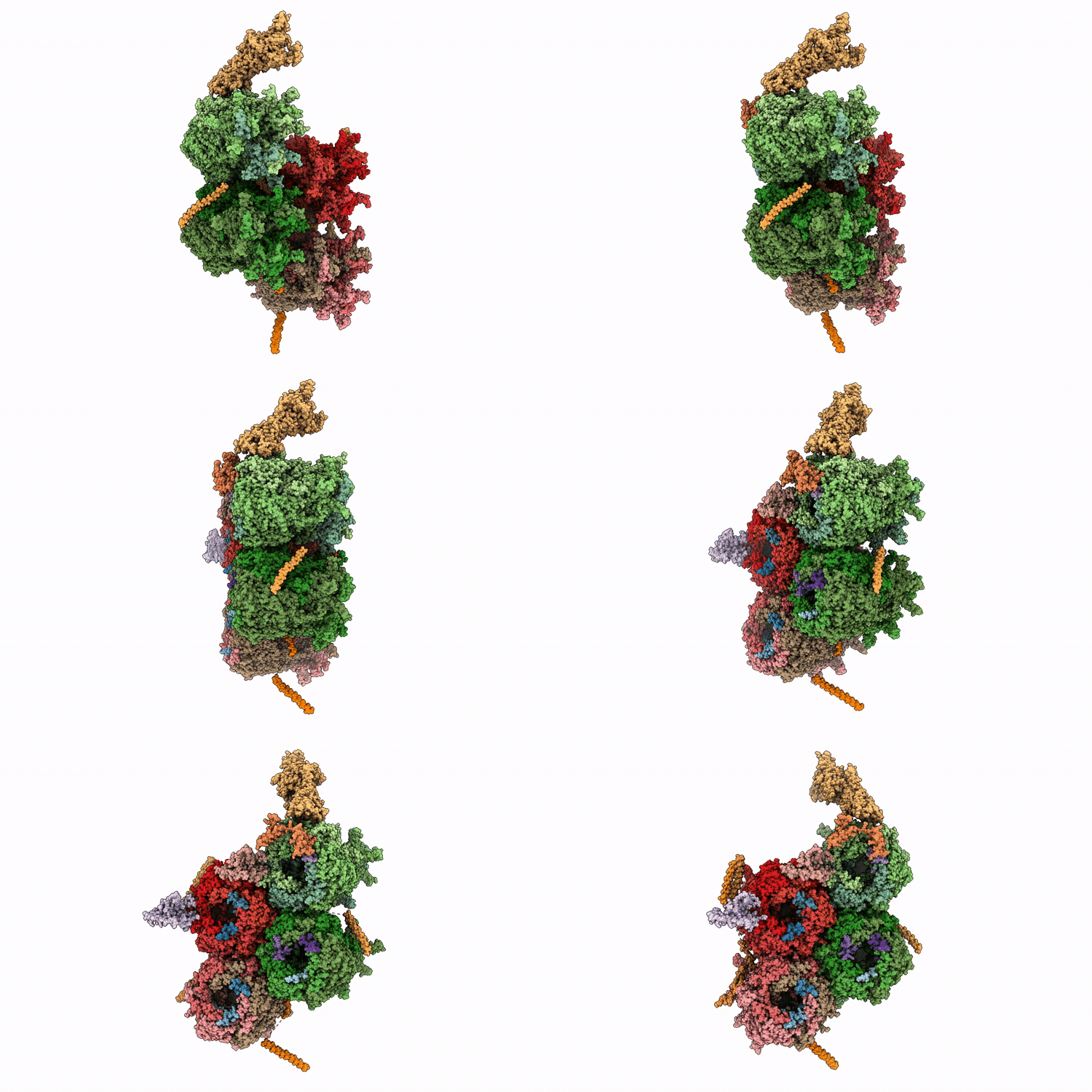
9YCJ image
Deposition Date 2025-09-18
Release Date 2026-07-01
Last Version Date 2026-07-01
Entry Detail
PDB ID:
9YCJ
Title:
Structure of the Adenovirus-7 VLP, Class 2
Biological Source:
Source Organism(s):
Expression System(s):
Method Details:
Experimental Method:
Resolution:
3.70 Å
Aggregation State:
PARTICLE
Reconstruction Method:
SINGLE PARTICLE
Macromolecular Entities
Structures with similar UniProt ID
Protein Blast
Polymer Type:polypeptide(L)
Molecule:Pre-protein VI
Gene (Uniprot):L3
Chain IDs:A (auth: 0), B (auth: 1), C (auth: 2), D (auth: 3), E (auth: 4), Z (auth: W), AA (auth: Y), BA (auth: Z)
Chain Length:250
Number of Molecules:8
Biological Source:Human adenovirus 7
Structures with similar UniProt ID
Protein Blast
Polymer Type:polypeptide(L)
Molecule:Hexon protein
Gene (Uniprot):L3
Chain IDs:F (auth: A), G (auth: B), H (auth: C), I (auth: D), J (auth: E), K (auth: F), L (auth: G), M (auth: H), N (auth: I), O (auth: J), P (auth: K), Q (auth: L)
Chain Length:937
Number of Molecules:12
Biological Source:Human adenovirus 7
Structures with similar UniProt ID
Protein Blast
Polymer Type:polypeptide(L)
Molecule:Pre-hexon-linking protein III
Gene (Uniprot):L1
Chain IDs:R (auth: M)
Chain Length:588
Number of Molecules:1
Biological Source:Human adenovirus 7
Structures with similar UniProt ID
Protein Blast
Polymer Type:polypeptide(L)
Molecule:Penton protein
Gene (Uniprot):L2
Chain IDs:S (auth: N)
Chain Length:544
Number of Molecules:1
Biological Source:Human adenovirus 7
Structures with similar UniProt ID
Protein Blast
Polymer Type:polypeptide(L)
Molecule:Hexon-interlacing protein IX
Gene (Uniprot):IX
Chain IDs:T (auth: P), U (auth: Q), V (auth: R), W (auth: S)
Chain Length:138
Number of Molecules:4
Biological Source:Human adenovirus 7
Structures with similar UniProt ID
Protein Blast
Polymer Type:polypeptide(L)
Molecule:Pre-hexon-linking protein VII
Gene (Uniprot):L4
Chain IDs:X (auth: U), Y (auth: V)
Chain Length:227
Number of Molecules:2
Biological Source:Human adenovirus 7
Ligand Molecules
Primary Citation
Structure of Human adenovirus 7 virus-like particles, a platform for developing nanotherapeutics and studying capsid assembly.
Proc.Natl.Acad.Sci.USA 123 e2526969123 e2526969123 (2026)
PMID: 42301791 DOI: 10.1073/pnas.2526969123

Abstact

Adenoviridae family members routinely infect humans, exhibit significant genetic diversity, and are associated with a variety of illnesses. Types 4 and 7 frequently circulate in the United States and are major causes of respiratory disease. Infections can result in hospitalization and, in severe cases, death. Although a live wild-type-virus vaccine targeting these two types exists, its use is restricted to military personnel due to concerns about viral-shedding and potential for genetic recombination. To overcome these limitations, we recently developed a virus-like particle (VLP) platform as an alternative vaccination strategy. These VLPs are stable, lack genomic material, and elicit a potent humoral immune response in mice, effectively neutralizing adenoviral infection. Here, we describe the cryo-EM structure of adenovirus 7 (AdV-7) VLPs. Structural insights are essential to ensure that neutralizing antigens displayed on the VLPs accurately mimic those of the virion, guide the design of particles with improved stability and efficacy, and enable engineering of VLPs with antigenic properties targeting multiple adenovirus types. The structure shows that hexon, penton, pIIIa, pVI, pVIII, and IX assemble comparable to AdV-5, hexon and penton neutralizing epitopes are appropriately displayed for antibody recognition, penton insertion into the hexon shell promotes cement protein pIIIa to increase its interaction with the peripentonal hexons, and presence of the core-genome is associated with increased interaction between cement protein pVIII and hexon. Finally, limited proteolysis and mass spectrometry demonstrate that VLP incorporated hexons digest more readily than virion incorporated hexons, indicating the greater dynamic nature of the VLP.

Legend

Protein

Chemical

Disease

Primary Citation of related structures
Feedback Form
Name
Email
Institute
Feedback