

9YAK image
Deposition Date 2025-09-16
Release Date 2026-07-01
Last Version Date 2026-07-01
Entry Detail
PDB ID:
9YAK
Title:
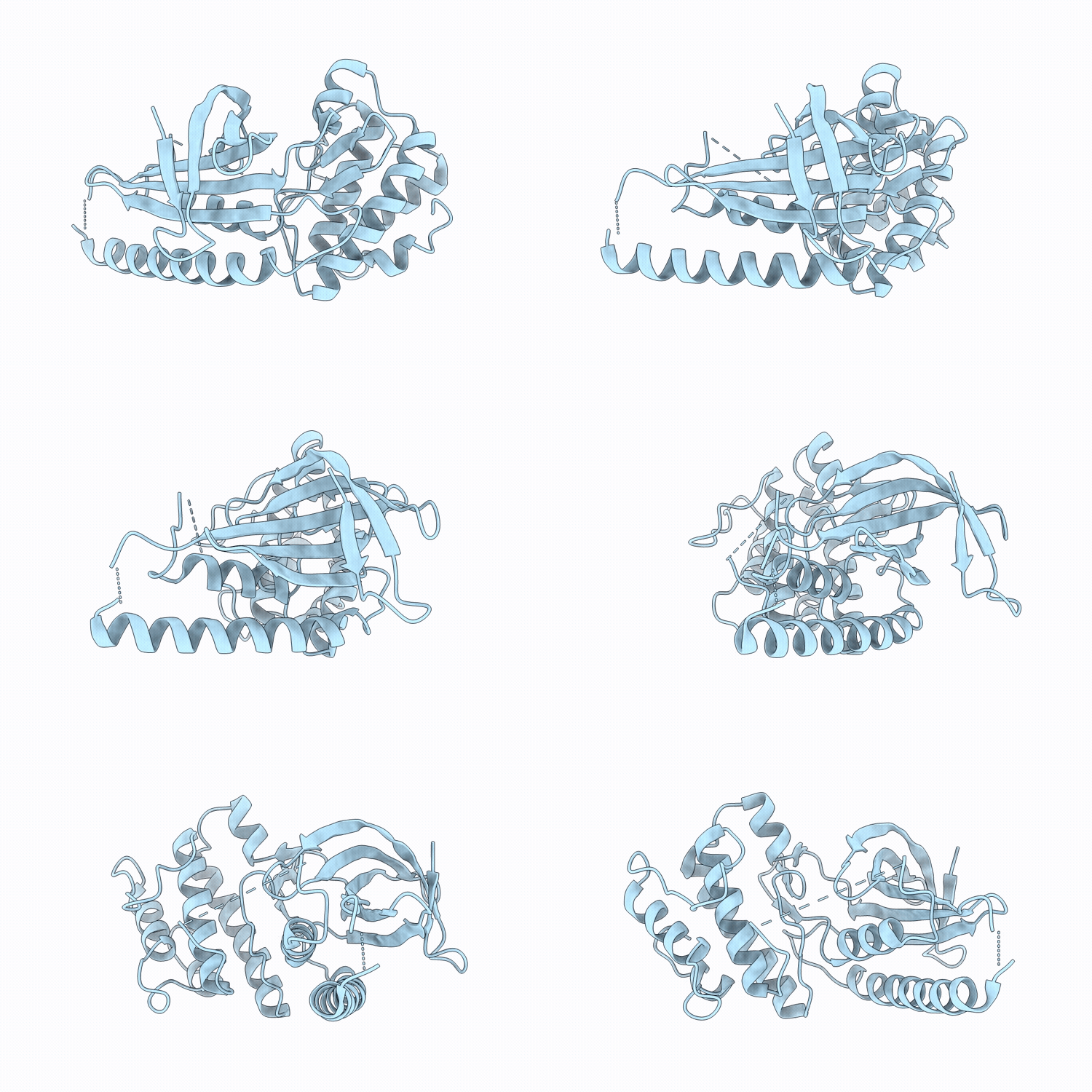
Structure of the GCN2 pseudokinase domain
Biological Source:
Source Organism(s):
Homo sapiens (Taxon ID: 9606)
Expression System(s):
Method Details:
Experimental Method:
Resolution:
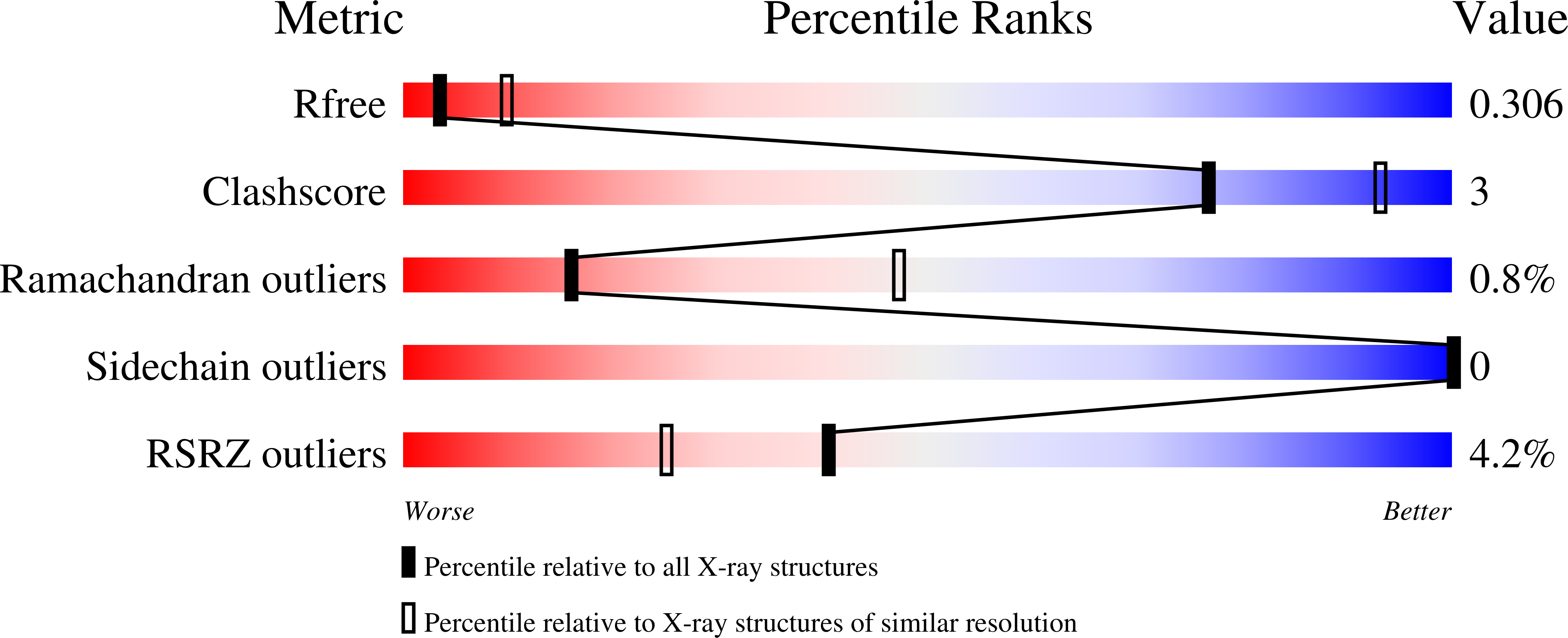
2.98 Å
R-Value Free:
0.30
R-Value Work:
0.26
R-Value Observed:
0.26
Space Group:
P 4 2 2
Macromolecular Entities
Polymer Type:polypeptide(L)
Molecule:eIF-2-alpha kinase GCN2
Gene (Uniprot):EIF2AK4
Chain IDs:A
Chain Length:275
Number of Molecules:1
Biological Source:Homo sapiens
Ligand Molecules
Primary Citation
Structural basis for pseudokinase-mediated regulation of GCN2 in the integrated stress response.
Proc.Natl.Acad.Sci.USA 123 e2526598123 e2526598123 (2026)
PMID: 41615758 DOI: 10.1073/pnas.2526598123

Abstact

The general control nonderepressible 2 (GCN2) is a conserved stress-responsive protein that plays a critical role in restoring cellular homeostasis in the integrated stress response (ISR). In response to amino acid starvation or ribosome stalling and collisions, GCN2 phosphorylates the translation initiation factor eIF2alpha, conferring translational control to alleviate stress. GCN2 is a multidomain protein, containing a tandem kinase domain (KD) and a catalytically inactive pseudokinase domain (psiKD). Stress-induced activation of the kinase domain requires allosteric regulation and dimerization mediated by its regulatory domains. While the pseudokinase domain is essential for GCN2 function in yeast, its mechanistic role remains unclear and underexplored in other organisms. Here, we present the first crystal structure of the human GCN2 psiKD, revealing its distinct structural features. The structure visualizes an insertion N-terminal to helix alphaC unique to the GCN2 psiKD that interacts with the pseudoactivation loop, stabilizing an inactive conformation. Further structural analysis shows that the psiKD forms a dimer in the crystal lattice via a network of hydrophobic and electrostatic interactions spanning both the N- and C-lobes. Mutations that disrupt the dimer interface reduced downstream ATF4 expression that is important for stress adaptation, underscoring the functional significance of the GCN2 psiKD dimer in regulating GCN2 activity. Complementary AI-guided structure predictions indicate that the dimeric GCN2 psiKD architecture is conserved across evolution. These results support the role of psiKD dimerization as a regulatory feature in GCN2-mediated ISR signaling.

Legend

Protein

Chemical

Disease

Primary Citation of related structures
Feedback Form
Name
Email
Institute
Feedback