

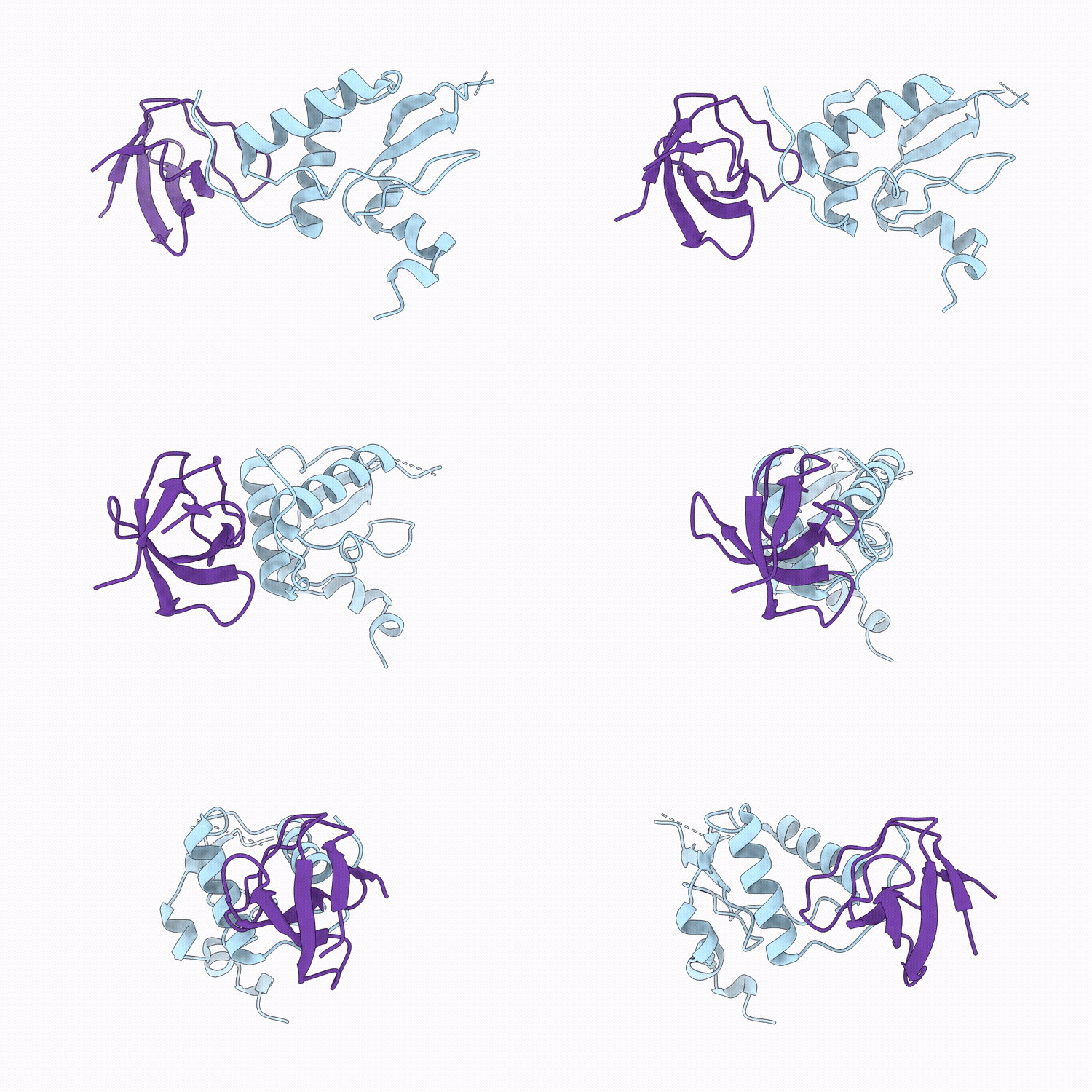
9Y58 image
Deposition Date 2025-09-04
Release Date 2026-07-15
Last Version Date 2026-10-21
Entry Detail
PDB ID:
9Y58
Keywords:
Title:
Nef SF2 dimerization mutant bound to Hck SH3
Biological Source:
Source Organism(s):
HIV-1 M:B_ARV2/SF2 (Taxon ID: 11685)
Homo sapiens (Taxon ID: 9606)
Method Details:
Experimental Method:
Resolution:
2.25 Å
R-Value Free:
0.27
R-Value Work:
0.23
R-Value Observed:
0.23
Space Group:
P 41 21 2
Macromolecular Entities
Polymer Type:polypeptide(L)
Molecule:C-terminal core protein
Gene (Uniprot):nef
Mutagens:L116A
Chain IDs:A
Chain Length:149
Number of Molecules:1
Biological Source:HIV-1 M:B_ARV2/SF2
Polymer Type:polypeptide(L)
Molecule:Tyrosine-protein kinase HCK
Gene (Uniprot):HCK
Chain IDs:B
Chain Length:73
Number of Molecules:1
Biological Source:Homo sapiens
Primary Citation
HIV-1 Nef Homodimerization as a Structural Mechanism for Kinase Activation and Small Molecule Inhibitor Action.
Biorxiv ? ? ? (2026)
PMID: 42845509 DOI: 10.64898/2026.08.10.744017

Abstact

The HIV-1 accessory protein Nef plays a central role in viral pathogenesis by enhancing viral replication, modulating cellular signaling, and evading immune recognition, making it a compelling target for therapeutic intervention. Nef lacks enzymatic activity and instead functions through diverse interactions with host cell proteins including the Src-family tyrosine kinase, Hck. Kinase activation may requires Nef homodimerization, as mutations disrupting the Nef dimer interface impair kinase activation as well as many other Nef functions. In the present study, we investigated the structural consequences of dimer interface mutations and their impact on Nef interactions with Hck regulatory domains. Using size-exclusion chromatography, multi-angle light scattering and crystallography, we found that mutations at dimer interface residues Leu112 and Phe121 abolish recombinant Nef protein dimerization while preserving the overall Nef fold, resulting in monomeric 1:1 complexes with Hck SH3 or SH3-SH2 domain proteins. These findings demonstrate that the broad phenotypic effects of interface mutations arise from loss of Nef dimerization rather than global misfolding or perturbation of SH3 binding. We also investigated the effects of small molecule Nef inhibitors on homodimer formation. These compounds, like the dimerization-defective mutations, suppress kinase activation, viral replication and restore immune recognition of HIV-infected cells. Using a SplitFAST fluorescence complementation assay, we provide direct evidence that these inhibitors disrupt Nef homodimer formation in solution. Co-crystallization of a wild-type Nef:SH3 complex with an inhibitor also prevented homodimer formation. Computational docking identified a shared pocket for six active Nef inhibitors formed by the Nef dimer interface but lost in the monomer. Together, our findings support homodimerization as a structural feature essential for many Nef functions and validate disruption of this interface as a promising therapeutic strategy against HIV-1.

Legend

Protein

Chemical

Disease

Primary Citation of related structures
Feedback Form
Name
Email
Institute
Feedback