

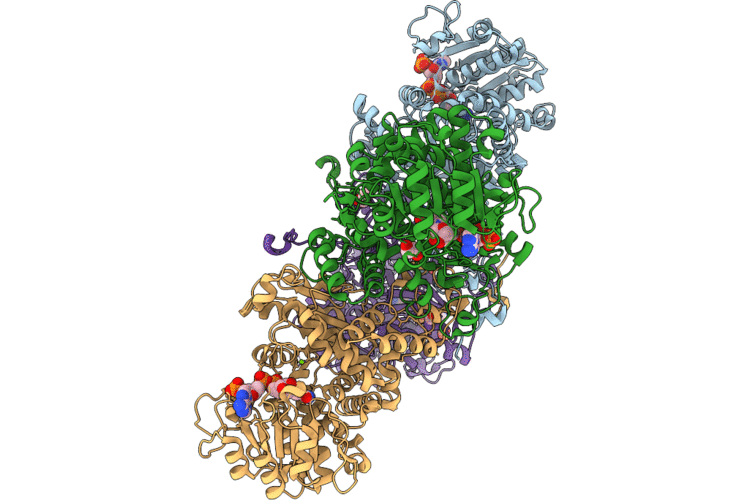
9Y3A image
Deposition Date 2025-09-02
Release Date 2026-08-26
Last Version Date 2026-08-26
Entry Detail
PDB ID:
9Y3A
Keywords:
Title:
Human malic enzyme 1 complex with NADP+ at 1.9 Angstrom.
Biological Source:
Source Organism(s):
Homo sapiens (Taxon ID: 9606)
Expression System(s):
Method Details:
Experimental Method:
Resolution:
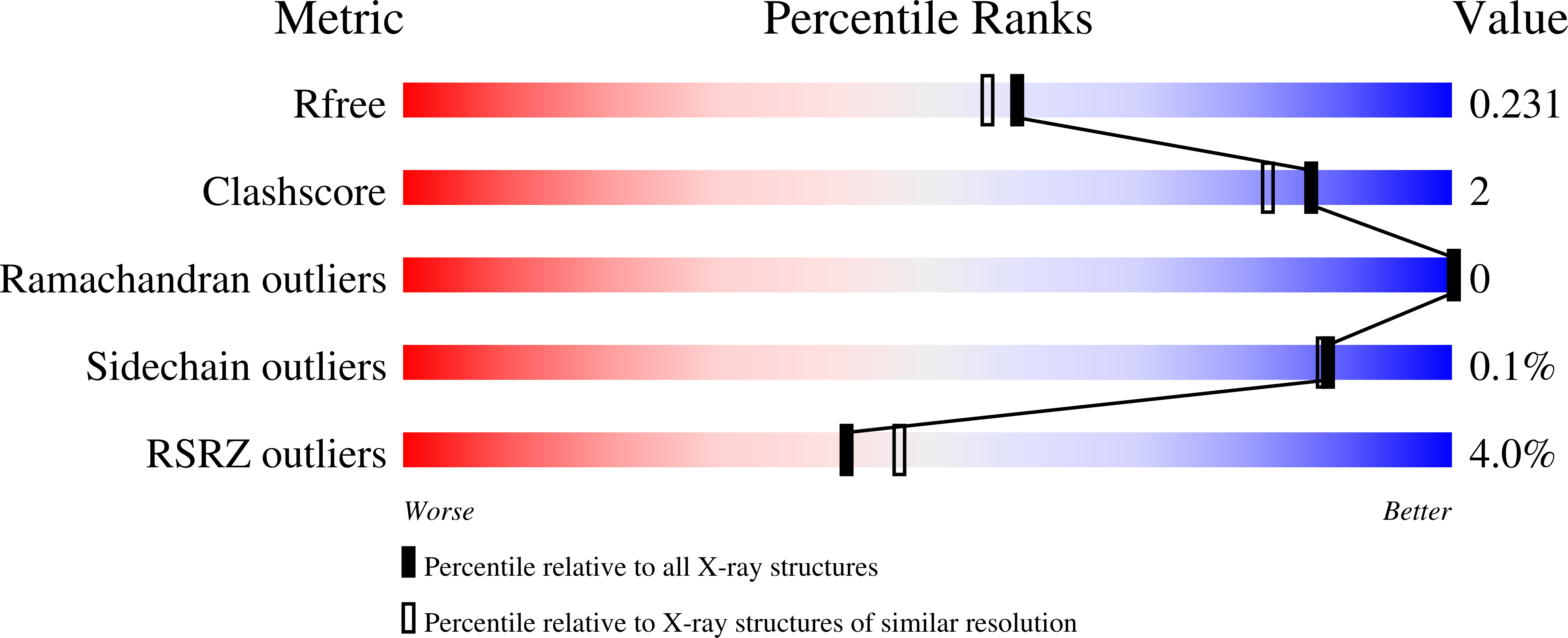
1.91 Å
R-Value Free:
0.22
R-Value Work:
0.19
Space Group:
P 1 21 1
Macromolecular Entities
Polymer Type:polypeptide(L)
Molecule:NADP-dependent malic enzyme
Gene (Uniprot):ME1
Chain IDs:A, B, C, D
Chain Length:580
Number of Molecules:4
Biological Source:Homo sapiens
Primary Citation
A cryptic allosteric pocket shapes isoform-selective inhibition of human malic enzymes.
Protein Sci. 35 e70757 e70757 (2026)
PMID: 42581399 DOI: 10.1002/pro.70757

Abstact

Malic enzymes (ME) regulate central carbon metabolism and cellular redox balance, and the mitochondrial isoform ME2 is frequently upregulated in aggressive cancers to support metabolic flexibility and stress resistance. Isoform-selective inhibition has remained out of reach because the catalytic machinery is essentially invariant across the three human enzymes (ME1-3), suggesting that selectivity must arise elsewhere than the active site. Here, we define matched kinetic and regulatory profiles for all three isoforms, highlighting key differences in substrate and cofactor dependence and metabolic regulation. Our x-ray crystal structures show that the active-site inhibitor 3',6'-dihydroxy-4,4''-dimethoxy-[1,1':4',1''-terphenyl]-2',5'-dione (NPD-389) occupies a conserved, metal-coordinating pose in all three isoforms, explaining its non-selective inhibition observed in enzyme assays. We further identify a cryptic pocket adjacent to the active site that is engaged by our probe molecule, flavianic acid (FLA), and accessible only in the mitochondrial enzymes ME2 and ME3. FLA binding locks an open, inactive enzyme conformation in place, with kinetic studies revealing isoform-specific allosteric responses and suggesting that this pocket may be a native regulatory site sensitive to the mitochondrial metabolic state. Our cellular viability assays suggest that molecules exploiting this cryptic pocket reduce proliferation in cancer cell models with elevated ME2 expression. Conformational dynamics, rather than sequence divergence at the catalytic center, can therefore generate isoform-specific regulatory and inhibitory mechanisms within a conserved enzyme family.

Legend

Protein

Chemical

Disease

Primary Citation of related structures
Feedback Form
Name
Email
Institute
Feedback