

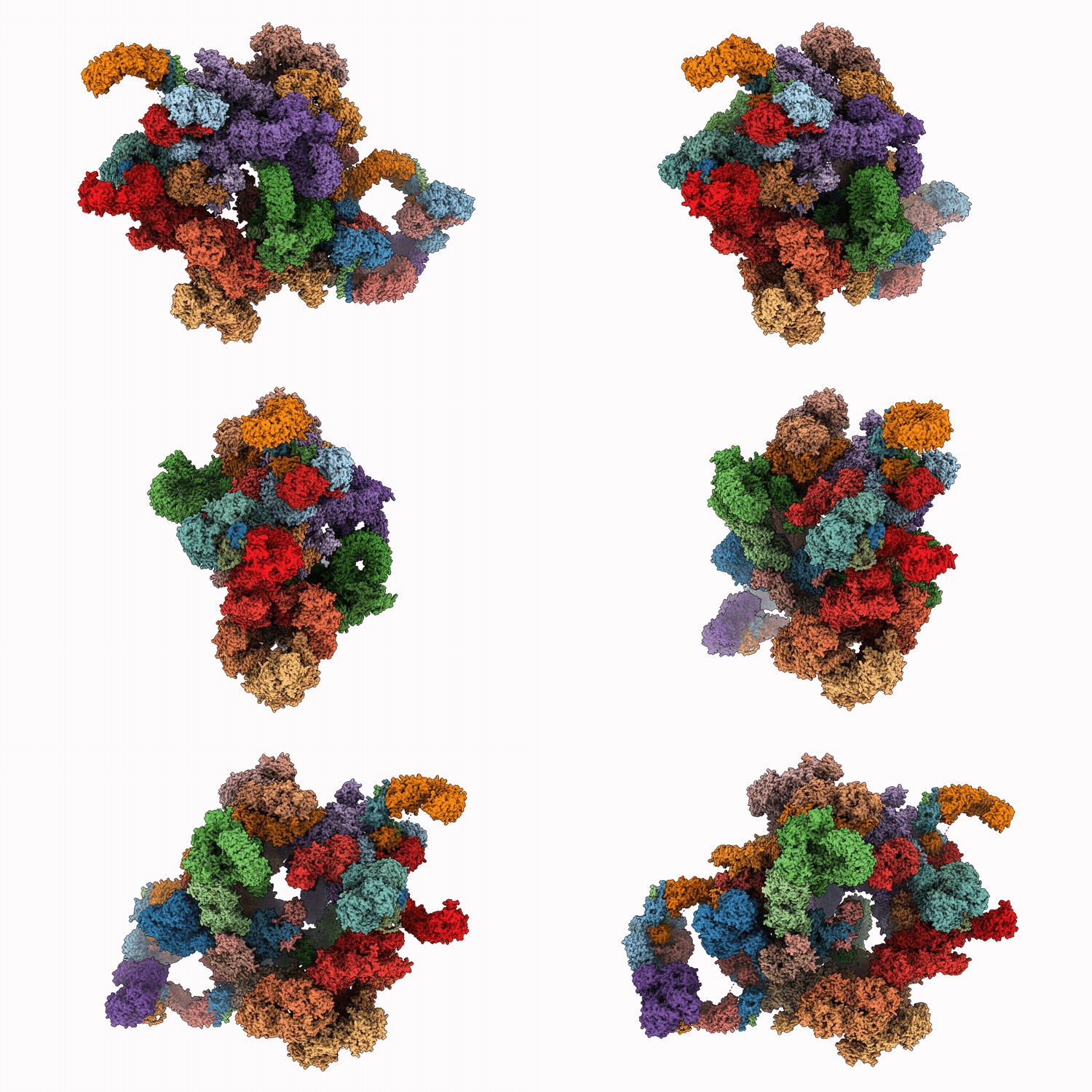
9XRL image
Deposition Date 2025-11-19
Release Date 2026-03-18
Last Version Date 2026-04-15
Entry Detail
PDB ID:
9XRL
Title:
Structure of mouse cytoplasmic lattice (CPL) repeating unit
Biological Source:
Source Organism(s):
Mus musculus (Taxon ID: 10090)
Method Details:
Experimental Method:
Resolution:
3.74 Å
Aggregation State:
FILAMENT
Reconstruction Method:
SINGLE PARTICLE
Macromolecular Entities
Structures with similar UniProt ID
Protein Blast
Polymer Type:polypeptide(L)
Molecule:Zinc finger BED domain-contai
Gene (Uniprot):Zbed3
Chain IDs:A (auth: 1), B (auth: 3), E (auth: 9)
Chain Length:228
Number of Molecules:3
Biological Source:Mus musculus
Structures with similar UniProt ID
Protein Blast
Polymer Type:polypeptide(L)
Molecule:KH domain-containing protein
Gene (Uniprot):Khdc3
Chain IDs:C (auth: 4), D (auth: 6), TA (auth: AA)
Chain Length:440
Number of Molecules:3
Biological Source:Mus musculus
Structures with similar UniProt ID
Protein Blast
Polymer Type:polypeptide(L)
Molecule:F-box and WD-40 domain protei
Gene (Uniprot):Fbxw21
Chain IDs:F (auth: A)
Chain Length:468
Number of Molecules:1
Biological Source:Mus musculus
Structures with similar UniProt ID
Protein Blast
Polymer Type:polypeptide(L)
Molecule:E3 ubiquitin-protein ligase U
Gene (Uniprot):Uhrf1
Chain IDs:OA (auth: AL), RA (auth: AR), PB (auth: x)
Chain Length:782
Number of Molecules:3
Biological Source:Mus musculus
Structures with similar UniProt ID
Protein Blast
Polymer Type:polypeptide(L)
Molecule:Ubiquitin-conjugating enzyme
Gene (Uniprot):Ube2d3
Chain IDs:NA (auth: AM), QA (auth: AS), LB (auth: AD)
Chain Length:147
Number of Molecules:3
Biological Source:Mus musculus
Structures with similar UniProt ID
Protein Blast
Polymer Type:polypeptide(L)
Molecule:S-phase kinase-associated pro
Gene (Uniprot):Skp1
Chain IDs:G (auth: D), V (auth: p), UA (auth: O), VA (auth: q), DB (auth: F)
Chain Length:581
Number of Molecules:5
Biological Source:Mus musculus
Structures with similar UniProt ID
Protein Blast
Polymer Type:polypeptide(L)
Molecule:Transducin-like enhancer prot
Gene (Uniprot):Tle6
Chain IDs:H (auth: E), J (auth: I), S (auth: z), SA (auth: P), WA (auth: AC), EB (auth: 8)
Chain Length:581
Number of Molecules:6
Biological Source:Mus musculus
Structures with similar UniProt ID
Protein Blast
Polymer Type:polypeptide(L)
Molecule:NLR family, pyrin domain cont
Gene (Uniprot):Nlrp4f
Chain IDs:I (auth: H), L (auth: Q), SB (auth: i), TB (auth: h)
Chain Length:581
Number of Molecules:4
Biological Source:Mus musculus
Structures with similar UniProt ID
Protein Blast
Polymer Type:polypeptide(L)
Molecule:F-box and WD-40 domain protei
Gene (Uniprot):Fbxw19
Chain IDs:BB (auth: L), CB (auth: C)
Chain Length:466
Number of Molecules:2
Biological Source:Mus musculus
Structures with similar UniProt ID
Protein Blast
Polymer Type:polypeptide(L)
Molecule:Inactive protein-arginine dei
Gene (Uniprot):Padi6
Chain IDs:K (auth: S), R (auth: T), W (auth: Y), X (auth: b), Y (auth: X), Z, AA (auth: V), BA (auth: W), CA (auth: n), DA (auth: f), EA (auth: s), FA (auth: m), GA (auth: o), HA (auth: d), IA (auth: j), AB (auth: r), HB (auth: B), IB (auth: K), NB (auth: U), OB (auth: c)
Chain Length:682
Number of Molecules:20
Biological Source:Mus musculus
Structures with similar UniProt ID
Protein Blast
Polymer Type:polypeptide(L)
Molecule:Oocyte-expressed protein homo
Gene (Uniprot):Ooep
Chain IDs:M (auth: e), Q (auth: g), U (auth: AH), YA (auth: AJ), KB (auth: AI), UB (auth: AT)
Chain Length:164
Number of Molecules:6
Biological Source:Mus musculus
Structures with similar UniProt ID
Protein Blast
Polymer Type:polypeptide(L)
Molecule:Expressed sequence C85627
Gene (Uniprot):Fbxw18
Chain IDs:N (auth: k), O (auth: l)
Chain Length:466
Number of Molecules:2
Biological Source:Mus musculus
Structures with similar UniProt ID
Protein Blast
Polymer Type:polypeptide(L)
Molecule:Tubulin beta-4B chain
Gene (Uniprot):Tubb4b
Chain IDs:P (auth: t), LA (auth: AE), JB (auth: AN)
Chain Length:682
Number of Molecules:3
Biological Source:Mus musculus
Structures with similar UniProt ID
Protein Blast
Polymer Type:polypeptide(L)
Molecule:Tubulin alpha-1A chain
Gene (Uniprot):Tuba1a
Chain IDs:JA (auth: u), MA (auth: AF), PA (auth: AO)
Chain Length:682
Number of Molecules:3
Biological Source:Mus musculus
Structures with similar UniProt ID
Protein Blast
Polymer Type:polypeptide(L)
Molecule:NACHT, LRR and PYD domains-co
Gene (Uniprot):Nlrp14
Chain IDs:KA (auth: w), QB (auth: AK), RB (auth: AQ)
Chain Length:993
Number of Molecules:3
Biological Source:Mus musculus
Structures with similar UniProt ID
Protein Blast
Polymer Type:polypeptide(L)
Molecule:NACHT, LRR and PYD domains-co
Gene (Uniprot):Nlrp5
Chain IDs:T (auth: y), XA (auth: AB), ZA (auth: 0), FB (auth: 7), GB (auth: 5), MB (auth: 2)
Chain Length:1059
Number of Molecules:6
Biological Source:Mus musculus
Primary Citation
Structure of the mouse cytoplasmic lattice.
Nature ? ? ? (2026)
PMID: 41917274 DOI: 10.1038/s41586-026-10442-6

Abstact

The fertilized egg relies almost entirely on maternal stores in the oocyte to ensure the successful initiation of development(1). The cytoplasmic lattices (CPLs) in mammalian oocytes store maternal-expressed proteins and play an essential role in embryogenesis(2,3). Impairing multiple CPL members leads to early embryonic arrest (EEA), resulting in infertility in mammals. However, the mechanism underlying the assembly and storage of CPLs remains largely unknown. Here, we report the cryo-EM structure of a native mouse CPL repeating unit (~ 4 MDa) at 3.74 A resolution. This repeating unit exhibits a tripartite architecture comprising a framework, extended linkers, and a CPL core. The external framework is built from PADI6 decamers and the subcortical maternal complexes (SCMC). Two linkers formed by NLRP4F polymerize the frameworks into an extended filament. In CPL core, the epigenetic regulator UHRF1 is trapped by PADI6, UBE2D, and NLRP14 in a compact, autoinhibited conformation that prevents nuclear entry and ubiquitin ligase activity. Moreover, the CPL core stores GTP-bound alpha/beta-tubulin heterodimers and inactive SCF E3-ubiquitin ligase components (FBXW-SKP1 complex) in a poised but restrained state. These features establish CPLs as a dynamic regulatory pool that enables rapid microtubule assembly and tightly controlled ubiquitination during the oocyte-to-embryo transition. Together, this semi-in-situ structure illuminates CPL assembly and storage-module organization, and establishes CPLs as specialized proteostasis organelles for maternal regulation in oocytes and early embryonic development.

Legend

Protein

Chemical

Disease

Primary Citation of related structures
Feedback Form
Name
Email
Institute
Feedback