

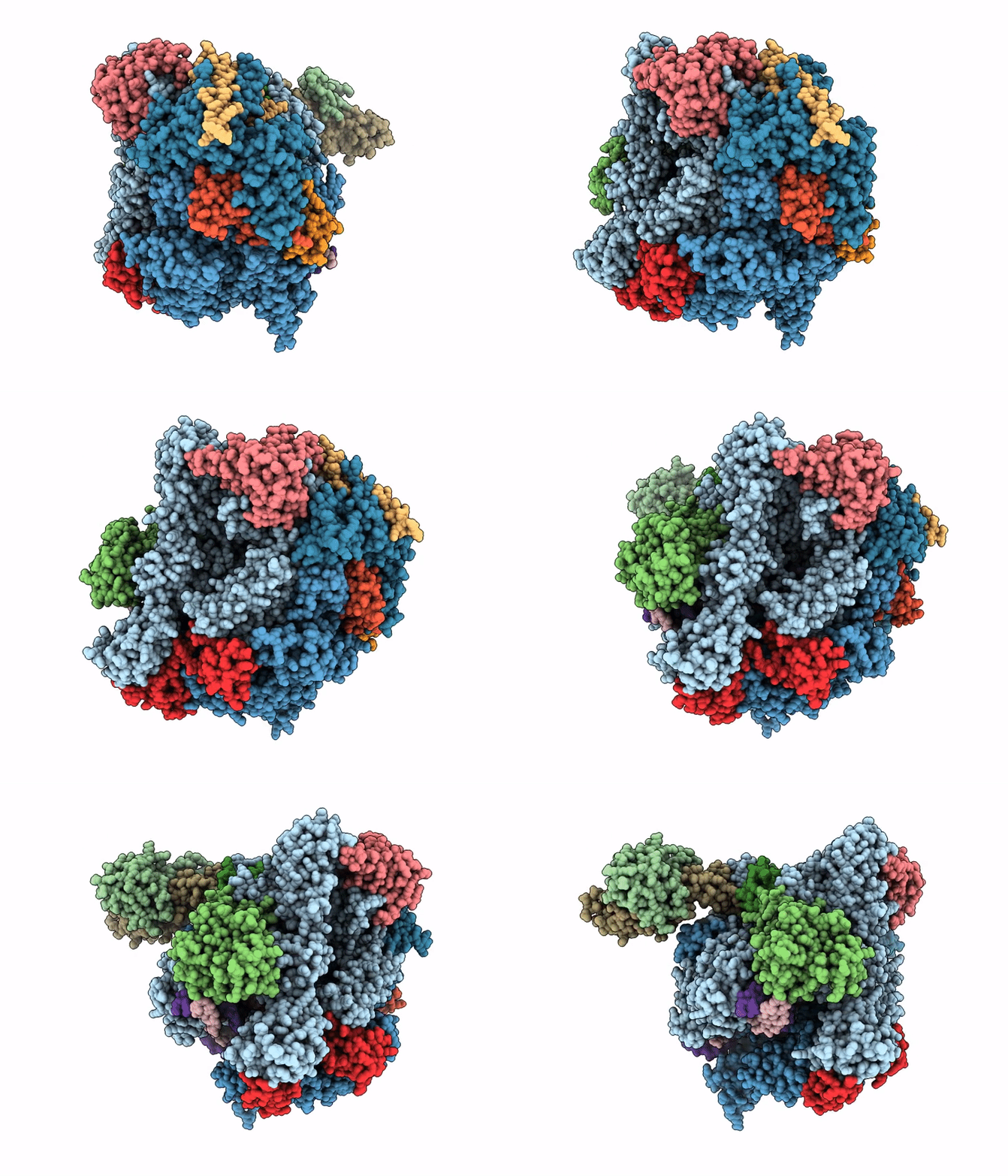
9XGK image
Deposition Date 2025-10-30
Release Date 2026-02-11
Last Version Date 2026-08-26
Entry Detail
PDB ID:
9XGK
Keywords:
Title:
Structure of mammalian RNA polymerase II stalled by Actinomycin D at the N-1 position.
Biological Source:
Source Organism(s):
synthetic construct (Taxon ID: 32630)
Bos taurus (Taxon ID: 9913)
Method Details:
Experimental Method:
Resolution:
2.53 Å
Aggregation State:
PARTICLE
Reconstruction Method:
SINGLE PARTICLE
Macromolecular Entities
Polymer Type:polypeptide(L)
Molecule:DNA-directed RNA polymerase I
Gene (Uniprot):POLR2A
Chain IDs:A
Chain Length:0
Number of Molecules:1
Biological Source:Bos taurus
Polymer Type:polypeptide(L)
Molecule:DNA-directed RNA polymerase I
Gene (Uniprot):POLR2B
Chain IDs:B
Chain Length:0
Number of Molecules:1
Biological Source:Bos taurus
Polymer Type:polypeptide(L)
Molecule:DNA-directed RNA polymerase I
Gene (Uniprot):POLR2C
Chain IDs:C
Chain Length:0
Number of Molecules:1
Biological Source:Bos taurus
Polymer Type:polypeptide(L)
Molecule:DNA-directed RNA polymerase I
Gene (Uniprot):POLR2D
Chain IDs:D
Chain Length:0
Number of Molecules:1
Biological Source:Bos taurus
Polymer Type:polypeptide(L)
Molecule:DNA-directed RNA polymerases
Gene (Uniprot):POLR2E
Chain IDs:E
Chain Length:0
Number of Molecules:1
Biological Source:Bos taurus
Polymer Type:polypeptide(L)
Molecule:DNA-directed RNA polymerases
Gene (Uniprot):POLR2F
Chain IDs:F
Chain Length:0
Number of Molecules:1
Biological Source:Bos taurus
Polymer Type:polypeptide(L)
Molecule:DNA-directed RNA polymerase I
Gene (Uniprot):POLR2G
Chain IDs:G
Chain Length:0
Number of Molecules:1
Biological Source:Bos taurus
Polymer Type:polypeptide(L)
Molecule:DNA-directed RNA polymerases
Gene (Uniprot):POLR2H
Chain IDs:H
Chain Length:0
Number of Molecules:1
Biological Source:Bos taurus
Polymer Type:polypeptide(L)
Molecule:DNA-directed RNA polymerase I
Gene (Uniprot):POLR2I
Chain IDs:I
Chain Length:0
Number of Molecules:1
Biological Source:Bos taurus
Polymer Type:polypeptide(L)
Molecule:DNA-directed RNA polymerases
Gene (Uniprot):POLR2L
Chain IDs:J
Chain Length:0
Number of Molecules:1
Biological Source:Bos taurus
Polymer Type:polypeptide(L)
Molecule:DNA-directed RNA polymerase I
Gene (Uniprot):POLR2J
Chain IDs:K
Chain Length:0
Number of Molecules:1
Biological Source:Bos taurus
Polymer Type:polypeptide(L)
Molecule:DNA-directed RNA polymerases
Gene (Uniprot):POLR2K
Chain IDs:L
Chain Length:0
Number of Molecules:1
Biological Source:Bos taurus
Polymer Type:polypeptide(L)
Molecule:Actinomycin D
Chain IDs:M
Chain Length:0
Number of Molecules:1
Biological Source:synthetic construct
Polymer Type:polydeoxyribonucleotide
Molecule:DNA (NTS, non-template strand
Chain IDs:N
Chain Length:0
Number of Molecules:1
Biological Source:synthetic construct
Polymer Type:polyribonucleotide
Molecule:RNA
Chain IDs:O (auth: P)
Chain Length:0
Number of Molecules:1
Biological Source:synthetic construct
Polymer Type:polydeoxyribonucleotide
Molecule:DNA (TS, template strand)
Chain IDs:P (auth: T)
Chain Length:0
Number of Molecules:1
Biological Source:synthetic construct
Peptide-like Molecules
PRD_000001
Primary Citation
Stepwise transcription stalling by the anti-cancer drug Actinomycin D and insights into short tandem repeat transcription inhibition.
Nat Commun 17 ? ? (2026)
PMID: 41833943 DOI: 10.1038/s41467-026-70612-y

Abstact

Short tandem repeats (STRs) comprise 6% of the human genome, and their transcription is linked to over 60 diseases. Actinomycin D (ACTD) is the first clinically approved anticancer antibiotic that inhibits transcription through an incompletely understood mechanism. Here, using reconstituted yeast and mammalian systems, we investigate the mechanism of transcription inhibition and examine the impact of ACTD on STR transcription. We show that ACTD induces RNA polymerase II (Pol II) pausing at three distinct states and present structural snapshots of Pol II processing ACTD in these states. Furthermore, we examine ACTD's effects on Pol II transcribing five disease-linked, GC-rich STRs and resolve structures of Pol II in complex with ACTD during the transcription of CTG repeats associated with myotonic dystrophy type 1. Our findings reveal the structural basis of ACTD-mediated transcription inhibition and provide a framework for the rational modification of ACTD to target STR-associated disorders.

Legend

Protein

Chemical

Disease

Primary Citation of related structures
Feedback Form
Name
Email
Institute
Feedback