

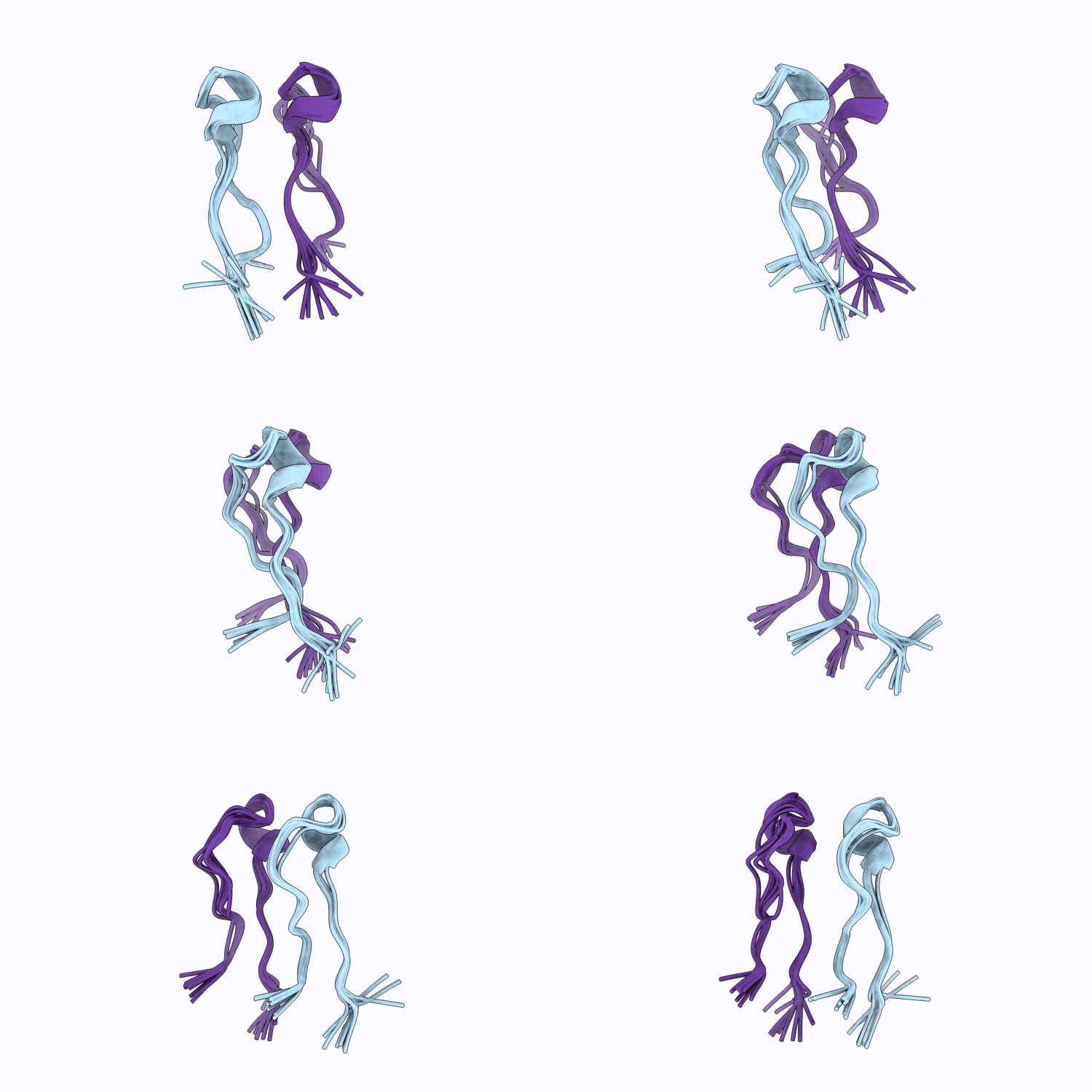
9XAP image
Deposition Date 2025-10-22
Release Date 2026-06-10
Last Version Date 2026-06-10
Entry Detail
PDB ID:
9XAP
Keywords:
Title:
Spatial structure of the dimeric antimicrobial peptide Ap9
Biological Source:
Source Organism(s):
Expression System(s):
Method Details:
Experimental Method:
Conformers Calculated:
100
Conformers Submitted:
10
Selection Criteria:
structures with the least restraint violations

Macromolecular Entities
Protein Blast
Polymer Type:polypeptide(L)
Molecule:antimicrobial peptide Ap9
Chain IDs:A, B
Chain Length:21
Number of Molecules:2
Biological Source:Abarenicola pacifica
Ligand Molecules
Primary Citation

Abstact

The rise in antimicrobial resistance represents a significant challenge to global health. The reason partially lies in an inappropriate use of conventional antibiotics and the subsequent rapid spread of multidrug-resistant pathogen strains. This emergency requires an urgent search for conceptually new antimicrobial agents. A viable alternative to conventional antibiotics is antimicrobial peptides (AMPs), which are ribosomally synthesized molecules with considerable potential as next-generation anti-infectious therapeutics. Previously, we have reported on the beta-hairpin peptide Ap9, an analog of abarenicin from the marine polychaeta Abarenicola pacifica, with potent activity against key Gram-negative pathogens. Here, it is shown that Ap9 acts in a manner resembling polymyxin B, namely via interaction with lipopolysaccharide (LPS), and retains its activity against polymyxin-resistant isolates without observed cross-resistance, and causes insignificant damage in cytoplasmic membrane at bactericidal concentrations. NMR spectroscopy reveals that LPS binding induces a conformational rearrangement of Ap9, its dimer formation, and local structural remodeling of the peptide region (residues 8-12) into 3(10)-helix. Bacterial resistance to Ap9 was found to be relatively low with a reduced susceptibility associated with infrequent genetic alterations, such as the mutation in lptD or the deletion in mlaA. Furthermore, Ap9 demonstrates a favorable tolerability, a wider therapeutic window than that of polymyxin B, and a sufficiently long half-life through the systemic use, as well as in vivo efficacy in murine models of Gram-negative infections, including sepsis caused by the mcr-1-harboring Escherichia coli strain. The obtained results point to Ap9 as a promising candidate for further preclinical studies aimed at development of an alternative to polymyxins.

Legend

Protein

Chemical

Disease

Primary Citation of related structures
Feedback Form
Name
Email
Institute
Feedback