

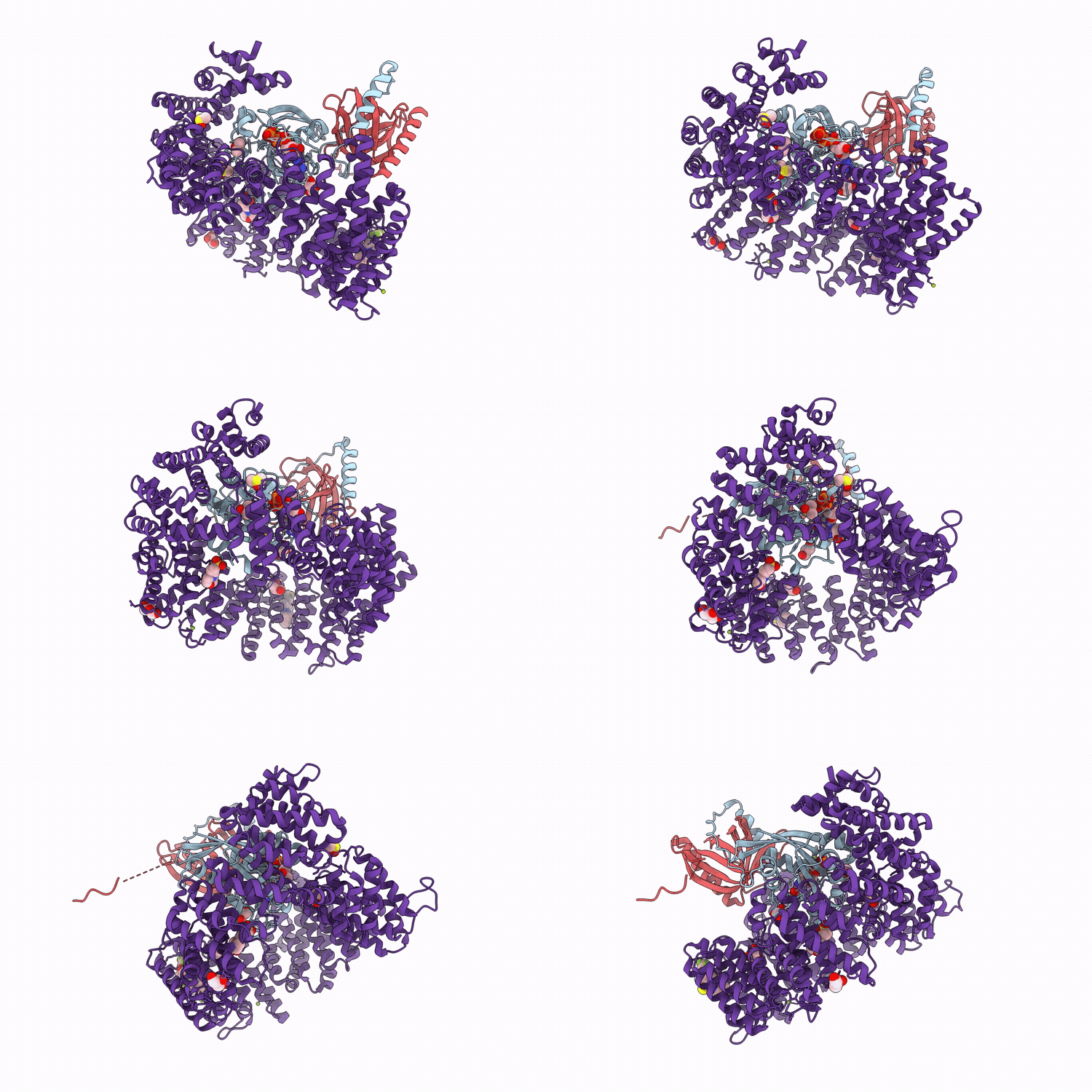
9X7O image
Deposition Date 2025-10-17
Release Date 2026-06-03
Last Version Date 2026-06-03
Entry Detail
PDB ID:
9X7O
Title:
Lansoprazole derivative in complex with CRM1-Ran-RanBP1
Biological Source:
Source Organism(s):
Expression System(s):
Method Details:
Experimental Method:
Resolution:
2.00 Å
R-Value Free:
0.21
R-Value Work:
0.18
R-Value Observed:
0.18
Space Group:
P 43 21 2
Macromolecular Entities
Structures with similar UniProt ID
Protein Blast
Polymer Type:polypeptide(L)
Molecule:GTP-binding nuclear protein R
Gene (Uniprot):RAN
Mutagens:Q69L/L182A
Chain IDs:A
Chain Length:216
Number of Molecules:1
Biological Source:Homo sapiens
Structures with similar UniProt ID
Protein Blast
Polymer Type:polypeptide(L)
Molecule:Ran-specific GTPase-activatin
Gene (Uniprot):YRB1
Chain IDs:B
Chain Length:140
Number of Molecules:1
Biological Source:Saccharomyces cerevisiae S288C
Structures with similar UniProt ID
Protein Blast
Polymer Type:polypeptide(L)
Molecule:Exportin-1
Gene (Uniprot):CRM1
Mutagens:S27E/Q49E/A51V/D537G/T539C/V540E/K541Q/S553R/Q561E/A741T/Y1022C
Chain IDs:C
Chain Length:1003
Number of Molecules:1
Biological Source:Saccharomyces cerevisiae S288C
Primary Citation
Mechanism of CRM1 Inhibition by Lansoprazole and Its Synergy with Cisplatin in Gastric Cancer.
J.Med.Chem. ? ? ? (2026)
PMID: 42134807 DOI: 10.1021/acs.jmedchem.6c01114

Abstact

CRM1 (Chromosome Region Maintenance 1, also known as Exportin-1 or XPO1) is a key nuclear export factor that exports and inactivates tumor suppressor proteins in cancer. Here, we report that the proton pump inhibitor lansoprazole, upon acid activation, is converted into a CRM1 inhibitor in vitro. The active component is a positively charged molecule that binds noncovalently to the nuclear export signal (NES) groove of CRM1, as revealed by biochemical studies and a 2.0 A cocrystal structure. Interestingly, lansoprazole undergoes spontaneous activation in cells, thereby inhibiting nuclear export to a similar extent as its preacid-activated form. Since the compound is susceptible to inhibition by glutathione (GSH), we designed a combination strategy where cisplatin, by depleting GSH, synergistically enhanced CRM1 inhibition. This combination demonstrated antitumor synergy in a gastric cancer xenograft model without increasing toxicity. Our work presents a novel CRM1 inhibitor and a chemosensitization strategy for gastric cancer.

Legend

Protein

Chemical

Disease

Primary Citation of related structures
Feedback Form
Name
Email
Institute
Feedback