

9X6M image
Deposition Date 2025-10-15
Release Date 2026-04-29
Last Version Date 2026-04-29
Entry Detail
PDB ID:
9X6M
Keywords:
Title:
Crystal structure of Klebsiella oxytoca ribitol dehydrogenase in complex with D-allose
Biological Source:
Source Organism(s):
Expression System(s):
Method Details:
Experimental Method:
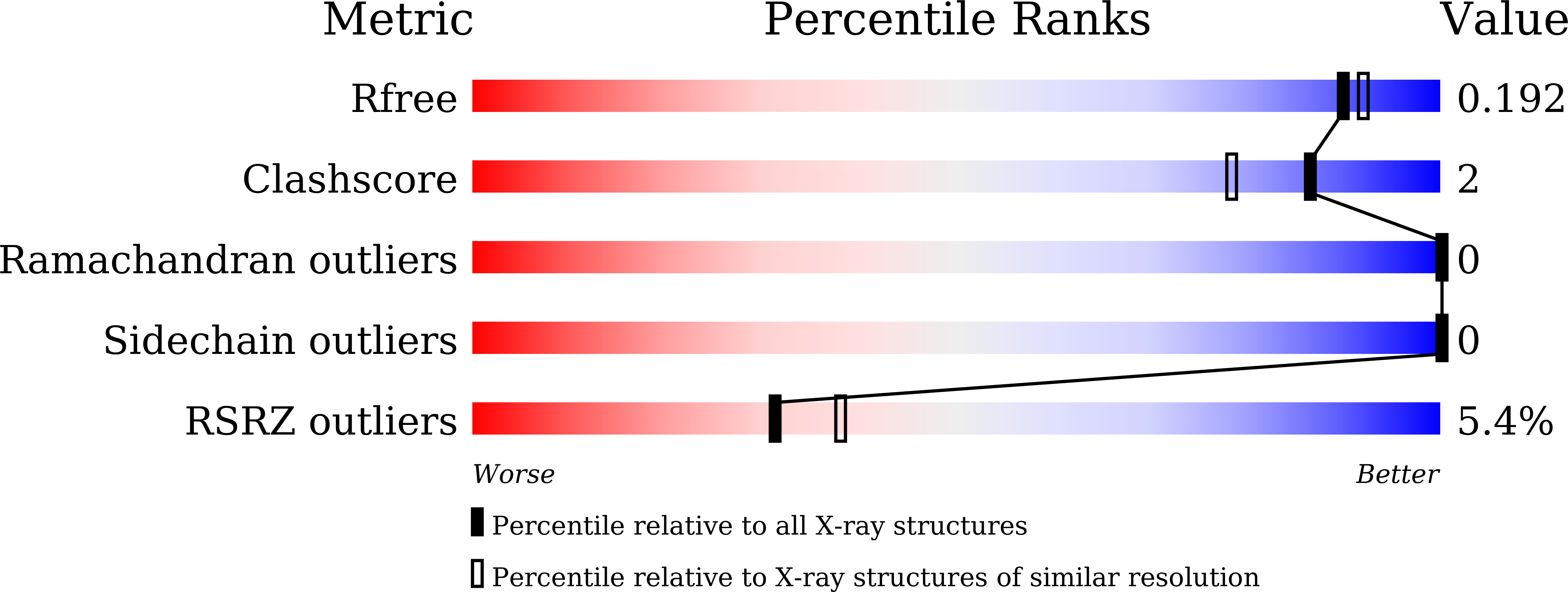
Resolution:
1.73 Å
R-Value Free:
0.19
R-Value Work:
0.15
R-Value Observed:
0.16
Space Group:
P 1 21 1
Macromolecular Entities
Structures with similar UniProt ID
Protein Blast
Polymer Type:polypeptide(L)
Molecule:Ribitol 2-dehydrogenase
Gene (Uniprot):DET57_113163
Chain IDs:A, B, C, D
Chain Length:270
Number of Molecules:4
Biological Source:Klebsiella oxytoca
Ligand Molecules
Primary Citation
Crystal structures of Klebsiella oxytoca ribitol dehydrogenase in complex with NAD + , d-allose, or d-allulose reveal insight into substrate recognition.
Febs Lett. ? ? ? (2026)
PMID: 42015598 DOI: 10.1002/1873-3468.70345

Abstact

Recombinant NAD(+)-dependent ribitol dehydrogenase derived from Klebsiella oxytoca (KoRdh) exhibits activity toward both ribitol and allitol. KoRdh catalyzes the NAD(+)-dependent oxidation of allitol to d-allulose and the NADH-dependent reduction of d-allulose to allitol. Notably, the flexible loop of KoRdh undergoes conformational changes upon NAD(+) and substrate binding. To elucidate the flexible loop's role in substrate recognition, we determined the X-ray structures of KoRdh alone and in complexes with NAD(+), d-allulose, or d-allose. Although d-allose is an aldose and not a substrate of KoRdh, it binds to KoRdh in the pyranose form, revealing the location of the substrate-binding site. Based on these structures, we propose a substrate recognition mechanism for KoRdh. Impact statement This research reveals an insight into a substrate recognition mechanism in the flexible region of ribitol dehydrogenase. Because ribitol dehydrogenase is a member of the short-chain reductases/oxidases (SDR) family, the current study will provide further insight into related enzymes that harbor the flexible region.

Legend

Protein

Chemical

Disease

Primary Citation of related structures
Feedback Form
Name
Email
Institute
Feedback