

9X4H image
Deposition Date 2025-10-10
Release Date 2026-05-27
Last Version Date 2026-05-27
Entry Detail
PDB ID:
9X4H
Keywords:
Title:
Structure Of the KEOPS-tRNA
Biological Source:
Source Organism(s):
Expression System(s):
Method Details:
Experimental Method:
Resolution:
3.36 Å
Aggregation State:
PARTICLE
Reconstruction Method:
SINGLE PARTICLE
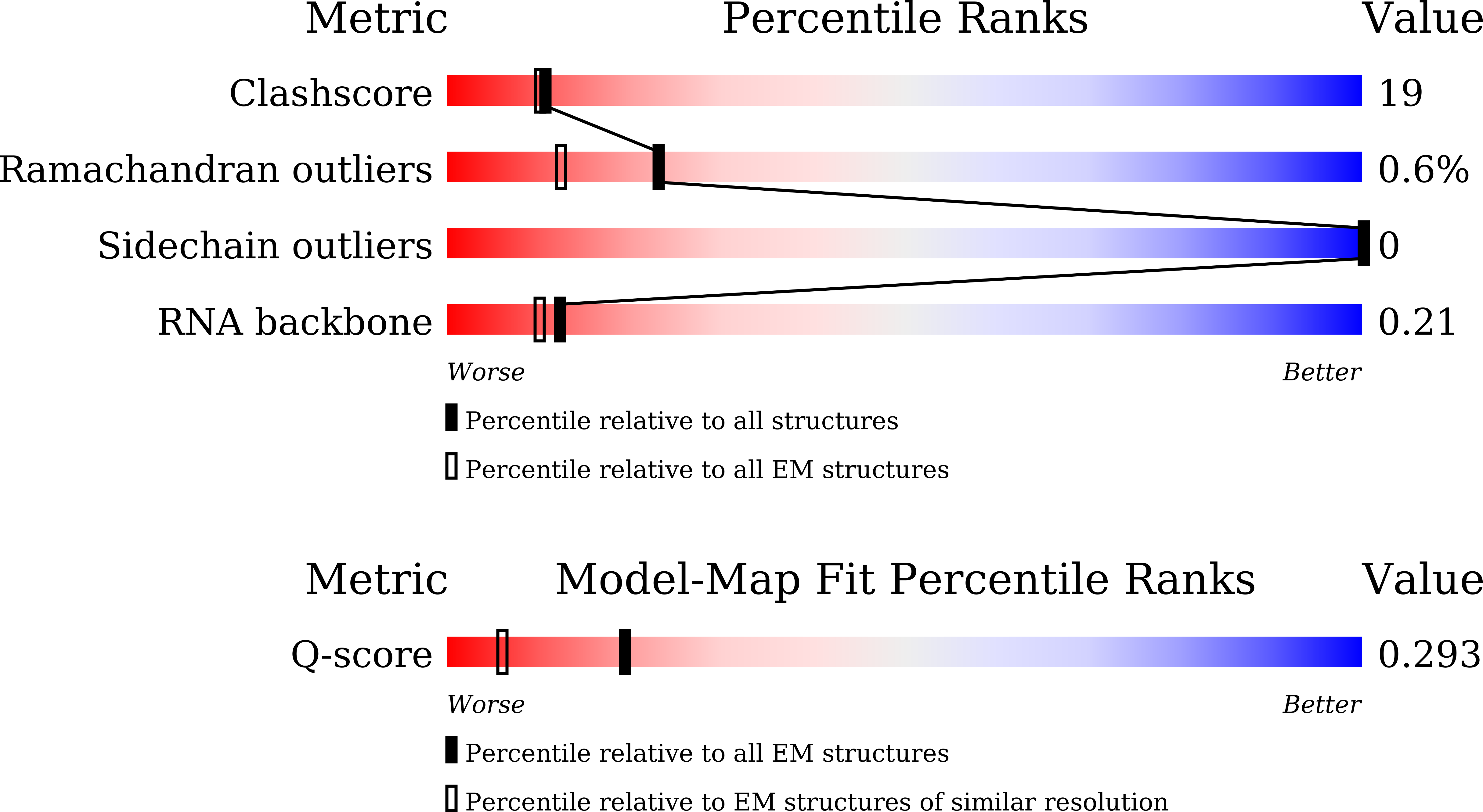
Macromolecular Entities
Structures with similar UniProt ID
Protein Blast
Polymer Type:polypeptide(L)
Molecule:N(6)-L-threonylcarbamoyladeni
Gene (Uniprot):CELE_Y71H2AM.1, Y71H2AM.1
Chain IDs:A, F
Chain Length:337
Number of Molecules:2
Biological Source:Caenorhabditis elegans
Structures with similar UniProt ID
Protein Blast
Polymer Type:polypeptide(L)
Molecule:non-specific serine/threonine
Gene (Uniprot):CELE_F52C12.6, F52C12.6
Chain IDs:B
Chain Length:245
Number of Molecules:1
Biological Source:Caenorhabditis elegans
Structures with similar UniProt ID
Protein Blast
Polymer Type:polypeptide(L)
Molecule:EKC/KEOPS complex subunit TPR
Gene (Uniprot):CELE_W03F8.4, W03F8.4
Chain IDs:C
Chain Length:183
Number of Molecules:1
Biological Source:Caenorhabditis elegans
Structures with similar UniProt ID
Protein Blast
Polymer Type:polypeptide(L)
Molecule:L antigen family member 3
Gene (Uniprot):CELE_F59A2.5, F59A2.5
Chain IDs:D, E
Chain Length:123
Number of Molecules:2
Biological Source:Caenorhabditis elegans
Polymer Type:polyribonucleotide
Molecule:RNA (76-MER)
Chain IDs:G (auth: T)
Chain Length:76
Number of Molecules:1
Biological Source:Caenorhabditis elegans
Ligand Molecules
Primary Citation
Catalytic and regulatory basis of tRNA t 6 A modification by the KEOPS complex.
Nat Commun ? ? ? (2026)
PMID: 42140986 DOI: 10.1038/s41467-026-73296-6

Abstact

N(6)-threonylcarbamoyladenosine (t(6)A) at tRNA position 37 is essential for translational fidelity and cellular homeostasis. The multi-subunit KEOPS complex catalyzes t(6)A formation in Archaea and Eukarya. Here we present cryo-EM structures of C. elegans KEOPS in its apo and tRNA-bound states. tRNA binding induces concerted conformational rearrangements, distorting the anticodon loop to project A37 into the Kae1 active site. Kae1 recognizes the conserved G10-C25 pair and 36-UAA-38 motif. Bud32 directly contacts the anticodon and acceptor arms, coupling ATP hydrolysis to t(6)A catalysis in the distant Kae1 active site through long-range conformational changes. Cgi121 enhances catalytic efficiency through cooperative binding with Bud32 and the tRNA 3' CCA. Pcc1 stabilizes the anticodon loop and mediates KEOPS dimerization, enhancing tRNA binding and t(6)A activity. GAMOS-associated mutations cluster at functional hotspots within the KEOPS-tRNA complex. This study provides a structural framework for understanding KEOPS mechanism and its cellular roles.

Legend

Protein

Chemical

Disease

Primary Citation of related structures
Feedback Form
Name
Email
Institute
Feedback