

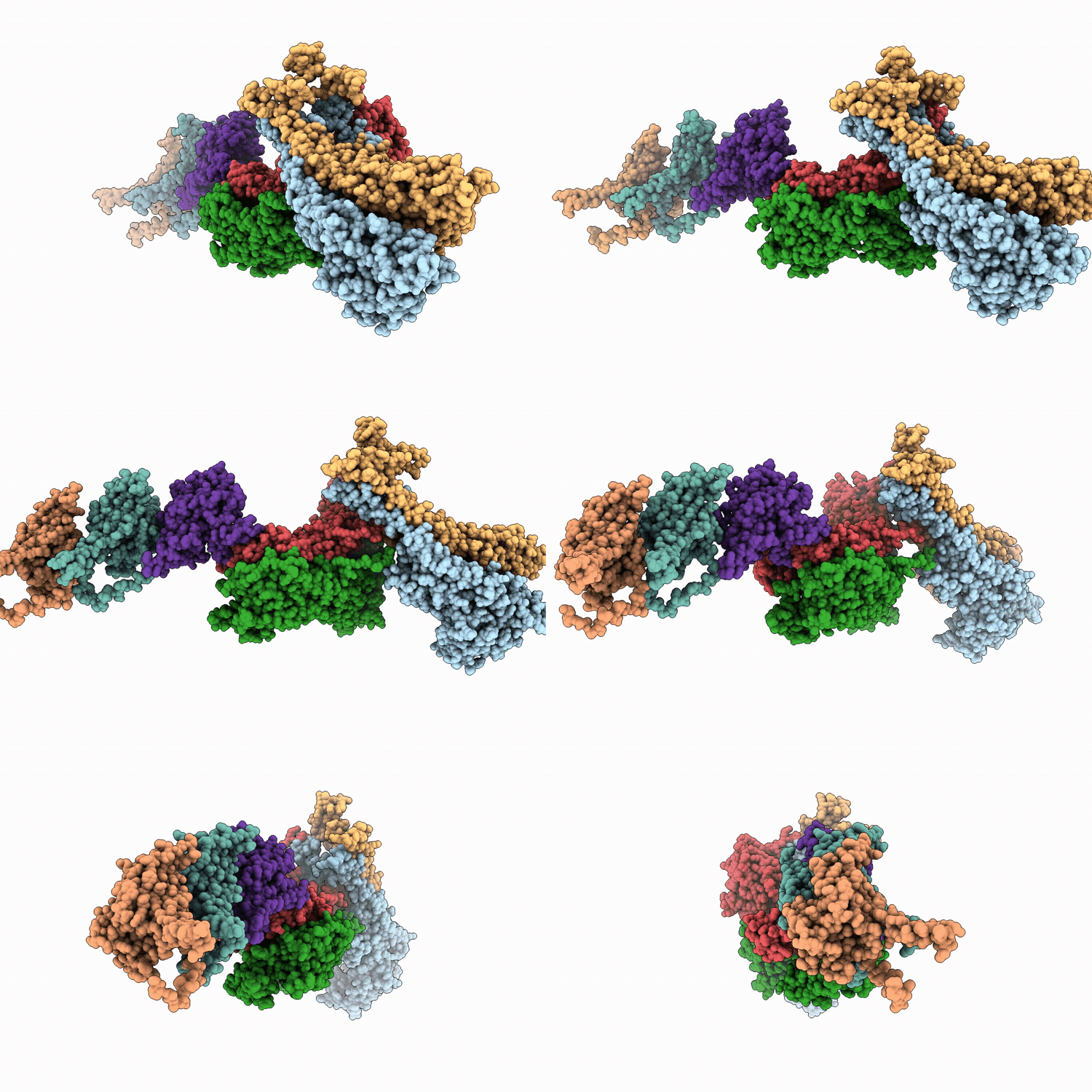
9WWA image
Deposition Date 2025-09-23
Release Date 2026-06-24
Last Version Date 2026-06-24
Entry Detail
PDB ID:
9WWA
Keywords:
Title:
Cryo-EM Structure of Parabacteroide phage PD491P1 head-to-tail interface
Biological Source:
Source Organism(s):
Method Details:
Experimental Method:
Resolution:
3.20 Å
Aggregation State:
PARTICLE
Reconstruction Method:
SINGLE PARTICLE
Macromolecular Entities
Structures with similar UniProt ID
Protein Blast
Polymer Type:polypeptide(L)
Molecule:portal protein
Chain IDs:D (auth: A), E (auth: M)
Chain Length:575
Number of Molecules:2
Biological Source:Parabacteroides phage PD491P1
Structures with similar UniProt ID
Protein Blast
Polymer Type:polypeptide(L)
Molecule:adaptor protein
Chain IDs:F (auth: I), G (auth: K)
Chain Length:440
Number of Molecules:2
Biological Source:Parabacteroides phage PD491P1
Structures with similar UniProt ID
Protein Blast
Polymer Type:polypeptide(L)
Molecule:tube protein
Chain IDs:B (auth: N), C (auth: B)
Chain Length:216
Number of Molecules:2
Biological Source:Parabacteroides phage PD491P1
Structures with similar UniProt ID
Protein Blast
Polymer Type:polypeptide(L)
Molecule:terminator protein
Chain IDs:A (auth: h)
Chain Length:189
Number of Molecules:1
Biological Source:Parabacteroides phage PD491P1
Ligand Molecules
Primary Citation
Cryo-EM structures of prevalent gut phage PD491P1 uncover extensive disulfide stabilization and distinct structural adaptations.
Structure 34 942 954.e2 (2026)
PMID: 42086047 DOI: 10.1016/j.str.2026.04.005

Abstact

Bacteriophages play crucial roles in modulating the human gut microbiome, yet structural characterization of prevalent gut phages remains limited. Here, we present high-resolution cryo-EM structures of Parabacteroides phage PD491P1, which is one of the most abundant bacteriophages in the human gut. The structures reveal its mature virion organization, including the capsid, head-to-tail interface, and tail tip regions. Strikingly, PD491P1 exhibits an exceptionally extensive disulfide bond network that covalently stabilizes nearly the entire virion. Unique structural features include an elaborate portal-adaptor-terminator interface and distinctive, upward-pointing and flexible tail fibers with multiple putative host recognition domains. These structural adaptations may enable phage PD491P1 to achieve survival and robust infection in the challenging gut environment. These findings expand our understanding of gut phage structural diversity, reveal mechanistic insights into phage stability and infection, and provide a foundation for future development of phage-based microbiome therapeutics.

Legend

Protein

Chemical

Disease

Primary Citation of related structures
Feedback Form
Name
Email
Institute
Feedback