

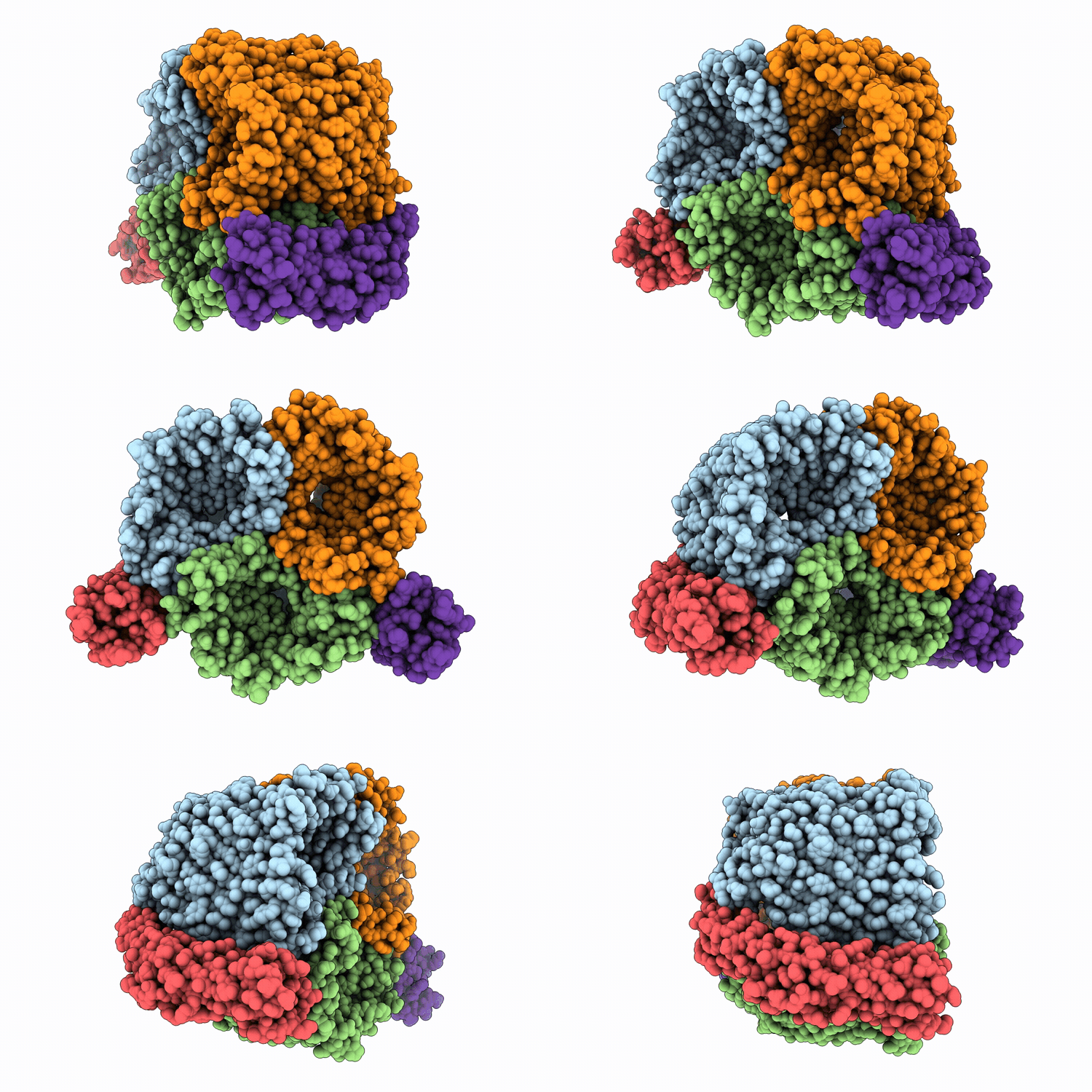
9WSO image
Deposition Date 2025-09-14
Release Date 2026-07-01
Last Version Date 2026-07-29
Entry Detail
PDB ID:
9WSO
Keywords:
Title:
LamB binding with bacteriophage Lom
Biological Source:
Source Organism(s):
Method Details:
Experimental Method:
Resolution:
3.45 Å
Aggregation State:
PARTICLE
Reconstruction Method:
SINGLE PARTICLE
Macromolecular Entities
Polymer Type:polypeptide(L)
Molecule:Maltoporin
Gene (Uniprot):lamB
Chain IDs:A, B, D
Chain Length:0
Number of Molecules:3
Biological Source:Shigella sonnei (strain Ss046)
Polymer Type:polypeptide(L)
Molecule:Outer membrane protein lom
Gene (Uniprot):lom
Chain IDs:C, E (auth: O)
Chain Length:0
Number of Molecules:2
Biological Source:Escherichia phage Lambda
Ligand Molecules
Primary Citation
A receptor-centered approach identifies Lom as a LamB-bound superinfection exclusion factor in bacteriophage lambda.
Cell Rep 45 117691 117691 (2026)
PMID: 42467530 DOI: 10.1016/j.celrep.2026.117691

Abstact

Bacteriophages face intense competition within bacterial populations. Although bacteria encode diverse anti-phage mechanisms, strategies protecting virions at the host surface remain poorly understood. Here, we develop a receptor-centered discovery approach that captures phage proteins bound to host receptors during infection. Applying this strategy to bacteriophage lambda and its outer-membrane receptor LamB, we identify Lom as a phage-encoded outer membrane protein that binds LamB. Structural, biochemical, and functional analyses show that Lom occupies the same LamB surface recognized by the receptor-binding protein gpJ, thereby reducing phage adsorption through receptor occlusion. Ribosome profiling indicates that lom is strongly expressed during late lytic growth and is also expressed during lysogeny, consistent with a role in receptor-level superinfection exclusion. Foldseek analyses identify structurally related Lom-like proteins in diverse temperate phages, raising the possibility that receptor occlusion is a more widespread strategy. These findings establish a framework for discovering receptor-level phage competition mechanisms.

Legend

Protein

Chemical

Disease

Primary Citation of related structures
Feedback Form
Name
Email
Institute
Feedback