

9WQW image
Deposition Date 2025-09-11
Release Date 2026-04-01
Last Version Date 2026-04-08
Entry Detail
PDB ID:
9WQW
Keywords:
Title:
aminoacyl-tRNA-dependent peptide synthase, Sbb17
Biological Source:
Source Organism(s):
Expression System(s):
Method Details:
Experimental Method:
Resolution:
1.96 Å
R-Value Free:
0.20
R-Value Work:
0.18
R-Value Observed:
0.18
Space Group:
C 2 2 21
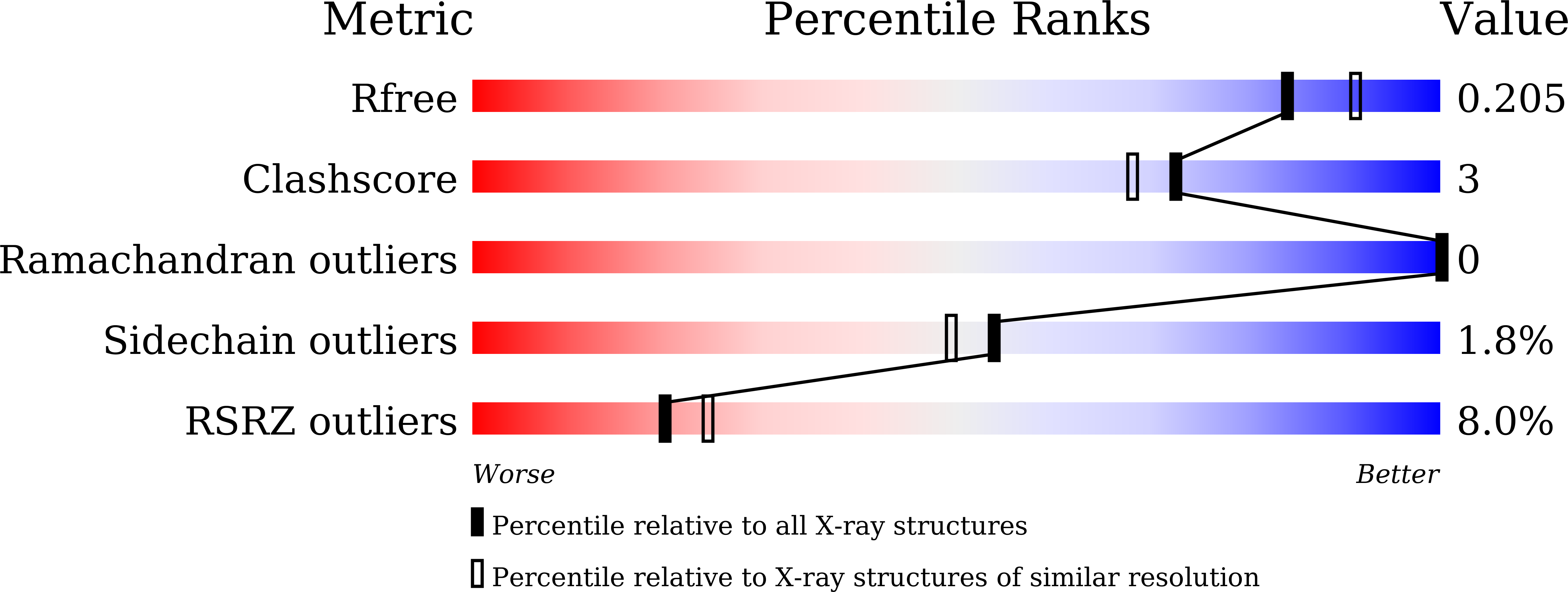
Macromolecular Entities
Protein Blast
Polymer Type:polypeptide(L)
Molecule:aminoacyl-tRNA-dependent pept
Chain IDs:A
Chain Length:311
Number of Molecules:1
Biological Source:Streptomyces prunicolor
Primary Citation
tRNA-Dependent Chemoenzymatic Transformation of Aminoacyl Pendant Moieties of Streptothricin Antibiotics.
J. Am. Chem. Soc. 148 12154 12165 (2026)
PMID: 41823201 DOI: 10.1021/jacs.6c00367

Abstact

Streptothricin (ST) antibiotics are promising agents against multidrug-resistant pathogens and are structurally classified into two groups, containing either a beta-lysyl or a glycyl pendant moiety attached via an amide bond to an amino sugar core. These pendant moieties are essential determinants of the biological activity and selective toxicity of ST antibiotics. We previously demonstrated that during ST biosynthesis, the beta-lysyl pendant moiety is installed by nonribosomal peptide synthetases, whereas the glycyl pendant moiety is generated by a Gly-tRNA(Gly)-dependent amide-forming enzyme. Here, we present a chemoenzymatic approach to transform aminoacyl pendant moieties using the promiscuous tRNA-dependent amide-forming enzyme Sba18. Remarkably, Sba18 generates two new ST derivatives, alanylthricin and serylthricin, by utilizing Ala-tRNA(Ala) and Ser-tRNA(Ser), respectively. Moreover, Sba18 accepts aminoacyl-tRNA mimics prepared by flexizyme-mediated charging of chemically synthesized aminoacyl groups and produces additional 11 ST derivatives. Alanylthricin and serylthricin retain antibiotic activity, demonstrating that this tRNA-dependent chemoenzymatic approach provides a viable strategy for expanding the structural diversity of streptothricin antibiotics. Furthermore, structural comparison of Sba18 with its Gly-tRNA(Gly)-specific orthologue Sbb17 elucidates the catalytic and substrate-recognition mechanisms underlying the broad specificity of Sba18. These structural insights provide a foundation for expanding the structural diversity not only of ST antibiotics but also of other peptide natural products biosynthesized using aminoacyl-tRNAs.

Legend

Protein

Chemical

Disease

Primary Citation of related structures
Feedback Form
Name
Email
Institute
Feedback