

9WQT image
Deposition Date 2025-09-11
Release Date 2026-04-08
Last Version Date 2026-04-08
Entry Detail
PDB ID:
9WQT
Keywords:
Title:
Crystal structure of Saccharomyces cerevisiae isoleucyl-tRNA synthetase in complex with reveromycin A and isoleucine
Biological Source:
Expression System(s):
Method Details:
Experimental Method:
Resolution:
1.90 Å
R-Value Free:
0.21
R-Value Work:
0.19
R-Value Observed:
0.19
Space Group:
C 1 2 1
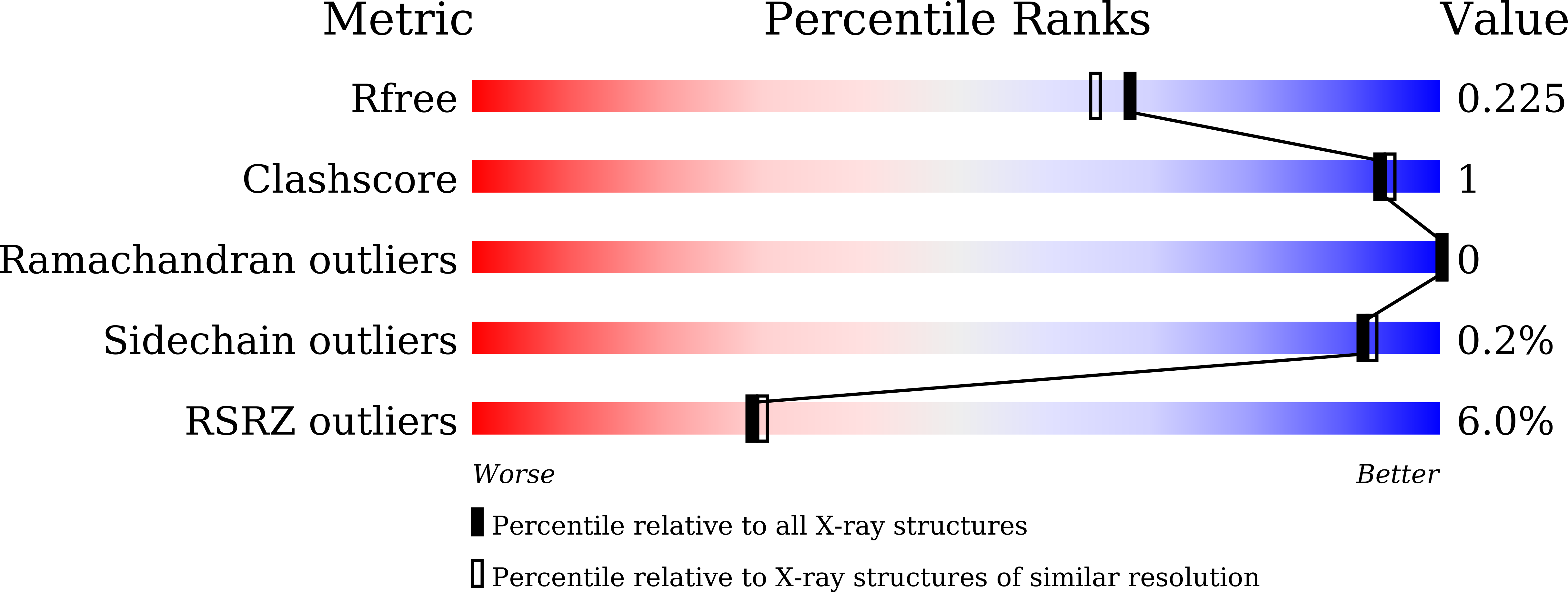
Macromolecular Entities
Structures with similar UniProt ID
Protein Blast
Polymer Type:polypeptide(L)
Molecule:Isoleucine--tRNA ligase, cyto
Gene (Uniprot):ILS1
Chain IDs:A
Chain Length:990
Number of Molecules:1
Biological Source:Saccharomyces cerevisiae (strain ATCC 204508 / S288c)
Primary Citation
Substrate l-isoleucine facilitates the hyper inhibition of reveromycin A on human cytoplasmic isoleucyl-tRNA synthetase.
Arch. Biochem. Biophys. 780 110789 110789 (2026)
PMID: 41839287 DOI: 10.1016/j.abb.2026.110789

Abstact

Aminoacyl-tRNA synthetases (AARSs) are essential for decoding the genetic code by accurately attaching amino acids to their corresponding tRNAs, making them attractive drug targets for treating various diseases. The natural product reveromycin A (RMA) demonstrates therapeutic potential for osteoporosis and other osteoclast-related disorders by selectively inducing osteoclast apoptosis, with human cytoplasmic isoleucyl-tRNA synthetase (HcIleRS) identified as its putative functional target. In this study, recombinant HcIleRS was expressed and characterized, and RMA was demonstrated to potently inhibit HcIleRS activity with an IC(50) value of 36 nM measured using an ATP consumption assay. The dissociation constant (K(d)) for RMA binding to HcIleRS was measured at 429 nM, which improved to 90 nM and 28 nM in the presence of an intermediate analog and the substrate isoleucine (l-Ile), respectively. Two co-crystal structures of Saccharomyces cerevisiae IleRS (ScIleRS) complexed with RMA and l-Ile, resolved under the same crystallization conditions, revealed that l-Ile facilitates RMA binding to the tRNA(Ile) CCA-end binding site in the catalytic domain by increasing hydrophobic stacking interactions between RMA and active site residues. Consequently, RMA not only directly competes with tRNA(Ile) for binding to the catalytic domain but also disrupts its interactions with the editing domain by blocking necessary conformational movements. Notably, the C18 hemisuccinate chain of RMA exhibited alternative conformations in the two structures, suggesting that its interaction with the KMSKS motif is not essential for the high-affinity binding. This substrate-aided cooperative binding mechanism facilitates the potent inhibition of IleRS by RMA and offers valuable insights for developing potential combination therapies targeting AARSs.

Legend

Protein

Chemical

Disease

Primary Citation of related structures
Feedback Form
Name
Email
Institute
Feedback