

9WP1 image
Deposition Date 2025-09-08
Release Date 2026-06-03
Last Version Date 2026-06-03
Entry Detail
PDB ID:
9WP1
Keywords:
Title:
Structural insights into tyrosine sulfation of CCR5 by human tyrosylprotein sulfotransferase-1
Biological Source:
Source Organism(s):
Homo sapiens (Taxon ID: 9606)
Expression System(s):
Method Details:
Experimental Method:
Resolution:
3.20 Å
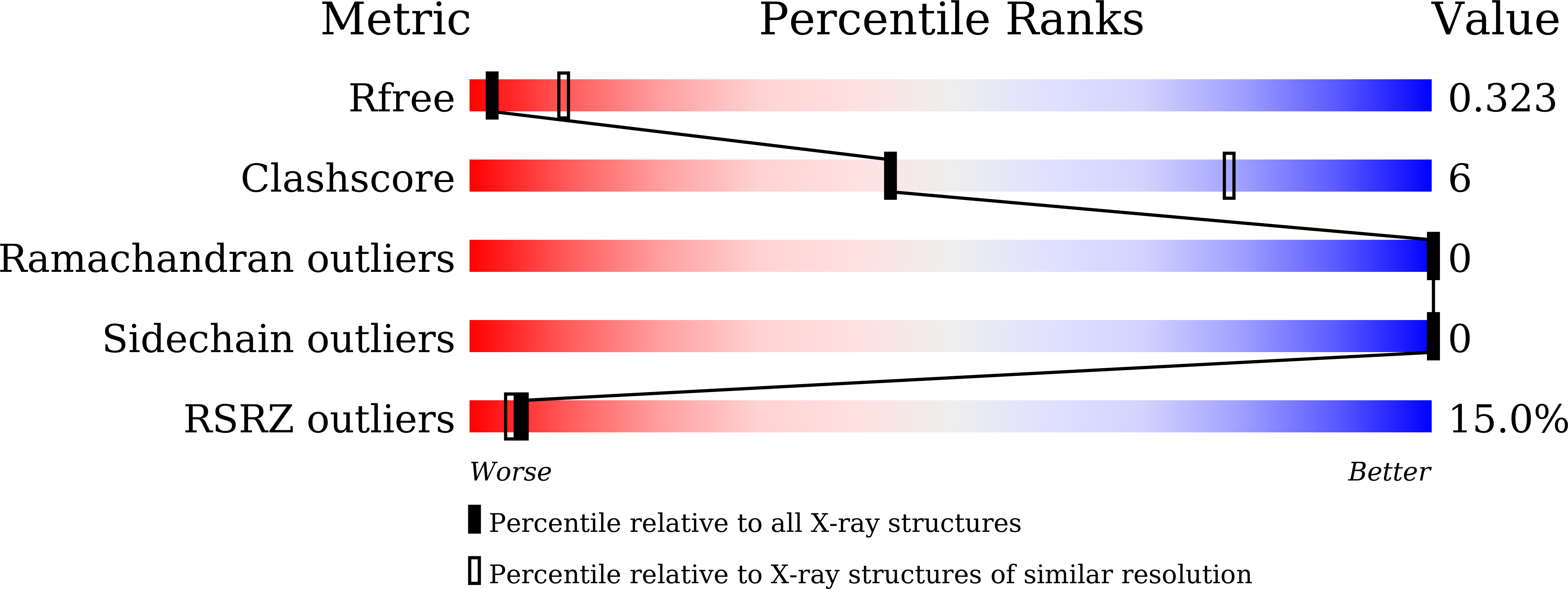
R-Value Free:
0.32
R-Value Work:
0.27
R-Value Observed:
0.27
Space Group:
C 1 2 1
Macromolecular Entities
Structures with similar UniProt ID
Protein Blast
Polymer Type:polypeptide(L)
Molecule:Protein-tyrosine sulfotransfe
Gene (Uniprot):TPST1
Chain IDs:A, B, C, D, E, F, G, H
Chain Length:276
Number of Molecules:8
Biological Source:Homo sapiens
Structures with similar UniProt ID
Protein Blast
Polymer Type:polypeptide(L)
Molecule:C-C chemokine receptor type 5
Gene (Uniprot):CCR5
Chain IDs:I (auth: L), J (auth: M), K (auth: N), L (auth: O), M (auth: P), N (auth: Q), O (auth: R), P (auth: S)
Chain Length:6
Number of Molecules:8
Biological Source:Homo sapiens
Primary Citation
Structural insights into tyrosine sulfation of CCR5 by human tyrosylprotein sulfotransferase-1.
Febs J. ? ? ? (2026)
PMID: 42175616 DOI: 10.1111/febs.70597

Abstact

Post-translational sulfation of the chemokine receptor CCR5 is involved in crucial biological processes such as viral infection and chemokine signaling. This sulfation can occur at the N-terminal tyrosine residues (Y3, Y10, Y14, and Y15) of CCR5 and is catalyzed by human tyrosylprotein sulfotransferases (hTPSTs) within the Golgi lumen. However, the detailed molecular mechanism by which these tyrosine residues are sulfated remains unresolved. To elucidate the mechanism, we determined the crystal structure of a soluble domain of hTPST1 bound to the sulfate donor product 3'-phosphoadenosine 5'-phosphate (PAP) and a modified 18-residue CCR5 peptide designed to isolate the Y3-centered binding mode, at 3.2 A resolution, with six peptide residues ordered. This structure defines key interactions consistent with Y3 sulfation and is consistent with previous biochemical data. Based on the crystal structure and prior knowledge, we constructed peptide docking models for Y10, Y14, and Y15 sulfation, as well as full-length hTPST1-PAP-CCR5 docking models. The crystal structure provides experimental insight into Y3 recognition, whereas the docking models provide testable hypotheses for how the other sulfation sites may be accommodated in the context of CCR5.

Legend

Protein

Chemical

Disease

Primary Citation of related structures
Feedback Form
Name
Email
Institute
Feedback