

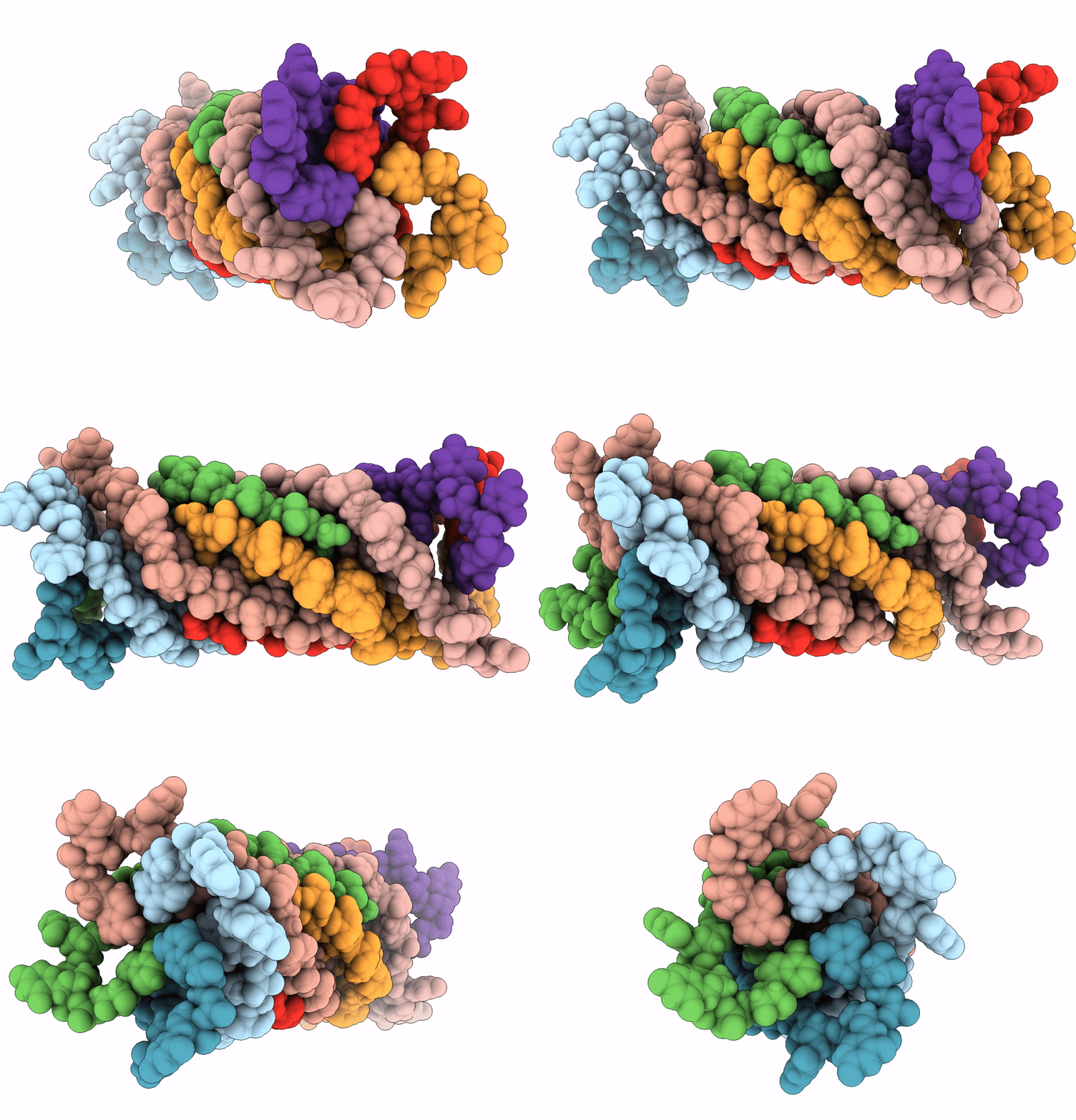
9WHV image
Deposition Date 2025-08-27
Release Date 2025-10-15
Last Version Date 2026-06-24
Entry Detail
PDB ID:
9WHV
Keywords:
Title:
Cross-Stacking-Stabilized Intra-Locked RNA G-Quadruplex
Biological Source:
Source Organism(s):
Homo sapiens (Taxon ID: 9606)
Method Details:
Experimental Method:
Conformers Calculated:
10
Conformers Submitted:
10
Selection Criteria:
structures with the lowest energy

Macromolecular Entities
Polymer Type:polyribonucleotide
Molecule:RNA (5'-R(*GP*UP*UP*AP*GP*GP*
Chain IDs:A, B, C, D, E, F, G, H
Chain Length:10
Number of Molecules:8
Biological Source:Homo sapiens
Ligand Molecules
Primary Citation
An intra-locked RNA G-quadruplex topology confers enhanced nuclease resistance and cancer cell targeting.
Int.J.Biol.Macromol. 367 152564 152564 (2026)
PMID: 42142778 DOI: 10.1016/j.ijbiomac.2026.152564

Abstact

Nucleic acid aptamers often suffer from poor serum nuclease resistance, which limits their translational applications. Here, we present Apt-10-2, a natural 10-nt RNA aptamer that forms a highly stable G-quadruplex (Tm > 90 degrees C) with prolonged serum persistence (>96 h), while maintaining nanomolar affinity for nucleolin (NCL). Functionally, Apt-10-2 distinguishes cancer cells from normal cells in vitro and demonstrates specific tumor accumulation (>8 h) in vivo. To investigate the molecular basis of its stability, we performed NMR-based structural analysis and proposed a restraint-supported structural model of Apt-10-2, suggesting a unique interlocked topology in which two subunits co-assemble into a 16-layered framework composed of G-, U-, and A-tetrad-like interactions.. The proposed structural model features an intra-locked domain stabilized by cross-stacking interactions between the G1-U2-U3 tetrads, which are critical for maintaining the aptamer's stability. Disruption of this domain significantly impairs the overall structure. Our findings provide a structural framework for understanding the prolonged stability of RNA G-quadruplexes, and highlight the potential of Apt-10-2 as a naturally stable, high-affinity aptamer scaffold for cancer-targeting applications, without the need for extensive chemical modifications.

Legend

Protein

Chemical

Disease

Primary Citation of related structures
Feedback Form
Name
Email
Institute
Feedback