

9WH1 image
Deposition Date 2025-08-25
Release Date 2026-06-03
Last Version Date 2026-07-29
Entry Detail
PDB ID:
9WH1
Title:
Structure of Klebsiella pneumoniae trypsin-HamAB bound with DNA, monomer
Biological Source:
Source Organism(s):
Expression System(s):
Method Details:
Experimental Method:
Resolution:
3.23 Å
Aggregation State:
PARTICLE
Reconstruction Method:
SINGLE PARTICLE
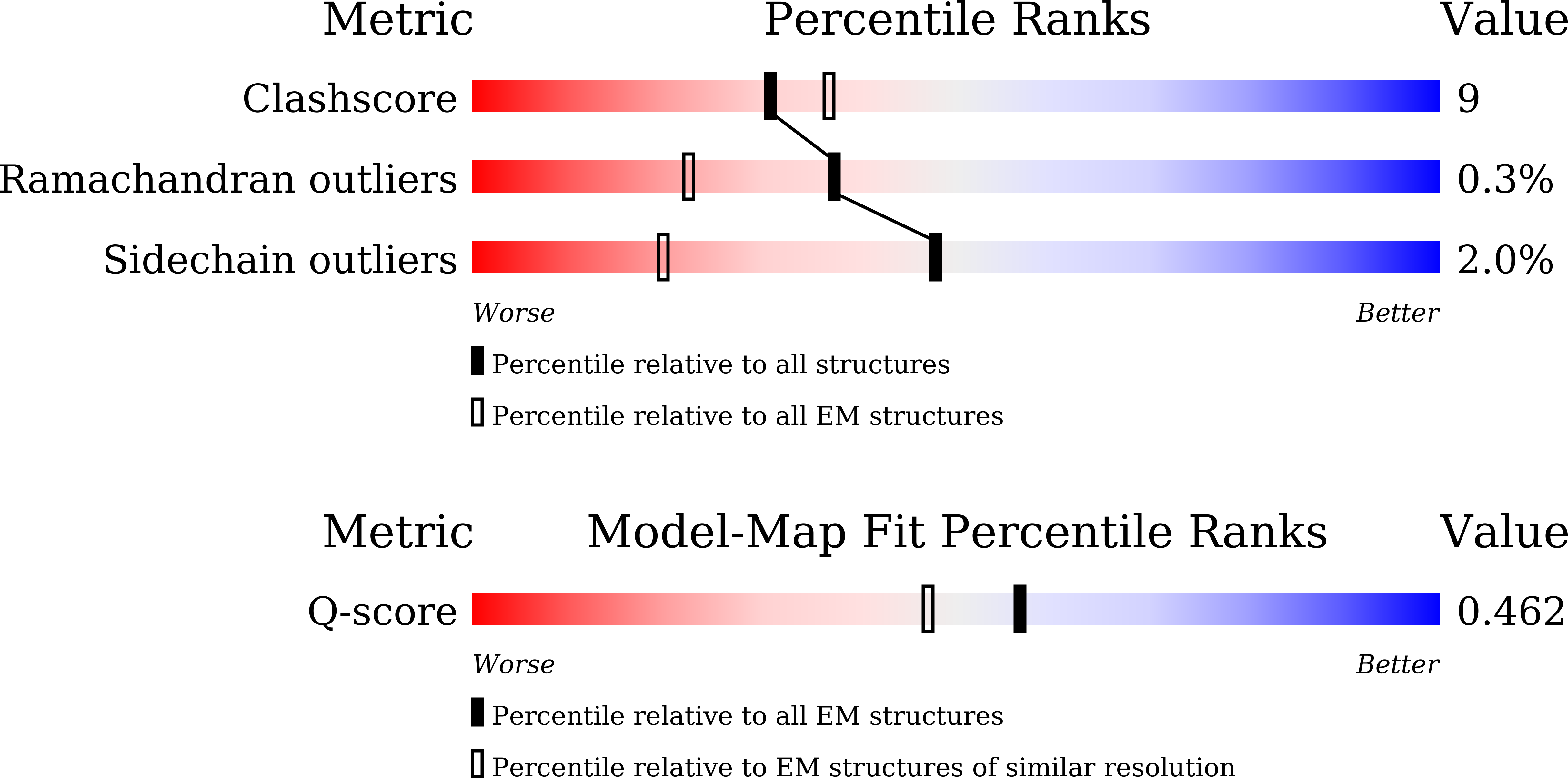
Macromolecular Entities
Polymer Type:polypeptide(L)
Molecule:Anti-bacteriophage protein A/
Gene (Uniprot):SAMEA4873653_00088
Chain IDs:A
Chain Length:0
Number of Molecules:1
Biological Source:Klebsiella pneumoniae
Polymer Type:polypeptide(L)
Molecule:DNA polymerase theta (Helicas
Gene (Uniprot):B6I68_29715, SAMEA4873653_00087
Chain IDs:B
Chain Length:0
Number of Molecules:1
Biological Source:Klebsiella pneumoniae
Polymer Type:polydeoxyribonucleotide
Molecule:DNA (5'-D(P*AP*AP*AP*AP*AP*AP
Chain IDs:C
Chain Length:0
Number of Molecules:1
Biological Source:Klebsiella pneumoniae
Ligand Molecules
Primary Citation
The antiphage mechanism of a widespread trypsin-MBL defense module.
Nat.Chem.Biol. ? ? ? (2026)
PMID: 42243536 DOI: 10.1038/s41589-026-02252-8

Abstact

Protease-mediated activation of immune effectors is an evolutionarily conserved mechanism. This study identifies a widespread trypsin-MBL (metallo-beta-lactamase) module as a core effector in diverse antiviral bacterial immune systems, such as Hachiman, AVAST and Argonaute. Focusing on the Hachiman-associated trypsin-MBL system, we show that trypsin*HamAB protease activity is inhibited by ATP, while MBL is an autoinhibited DNase with two insertion loops obstructing its catalytic site. Upon infection, trypsin*HamAB senses foreign DNA and hydrolyzes ATP, activating trypsin-like activity, which specifically cleaves MBL at the insertion loops to release repression. The activated MBL depletes DNA and arrests host cell growth. Cryo-electron microscopy structures of trypsin*HamAB-DNA reveal that DNA binding and ATP hydrolysis trigger HamAB oligomerization and trypsin-like domain release, enabling its activation. Our work elucidates a conserved immune mechanism wherein proteolytic activation of a nuclease enables robust immunity against phage while multilayered controls prevent self-toxicity, expanding the repertoire of immune processes governed by regulatory proteolysis.

Legend

Protein

Chemical

Disease

Primary Citation of related structures
Feedback Form
Name
Email
Institute
Feedback