

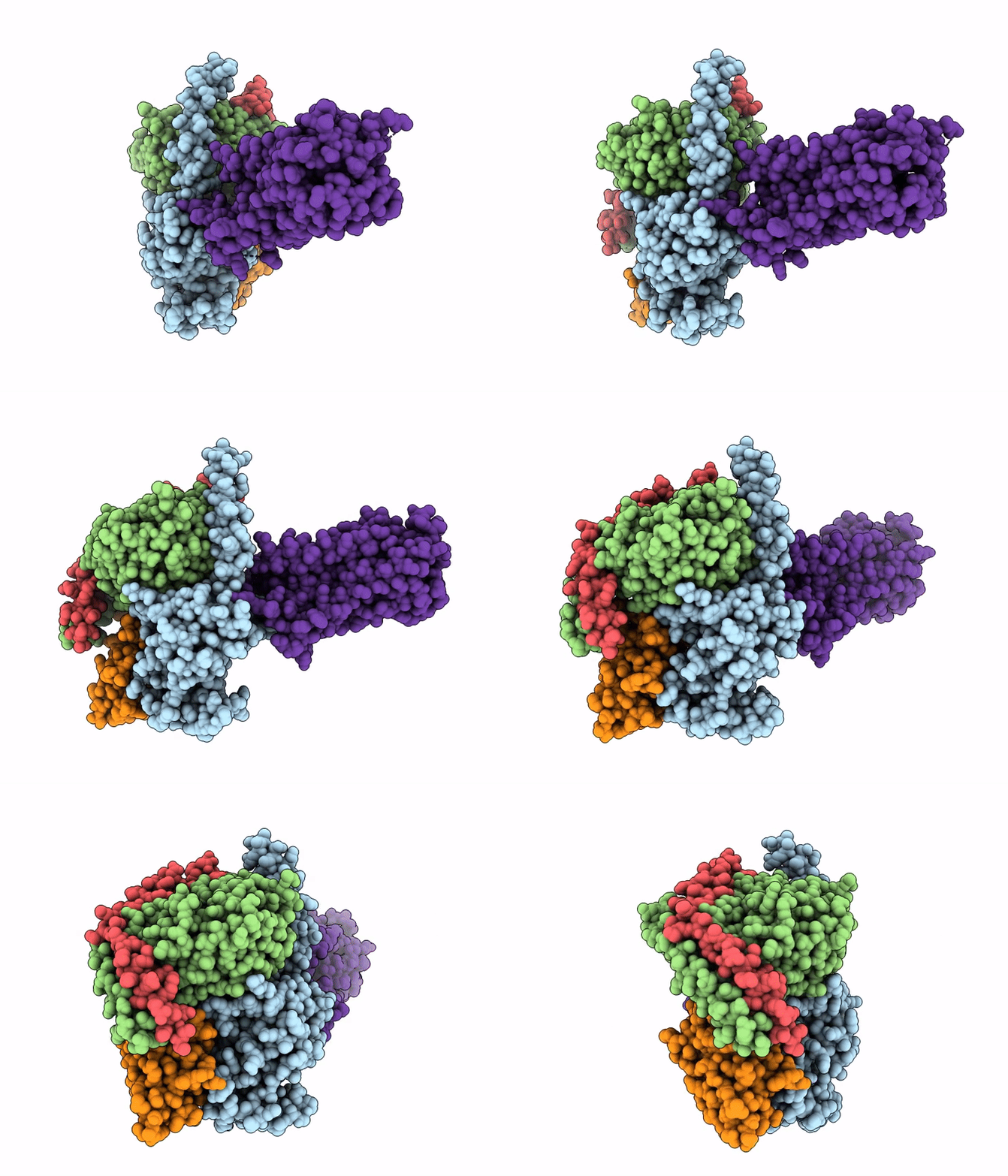
9WEY image
Deposition Date 2025-08-20
Release Date 2026-02-25
Last Version Date 2026-04-08
Entry Detail
PDB ID:
9WEY
Title:
Structure of HCMV UL33 in complex with human Gs protein
Biological Source:
Source Organism(s):
Homo sapiens (Taxon ID: 9606)
Lama glama (Taxon ID: 9844)
Human betaherpesvirus 5 (Taxon ID: 10359)
Method Details:
Experimental Method:
Resolution:
3.30 Å
Aggregation State:
PARTICLE
Reconstruction Method:
SINGLE PARTICLE
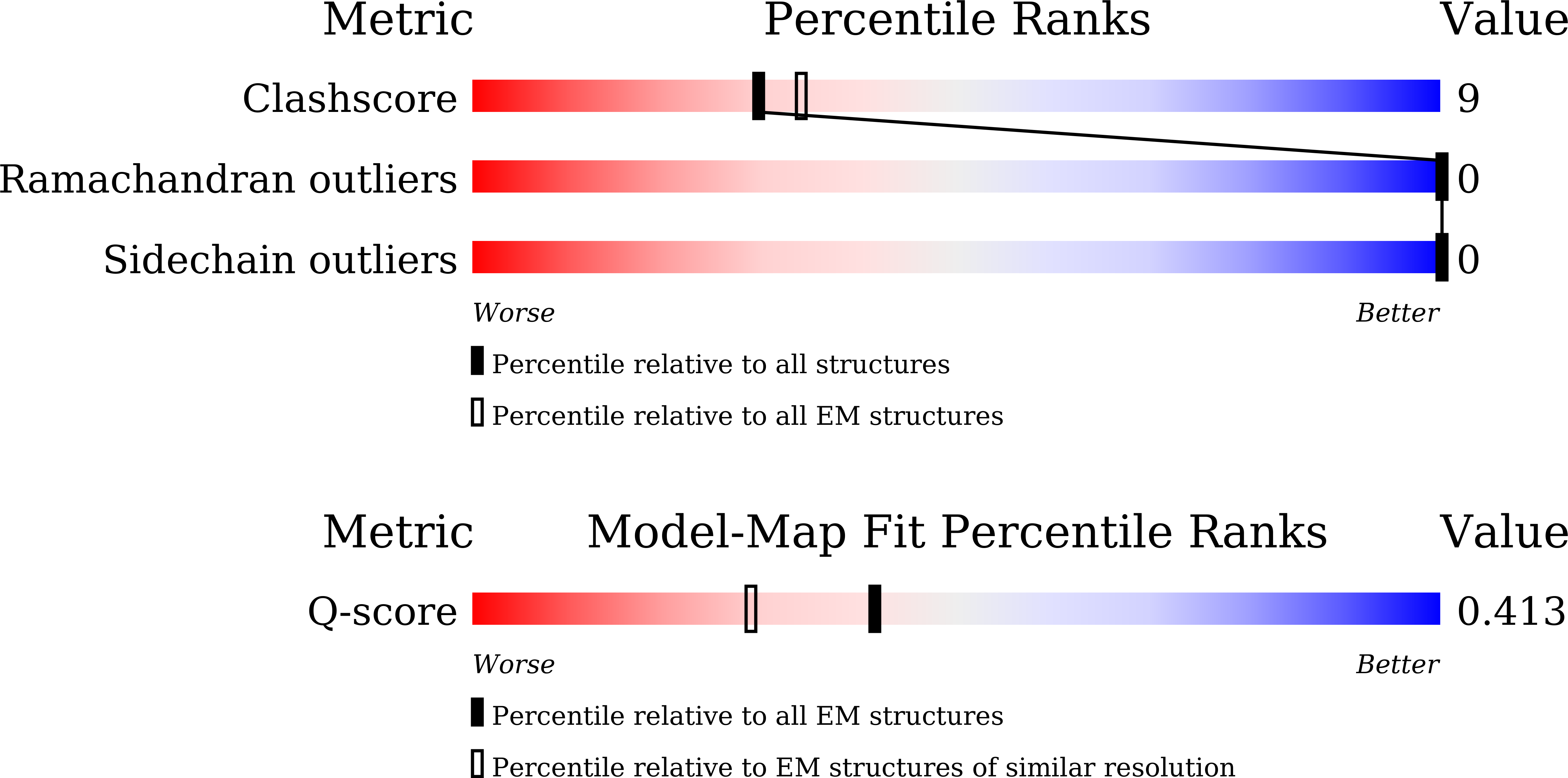
Macromolecular Entities
Structures with similar UniProt ID
Protein Blast
Polymer Type:polypeptide(L)
Molecule:Guanine nucleotide-binding pr
Gene (Uniprot):GNAS
Mutagens:S54N, G226A, E268A, N271K, K274D, R280K, T284D, I285T, A366S
Chain IDs:C (auth: A)
Chain Length:393
Number of Molecules:1
Biological Source:Homo sapiens
Structures with similar UniProt ID
Protein Blast
Polymer Type:polypeptide(L)
Molecule:Guanine nucleotide-binding pr
Gene (Uniprot):GNB1
Chain IDs:D (auth: B)
Chain Length:371
Number of Molecules:1
Biological Source:Homo sapiens
Structures with similar UniProt ID
Protein Blast
Polymer Type:polypeptide(L)
Molecule:Guanine nucleotide-binding pr
Gene (Uniprot):GNG2
Chain IDs:A (auth: C)
Chain Length:70
Number of Molecules:1
Biological Source:Homo sapiens
Protein Blast
Polymer Type:polypeptide(L)
Molecule:Nanobody35
Chain IDs:B (auth: N)
Chain Length:144
Number of Molecules:1
Biological Source:Lama glama
Protein Blast
Polymer Type:polypeptide(L)
Molecule:G-protein coupled receptor ho
Chain IDs:E (auth: R)
Chain Length:615
Number of Molecules:1
Biological Source:Human betaherpesvirus 5
Ligand Molecules
Primary Citation
Activation of cytomegalovirus-encoded G protein-coupled receptor UL33 by an innate N-terminal peptide.
Commun Biol 9 ? ? (2026)
PMID: 41680497 DOI: 10.1038/s42003-026-09660-5

Abstact

Human cytomegalovirus (HCMV) encodes the orphan G protein-coupled receptor (GPCR) UL33, which exhibits constitutive activity that disrupts host G protein signalling, facilitating efficient viral replication and pathogenesis. The cryo-electron microscopy (cryo-EM) structure of UL33 bound to the G(s) subtype of G protein reveals the N-terminal peptide as a tethered ligand reminiscent of the protease-activated receptors and adhesion GPCRs. This self-agonism induces a non-canonical active state that facilitates promiscuous G protein coupling, a plausible viral strategy for fine-tuning host signalling. Structure-guided mutagenesis disrupting key interactions between the N-terminus and its binding pocket abolishes G protein-mediated signalling, confirming the role of the N-terminus as a self-agonist. Our findings elucidate the structural basis for this activation mechanism and highlight the strategies employed by HCMV to hijack host G protein signalling.

Legend

Protein

Chemical

Disease

Primary Citation of related structures
Feedback Form
Name
Email
Institute
Feedback