

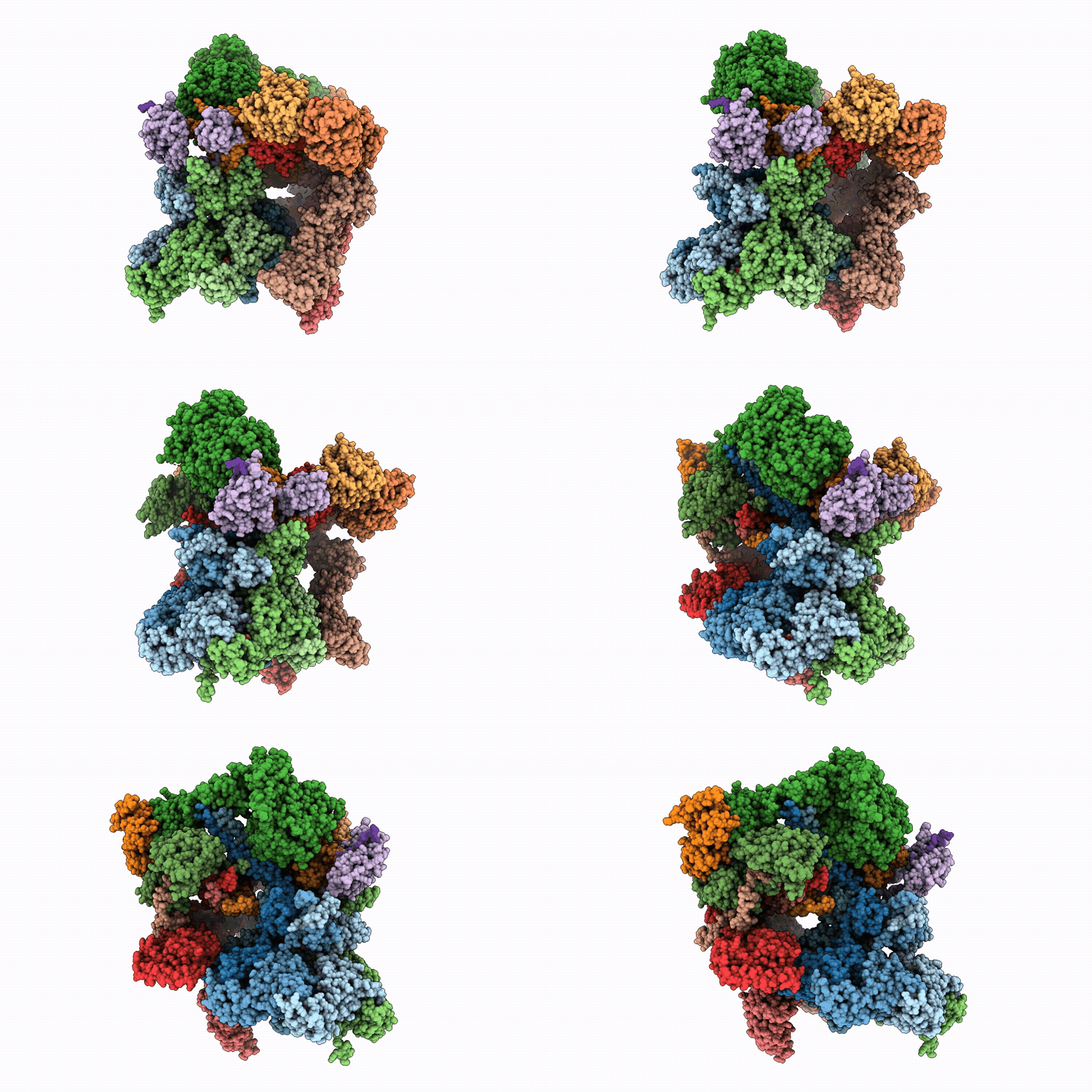
9WBG image
Deposition Date 2025-08-14
Release Date 2026-04-01
Last Version Date 2026-04-08
Entry Detail
PDB ID:
9WBG
Keywords:
Title:
Structure of human 26S proteasome complexed with midnolin, 19S proteasome with Ubl and Catch domain resolved
Biological Source:
Source Organism(s):
Expression System(s):
Method Details:
Experimental Method:
Resolution:
4.23 Å
Aggregation State:
PARTICLE
Reconstruction Method:
SINGLE PARTICLE
Macromolecular Entities
Structures with similar UniProt ID
Protein Blast
Polymer Type:polypeptide(L)
Molecule:26S proteasome regulatory sub
Gene (Uniprot):PSMC2
Chain IDs:P (auth: A)
Chain Length:376
Number of Molecules:1
Biological Source:Homo sapiens
Structures with similar UniProt ID
Protein Blast
Polymer Type:polypeptide(L)
Molecule:26S proteasome regulatory sub
Gene (Uniprot):PSMC1
Chain IDs:Q (auth: B)
Chain Length:377
Number of Molecules:1
Biological Source:Homo sapiens
Structures with similar UniProt ID
Protein Blast
Polymer Type:polypeptide(L)
Molecule:26S proteasome regulatory sub
Gene (Uniprot):PSMC5
Chain IDs:B (auth: C)
Chain Length:590
Number of Molecules:1
Biological Source:Homo sapiens
Structures with similar UniProt ID
Protein Blast
Polymer Type:polypeptide(L)
Molecule:26S proteasome regulatory sub
Gene (Uniprot):PSMC4
Chain IDs:C (auth: D)
Chain Length:350
Number of Molecules:1
Biological Source:Homo sapiens
Structures with similar UniProt ID
Protein Blast
Polymer Type:polypeptide(L)
Molecule:26S proteasome regulatory sub
Gene (Uniprot):PSMC6
Chain IDs:R (auth: E)
Chain Length:70
Number of Molecules:1
Biological Source:Homo sapiens
Structures with similar UniProt ID
Protein Blast
Polymer Type:polypeptide(L)
Molecule:26S proteasome regulatory sub
Gene (Uniprot):PSMC3
Chain IDs:S (auth: F)
Chain Length:439
Number of Molecules:1
Biological Source:Homo sapiens
Structures with similar UniProt ID
Protein Blast
Polymer Type:polypeptide(L)
Molecule:26S proteasome non-ATPase reg
Gene (Uniprot):PSMD1
Chain IDs:N (auth: U)
Chain Length:953
Number of Molecules:1
Biological Source:Homo sapiens
Structures with similar UniProt ID
Protein Blast
Polymer Type:polypeptide(L)
Molecule:26S proteasome non-ATPase reg
Gene (Uniprot):PSMD3
Chain IDs:D (auth: V)
Chain Length:534
Number of Molecules:1
Biological Source:Homo sapiens
Structures with similar UniProt ID
Protein Blast
Polymer Type:polypeptide(L)
Molecule:26S proteasome non-ATPase reg
Gene (Uniprot):PSMD12
Chain IDs:E (auth: W)
Chain Length:337
Number of Molecules:1
Biological Source:Homo sapiens
Structures with similar UniProt ID
Protein Blast
Polymer Type:polypeptide(L)
Molecule:26S proteasome non-ATPase reg
Gene (Uniprot):PSMD11
Chain IDs:F (auth: X)
Chain Length:422
Number of Molecules:1
Biological Source:Homo sapiens
Structures with similar UniProt ID
Protein Blast
Polymer Type:polypeptide(L)
Molecule:26S proteasome non-ATPase reg
Gene (Uniprot):PSMD6
Chain IDs:G (auth: Y)
Chain Length:389
Number of Molecules:1
Biological Source:Homo sapiens
Structures with similar UniProt ID
Protein Blast
Polymer Type:polypeptide(L)
Molecule:26S proteasome non-ATPase reg
Gene (Uniprot):PSMD7
Chain IDs:H (auth: Z)
Chain Length:324
Number of Molecules:1
Biological Source:Homo sapiens
Structures with similar UniProt ID
Protein Blast
Polymer Type:polypeptide(L)
Molecule:26S proteasome non-ATPase reg
Gene (Uniprot):PSMD13
Chain IDs:I (auth: a)
Chain Length:376
Number of Molecules:1
Biological Source:Homo sapiens
Structures with similar UniProt ID
Protein Blast
Polymer Type:polypeptide(L)
Molecule:26S proteasome non-ATPase reg
Gene (Uniprot):PSMD4
Chain IDs:J (auth: b)
Chain Length:377
Number of Molecules:1
Biological Source:Homo sapiens
Protein Blast
Polymer Type:polypeptide(L)
Molecule:Ubiquitin C-terminal hydrolas
Gene (Uniprot):KO493_00465, PSMD14
Chain IDs:O (auth: c)
Chain Length:590
Number of Molecules:1
Biological Source:Homo sapiens, Pseudotamlana agarivorans
Structures with similar UniProt ID
Protein Blast
Polymer Type:polypeptide(L)
Molecule:26S proteasome non-ATPase reg
Gene (Uniprot):PSMD8
Chain IDs:K (auth: d)
Chain Length:350
Number of Molecules:1
Biological Source:Homo sapiens
Structures with similar UniProt ID
Protein Blast
Polymer Type:polypeptide(L)
Molecule:26S proteasome complex subuni
Gene (Uniprot):SEM1
Chain IDs:L (auth: e)
Chain Length:70
Number of Molecules:1
Biological Source:Homo sapiens
Protein Blast
Polymer Type:polypeptide(L)
Molecule:Maltose/maltodextrin-binding
Gene (Uniprot):malE, MIDN
Chain IDs:A (auth: f)
Chain Length:439
Number of Molecules:1
Biological Source:Escherichia coli K-12, Homo sapiens
Protein Blast
Polymer Type:polypeptide(L)
Molecule:Substrate
Chain IDs:M (auth: v)
Chain Length:534
Number of Molecules:1
Biological Source:Homo sapiens
Protein Blast
Polymer Type:polypeptide(L)
Molecule:Early growth response protein
Chain IDs:T (auth: w)
Chain Length:337
Number of Molecules:1
Biological Source:Homo sapiens
Primary Citation
Structural dynamics of the midnolin-proteasome during ubiquitin-independent substrate turnover.
Nat Commun 17 ? ? (2026)
PMID: 41896529 DOI: 10.1038/s41467-026-71002-0

Abstact

The 26S proteasome typically degrades proteins marked by ubiquitin chains. However, a distinct, ubiquitin-independent degradation pathway for nuclear proteins exists, mediated by the adaptor protein midnolin, yet its molecular mechanism remains poorly understood. Here, we present nine cryo-electron microscopy structures of the human 26S proteasome in complex with midnolin, which collectively delineate a near-complete catalytic cycle. Our structures reveal that midnolin binds to the proteasome via the RPN1 subunit by its C-terminal helix. Unexpectedly, its ubiquitin-like domain interacts with the RPN11 deubiquitinase in a non-catalytic role. This interaction positions the adjacent Catch domain, which is responsible for substrate binding, directly above the proteasomal entrance, potentially facilitating substrate entry into the proteasome. Furthermore, we observe four consecutive spiral staircase conformations of the AAA+ ATPase hexamer during substrate translocation. These findings provide insights into the mechanisms underlying ubiquitin-independent nuclear protein degradation and may help develop strategies for targeting nuclear proteins via direct proteasomal degradation.

Legend

Protein

Chemical

Disease

Primary Citation of related structures
Feedback Form
Name
Email
Institute
Feedback