

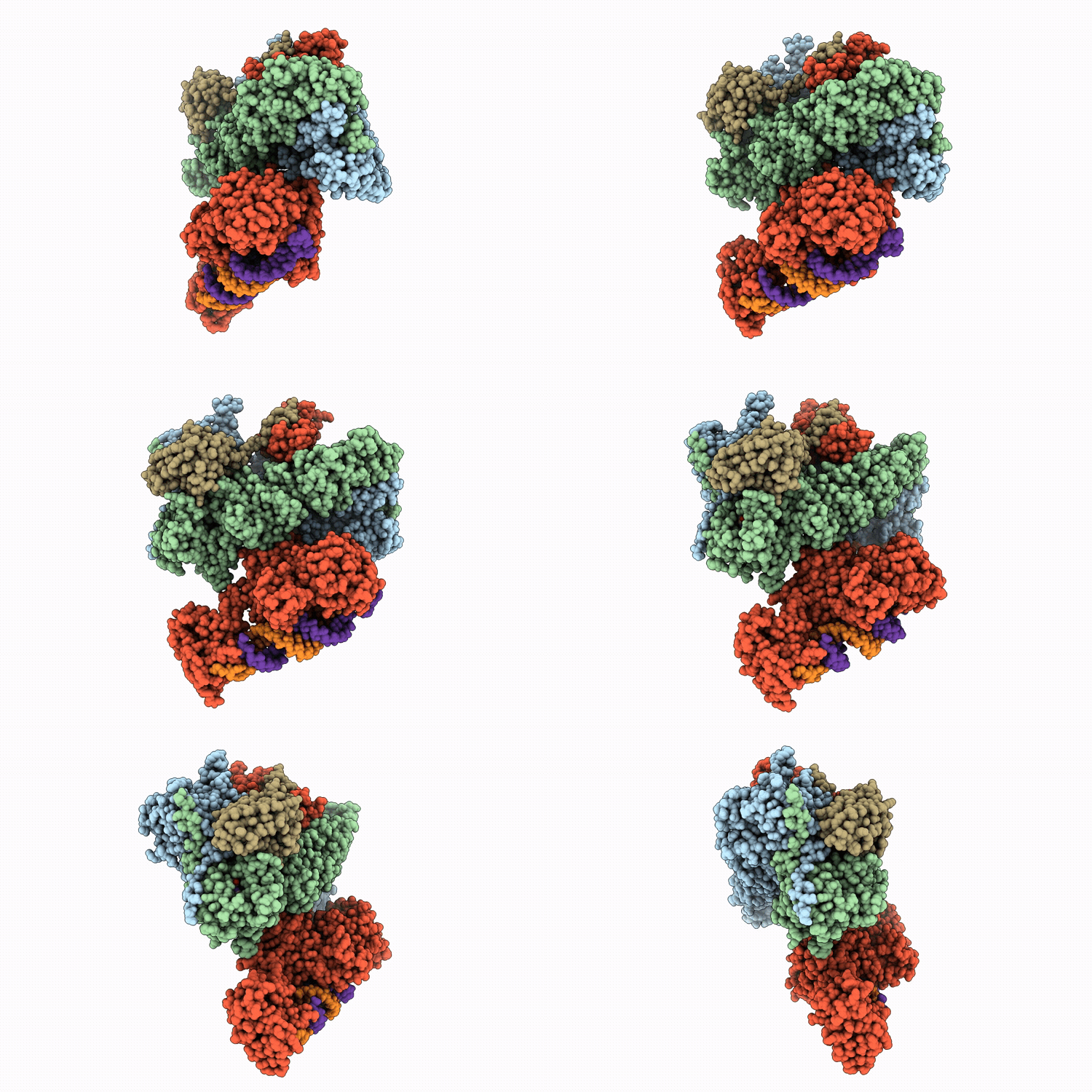
9W5I image
Deposition Date 2025-08-01
Release Date 2026-04-22
Last Version Date 2026-07-01
Entry Detail
PDB ID:
9W5I
Keywords:
Title:
AGO maturation complex (AMC): AGO2-miRNA duplex in complex with Hsp90 beta and co-chaperone p23
Biological Source:
Source Organism(s):
Homo sapiens (Taxon ID: 9606)
Expression System(s):
Method Details:
Experimental Method:
Resolution:
2.63 Å
Aggregation State:
PARTICLE
Reconstruction Method:
SINGLE PARTICLE
Macromolecular Entities
Polymer Type:polypeptide(L)
Molecule:Heat shock protein HSP 90-bet
Gene (Uniprot):HSP90AB1
Chain IDs:A, B
Chain Length:724
Number of Molecules:2
Biological Source:Homo sapiens
Polymer Type:polypeptide(L)
Molecule:Prostaglandin E synthase 3
Gene (Uniprot):PTGES3
Chain IDs:C
Chain Length:160
Number of Molecules:1
Biological Source:Homo sapiens
Polymer Type:polypeptide(L)
Molecule:Protein argonaute-2
Gene (Uniprot):AGO2
Chain IDs:D
Chain Length:859
Number of Molecules:1
Biological Source:Homo sapiens
Polymer Type:polyribonucleotide
Molecule:RNA (5'-R(P*UP*GP*AP*GP*GP*UP
Chain IDs:E
Chain Length:22
Number of Molecules:1
Biological Source:Homo sapiens
Polymer Type:polyribonucleotide
Molecule:RNA (5'-R(P*CP*UP*AP*UP*AP*CP
Chain IDs:F
Chain Length:22
Number of Molecules:1
Biological Source:Homo sapiens
Primary Citation
Structural basis for chaperone-guided assembly of RNA-induced silencing complex.
Nature ? ? ? (2026)
PMID: 42271054 DOI: 10.1038/s41586-026-10640-2

Abstact

The RNA-induced silencing complex (RISC), comprising an Argonaute (AGO) protein and a small RNA, is the central effector in RNA silencing. Small RNAs are loaded onto AGO as bulky duplexes in an HSP70- and HSP90-dependent process(1-3), but the molecular mechanism remains poorly understood. Here we identify the human AGO-HSP90-p23 complex, which captures AGO in an RNA-free state, termed the AGO maturation complex (AMC). The purified AMC enables RNA loading and AGO folding, faithfully recapitulating de novo RISC assembly. Using cryogenic electron microscopy, we determined the structure of AMC bound to a microRNA duplex. In contrast to its conformation in the RISC, AGO adopts a highly open conformation in the AMC: the N domain and the RNA-binding module (PAZ-MID-PIWI) are fully detached and anchored to opposite sides of the HSP90 dimer, connected solely by the unfolded L1 linker. This arrangement exposes a positively charged cleft that accommodates an RNA duplex. AGO folding is facilitated by a small RNA duplex containing a 5'-terminal phosphate-but not by single-stranded RNAs-revealing a role for the RNA duplex as a chaperone-like cofactor that directs AGO domain assembly. These findings elucidate the RISC assembly mechanism and establish the AMC as a molecular tool for probing optimal RNA features and chemical modifications for the rational design of small interfering RNA therapeutics. Our study also sheds light on how chaperones, together with ligands, can guide the folding of client proteins.

Legend

Protein

Chemical

Disease

Primary Citation of related structures
Feedback Form
Name
Email
Institute
Feedback