

9W4W image
Deposition Date 2025-08-01
Release Date 2026-03-25
Last Version Date 2026-04-29
Entry Detail
PDB ID:
9W4W
Keywords:
Title:
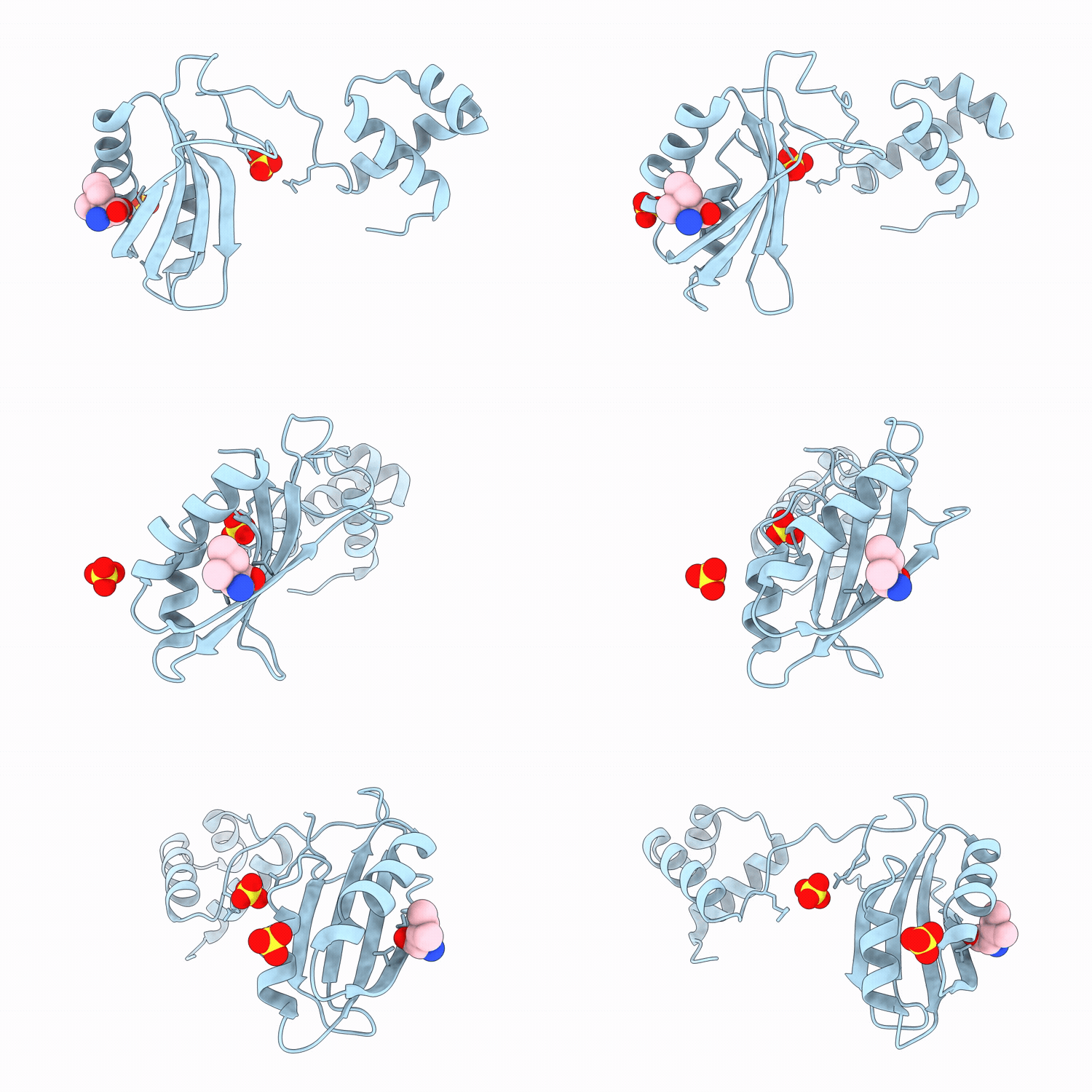
Structure of transcription factor in complex with L-Ile
Biological Source:
Source Organism(s):
Expression System(s):
Method Details:
Experimental Method:
Resolution:
1.39 Å
R-Value Free:
0.19
R-Value Work:
0.17
R-Value Observed:
0.17
Space Group:
I 4 2 2

Macromolecular Entities
Structures with similar UniProt ID
Protein Blast
Polymer Type:polypeptide(L)
Molecule:Uncharacterized HTH-type tran
Gene (Uniprot):PH0140
Chain IDs:A
Chain Length:178
Number of Molecules:1
Biological Source:Pyrococcus horikoshii
Primary Citation
A distinct gene expression mechanism for d-amino acid utilization in hyperthermophilic archaeon Pyrococcus horikoshii.
Febs J. ? ? ? (2026)
PMID: 41991193 DOI: 10.1111/febs.70545

Abstact

Growing the hyperthermophilic archaeon Pyrococcus horikoshii OT-3 in medium supplemented with d-allo-Ile instead of l-Ile markedly upregulates the activity of broad substrate specificity amino acid racemase (BAR). In P. horikoshii genome, the BAR gene (PH0138) forms a cluster with PH0137, which encodes a putative transporter protein, and PH0140 that encodes a feast/famine regulatory protein (FFRP), involved in the transcriptional regulation of metabolic pathway genes. Here, we performed gene expression, protein-DNA interaction, and crystallographic analyses to elucidate the expression mechanism of the BAR cluster. Gene expression analysis revealed that d-allo-Ile simultaneously induces PH0138 and PH0137. Electrophoretic mobility shift assays demonstrated that the PH0140 protein binds to the PH0137 promoter in the presence of l-Ile, but this interaction is disrupted by d-allo-Ile, identifying PH0140 as a d-amino acid-responsive regulatory protein (DARP). The crystal structures of DARP bound to l-Ile and d-allo-Ile were compared with those of another FFRP family member, P. horikoshii FL11. Our findings reveal a dimeric arrangement of l-Ile-bound DARP resembling the DNA-bound (open) form of FL11, whereas d-allo-Ile-bound DARP corresponds to the DNA-unbound (closed) form. These conformational changes result from subtle alterations in hydrogen bonding around the coregulators. Furthermore, cultivation in d-allo-Ile substitution medium only impacted the expression of PH0138 and PH0137, and not the other genes, suggesting that DARP regulates a more limited gene set than FL11. Cumulatively, these results reveal a distinct mechanism by which an FFRP homolog controls d-amino acid utilization.

Legend

Protein

Chemical

Disease

Primary Citation of related structures
Feedback Form
Name
Email
Institute
Feedback