

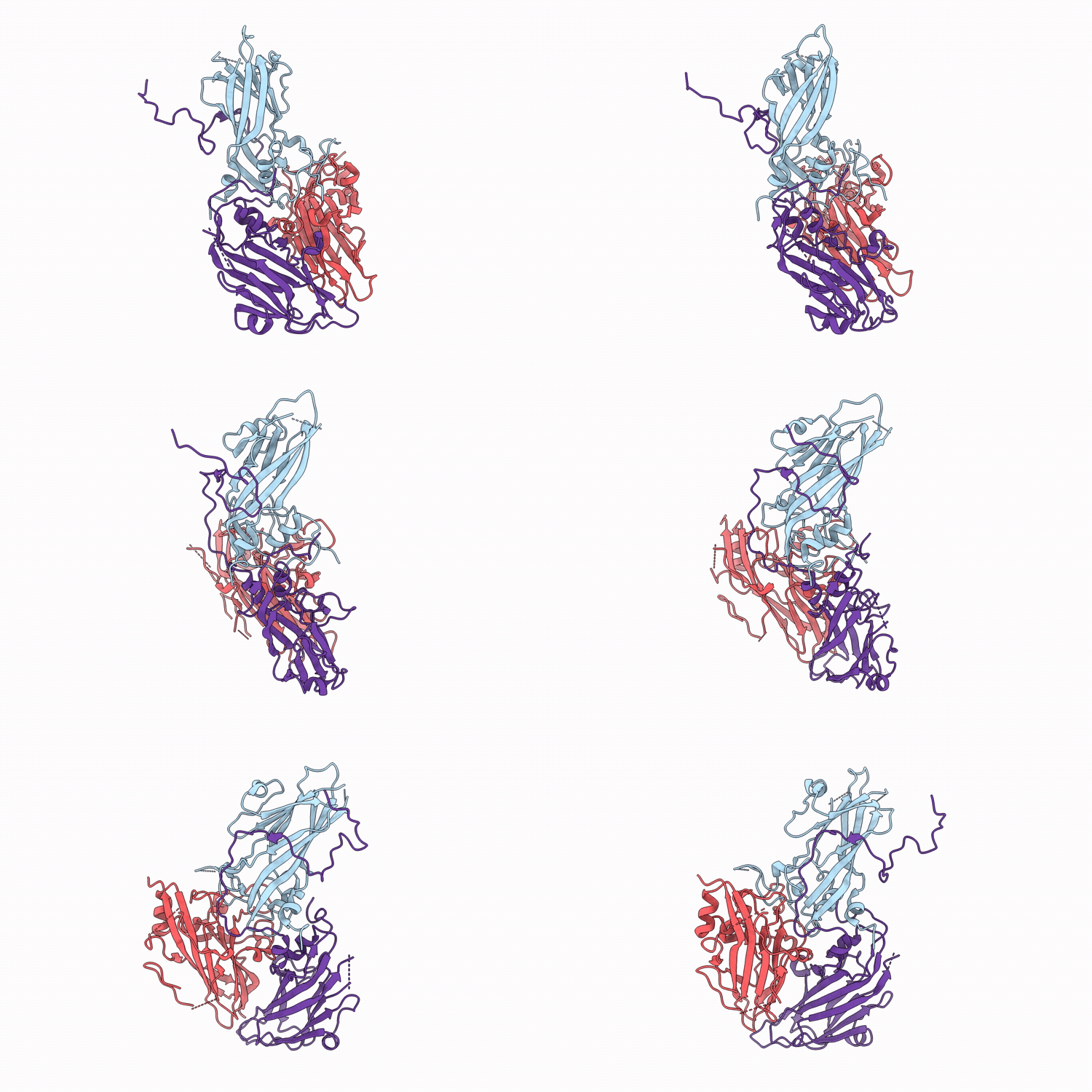
9W4I image
Deposition Date 2025-07-31
Release Date 2026-07-01
Last Version Date 2026-07-01
Entry Detail
PDB ID:
9W4I
Title:
Cryo-EM structure of Enterovirus-D68 MO strain virus-like particle
Biological Source:
Source Organism(s):
Expression System(s):
Method Details:
Experimental Method:
Resolution:
2.57 Å
Aggregation State:
PARTICLE
Reconstruction Method:
SINGLE PARTICLE
Macromolecular Entities
Structures with similar UniProt ID
Protein Blast
Polymer Type:polypeptide(L)
Molecule:Capsid protein VP1
Chain IDs:A
Chain Length:297
Number of Molecules:1
Biological Source:enterovirus D68
Structures with similar UniProt ID
Protein Blast
Polymer Type:polypeptide(L)
Molecule:Capsid protein VP0
Chain IDs:B
Chain Length:317
Number of Molecules:1
Biological Source:enterovirus D68
Structures with similar UniProt ID
Protein Blast
Polymer Type:polypeptide(L)
Molecule:Capsid protein VP3
Chain IDs:C
Chain Length:247
Number of Molecules:1
Biological Source:enterovirus D68
Ligand Molecules
Primary Citation
Comparative immunogenic and structural analysis of virus-like particle and inactivated whole-virion vaccines against enterovirus D68.
Mol Ther Nucleic Acids 37 102957 102957 (2026)
PMID: 42293247 DOI: 10.1016/j.omtn.2026.102957

Abstact

Enterovirus D68 (EV-D68) primarily causes respiratory illnesses and has been implicated in acute flaccid myelitis. Although virus-like particle (VLP) and traditional inactivated whole-virion (IWV) vaccines have demonstrated efficacy in mice, their immunological differences remain undetermined. Here, we directly compared the immunogenic and structural properties of VLP and IWV vaccines derived from the same EV-D68 strain under identical conditions. Although VLP induced significantly lower levels of EV-D68-specific IgG than IWV, neutralizing antibody titers and protective effects against viral challenge were comparable between the two groups in mice. Passive transfer experiments in neonatal mice further confirmed protection against lethal infection for both vaccine groups. Notably, in contrast to the IWV vaccine, the VLP vaccine elicited antibodies that preferentially recognized a limited subset of epitopes. Cryo-electron microscopy analyses revealed that VLPs structurally resemble the native virus but display distinct features in regions corresponding to epitopes that show differential antibody reactivity between VLP and IWV vaccines. By integrating structural and immunological analyses, we established a mechanistic framework linking capsid architecture to vaccine-induced antibody specificity. These findings suggest that VLP is a promising EV-D68 vaccine antigen with distinct epitope recognition profiles driven by structural characteristics.

Legend

Protein

Chemical

Disease

Primary Citation of related structures
Feedback Form
Name
Email
Institute
Feedback