

9W3Z image
Deposition Date 2025-07-30
Release Date 2026-04-08
Last Version Date 2026-04-15
Entry Detail
PDB ID:
9W3Z
Keywords:
Title:
Cryo-EM structure of the 4:4 Lac1-Lip1 complex
Biological Source:
Source Organism(s):
Expression System(s):
Method Details:
Experimental Method:
Resolution:
3.36 Å
Aggregation State:
PARTICLE
Reconstruction Method:
SINGLE PARTICLE
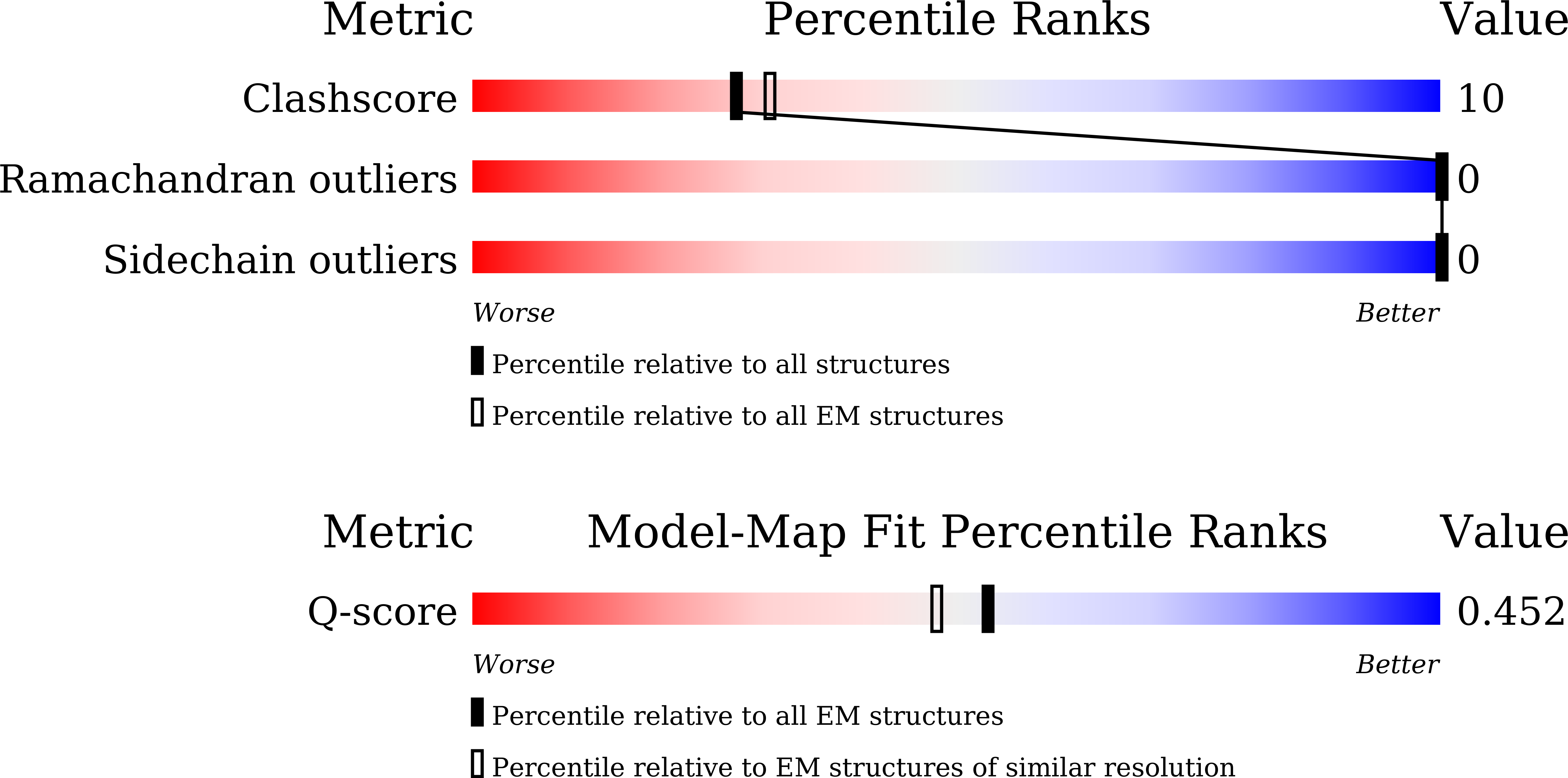
Macromolecular Entities
Structures with similar UniProt ID
Protein Blast
Polymer Type:polypeptide(L)
Molecule:Ceramide synthase LAC1
Gene (Uniprot):LAC1
Chain IDs:A, B (auth: C), E, F (auth: G)
Chain Length:428
Number of Molecules:4
Biological Source:Saccharomyces cerevisiae S288C
Structures with similar UniProt ID
Protein Blast
Polymer Type:polypeptide(L)
Molecule:Ceramide synthase subunit LIP
Gene (Uniprot):LIP1
Chain IDs:C (auth: B), D, G (auth: F), H
Chain Length:150
Number of Molecules:4
Biological Source:Saccharomyces cerevisiae S288C
Ligand Molecules
Primary Citation
Structural and functional dissection of a higher-order oligomerization interface in yeast ceramide synthase.
Nat Commun ? ? ? (2026)
PMID: 41917020 DOI: 10.1038/s41467-026-71272-8

Abstact

Ceramide synthases (CerSs) are crucial enzymes in sphingolipid metabolism and have shown therapeutic potential for treating various metabolic disorders. However, their regulatory mechanisms remain poorly understood. In this study, we report the cryo-electron microscopy structure of a yeast CerS (yCerS), composed of a catalytic Lac1 subunit and a regulatory Lip1 subunit, organized into a higher-order 4:4 assembly. This assembly is formed by dimerization of two 2:2 Lac1-Lip1 subcomplexes via an interface primarily involving the Lac1 subunit. Notably, within this interface, the C-terminal transmembrane helix (TM8) of Lac1 adopts a dramatically twisted conformation and engages in extensive interactions with TMs 6/7/8 of the adjacent Lac1 subunit. This structural rearrangement sterically occludes the catalytic chamber and blocks acyl-CoA substrate entry. Functional assays further demonstrate that, although structurally reminiscent of an autoinhibitory conformation, this interface is required for the regulation of ceramide output and cellular adaption during perturbation of complex sphingolipid biosynthesis. Together, our findings uncover a complex oligomerization-mediated regulatory mechanism in yCerS, advancing the mechanistic understanding of ceramide synthesis control and highlighting the nuanced role of oligomerization in modulating CerS activity.

Legend

Protein

Chemical

Disease

Primary Citation of related structures
Feedback Form
Name
Email
Institute
Feedback