

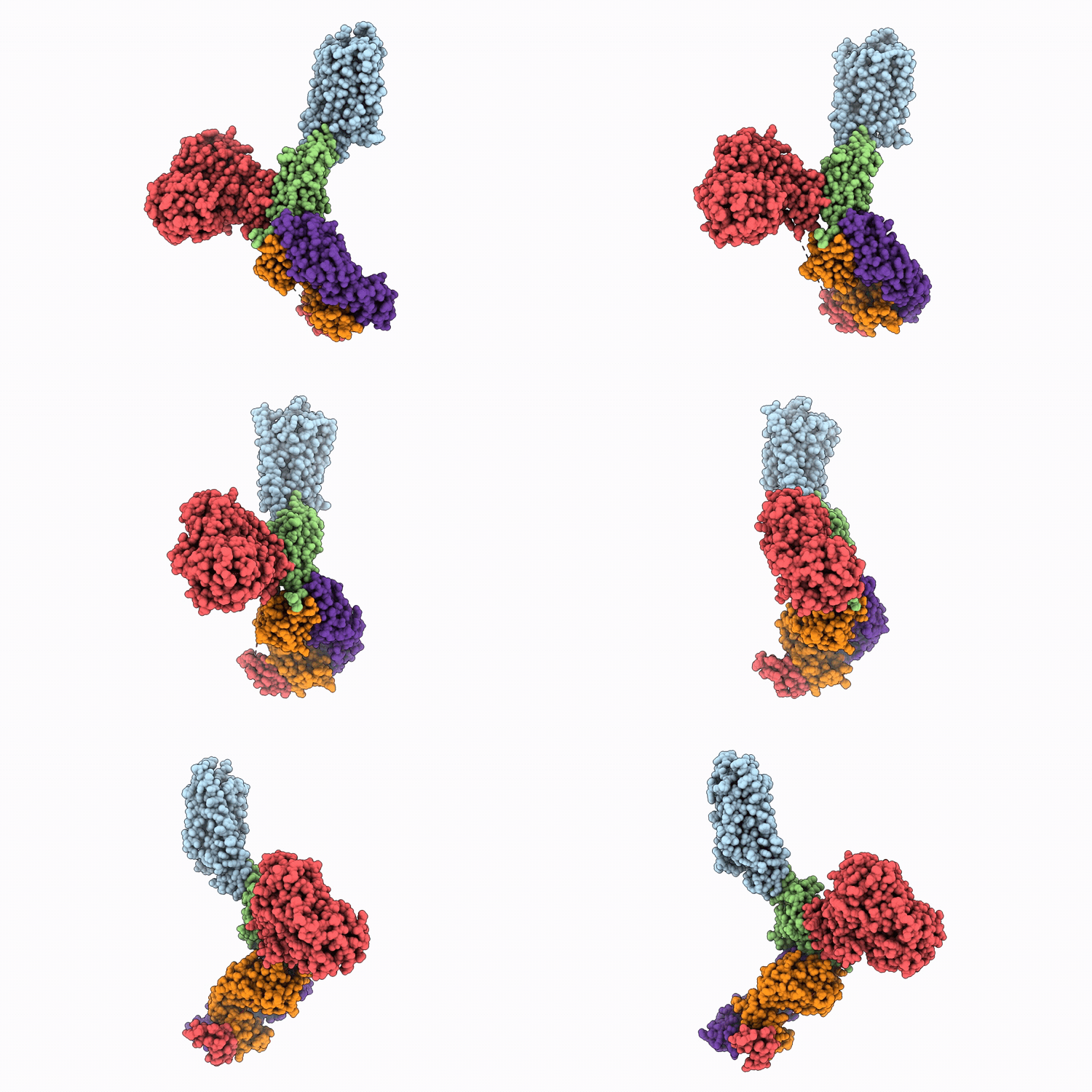
9W3K image
Deposition Date 2025-07-29
Release Date 2026-05-06
Last Version Date 2026-05-13
Entry Detail
PDB ID:
9W3K
Title:
GPR151-Legobody complex
Biological Source:
Method Details:
Experimental Method:
Resolution:
3.08 Å
Aggregation State:
PARTICLE
Reconstruction Method:
SINGLE PARTICLE
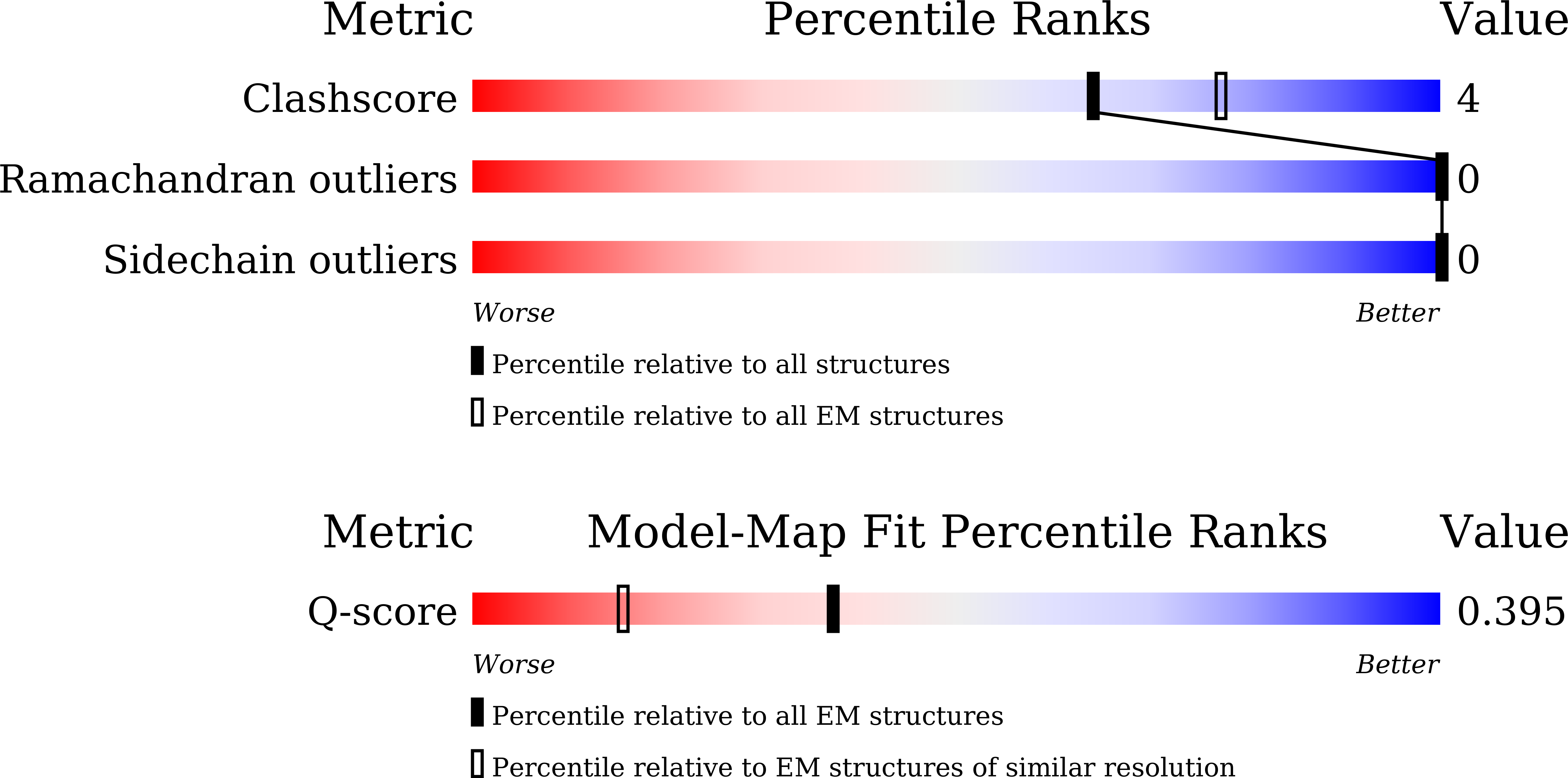
Macromolecular Entities
Structures with similar UniProt ID
Protein Blast
Polymer Type:polypeptide(L)
Molecule:G-protein coupled receptor 15
Gene (Uniprot):GPR151
Chain IDs:D (auth: A)
Chain Length:419
Number of Molecules:1
Biological Source:Homo sapiens
Protein Blast
Polymer Type:polypeptide(L)
Molecule:NB6
Chain IDs:E (auth: B)
Chain Length:127
Number of Molecules:1
Biological Source:Spodoptera frugiperda
Protein Blast
Polymer Type:polypeptide(L)
Molecule:Maltose/maltodextrin-binding
Gene (Uniprot):spg, spa, malE
Chain IDs:A (auth: C)
Chain Length:559
Number of Molecules:1
Biological Source:Escherichia coli O157:H7, Staphylococcus aureus, Staphylococcus aureus subsp. aureus Mu50, Streptococcus sp. 'group G'
Protein Blast
Polymer Type:polypeptide(L)
Molecule:Fab-8D3-2-H-His
Chain IDs:B (auth: H)
Chain Length:253
Number of Molecules:1
Biological Source:Homo sapiens
Protein Blast
Polymer Type:polypeptide(L)
Molecule:Fab_8D3_L
Chain IDs:C (auth: L)
Chain Length:239
Number of Molecules:1
Biological Source:Homo sapiens
Ligand Molecules
Primary Citation
Decoding the structure of GPR151 via NELiS.
Proc.Natl.Acad.Sci.USA 123 e2534234123 e2534234123 (2026)
PMID: 42085164 DOI: 10.1073/pnas.2534234123

Abstact

Structure determination of orphan G protein-coupled receptors (GPCRs) is hindered by lack of known ligands and their inherent instability during purification. Conventional thermostability screening requires ligands or purified protein, limiting its utility for orphan GPCRs. Here, we present the Nb6-Enabled Ligand-Free Stabilization Platform (NELiS)-a ligand- and purification-independent method for identifying stabilizing mutations. Applied to GPR151, an orphan GPCR enriched in habenula and implicated in neuropsychiatric disorders, NELiS identified four mutations that significantly improved thermostability and expression, allowing receptor purification. Using the stabilized and purified receptor, we further found a high-affinity, GPR151-specific nanobody that facilitated structural determination. Structural analysis revealed unconventional activation-resistant features across canonical motifs and an autoinhibitory N-terminal region occupying the orthosteric pocket. Functional studies confirmed a unique activation mechanism and the critical role of the N terminus in receptor maturation and trafficking. These results establish NELiS as a generalizable tool for structural and functional investigation of orphan GPCRs.

Legend

Protein

Chemical

Disease

Primary Citation of related structures
Feedback Form
Name
Email
Institute
Feedback