

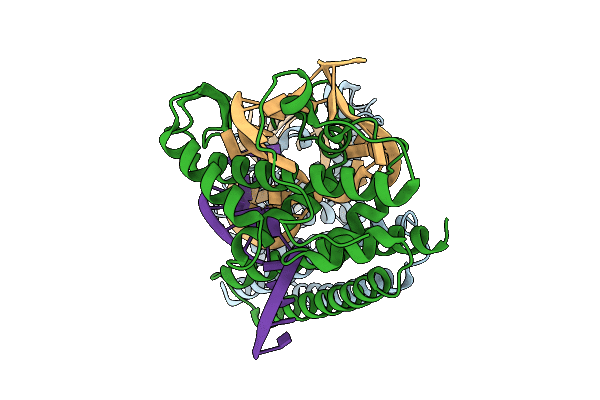
9W02 image
Deposition Date 2025-07-23
Release Date 2026-03-11
Last Version Date 2026-04-22
Entry Detail
PDB ID:
9W02
Title:
Cryo-EM structure of TasH-tigRNA-ssDNA complex
Biological Source:
Source Organism(s):
Expression System(s):
Method Details:
Experimental Method:
Resolution:
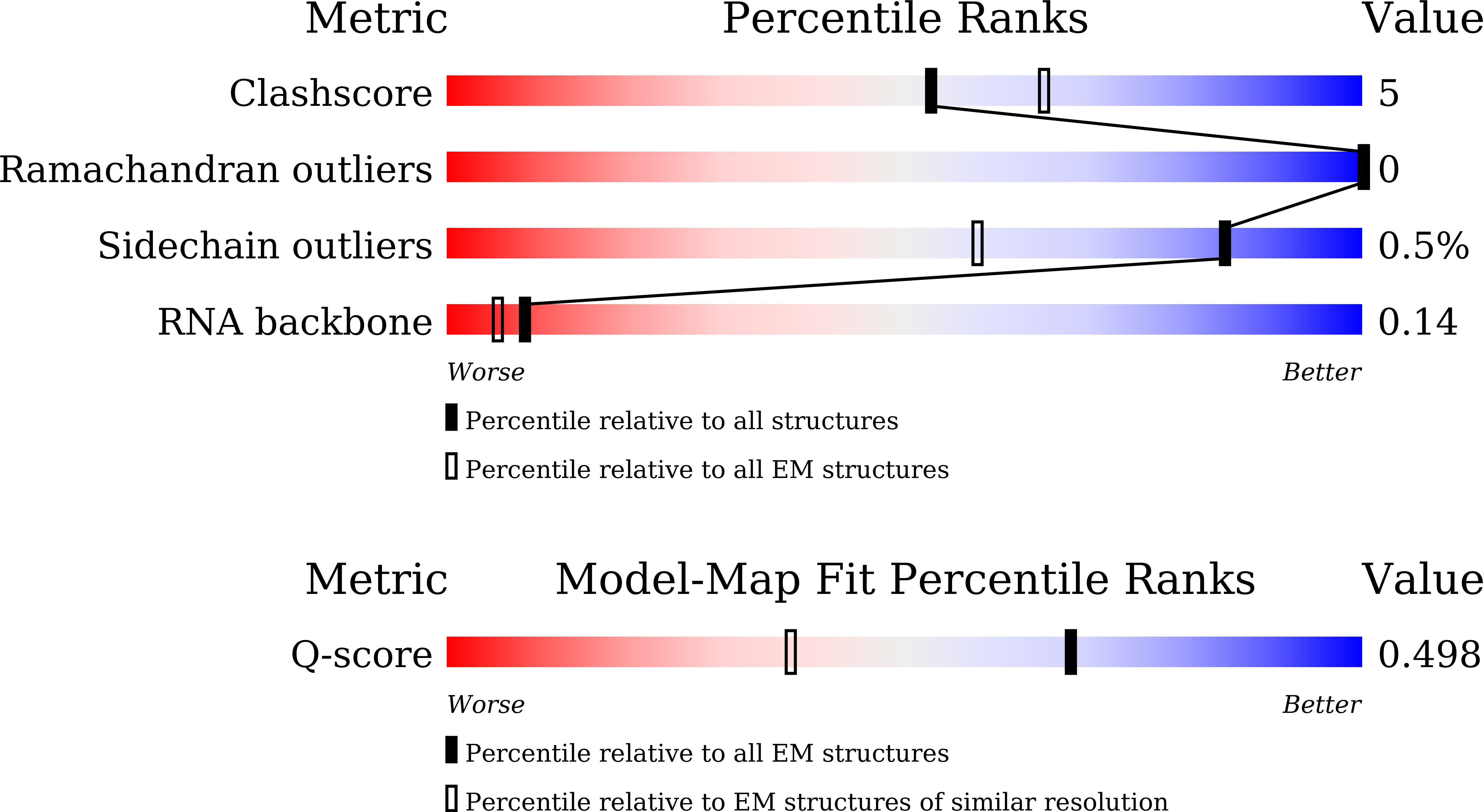
2.72 Å
Aggregation State:
PARTICLE
Reconstruction Method:
SINGLE PARTICLE
Macromolecular Entities
Structures with similar UniProt ID
Protein Blast
Polymer Type:polypeptide(L)
Molecule:HNH nuclease domain-containin
Chain IDs:A, B
Chain Length:354
Number of Molecules:2
Biological Source:Salicola phage CGphi29
Polymer Type:polyribonucleotide
Molecule:RNA (36-MER)
Chain IDs:C
Chain Length:37
Number of Molecules:1
Biological Source:Salicola phage CGphi29
Polymer Type:polydeoxyribonucleotide
Molecule:DNA (38-MER)
Chain IDs:D
Chain Length:38
Number of Molecules:1
Biological Source:Salicola phage CGphi29
Ligand Molecules
Primary Citation
Molecular basis for dual-spacer-guided target cleavage by the TIGR-TasH system.
Mol. Cell 86 1217 1229.e6 (2026)
PMID: 41831437 DOI: 10.1016/j.molcel.2026.02.017

Abstact

The RNA-directed programmable nuclease systems, exemplified by the CRISPR-Cas system, have been widely used in genome editing. In contrast to the single-spacer configuration of CRISPR RNA (crRNA), the guide RNA (tigRNA) of the tandem interspaced guide RNA (TIGR) system features a dual-spacer arrangement, thereby directing the TIGR-associated (Tas) protein to engage both strands of the target double-stranded DNA (dsDNA). Here, we determine six cryo-electron microscopy structures of the Salicola phage TIGR-TasH complex. The central coiled-coil region of TasH mediates dimerization, while the C-terminal nucleolar protein (Nop) domain is able to autonomously process precursor tigRNA. Upon target binding, the dynamic N-terminal HNH nuclease domain is recruited for cleavage through a beta-hairpin, which also determines the target preference. More interestingly, the conserved box C motif of tigRNA stabilizes this beta-hairpin in an adenine-specific manner, enabling us to rationally design a guide RNA-defined nickase, distinct from conventional protein-based nickase strategies used in genome editing.

Legend

Protein

Chemical

Disease

Primary Citation of related structures
Feedback Form
Name
Email
Institute
Feedback