

9VUE image
Deposition Date 2025-07-13
Release Date 2026-06-17
Last Version Date 2026-06-17
Entry Detail
PDB ID:
9VUE
Keywords:
Title:
Structure of human proteasome ATPase-CP intermediate assembles with 15min rapaprotin addition
Biological Source:
Source Organism(s):
Homo sapiens (Taxon ID: 9606)
Expression System(s):
Method Details:
Experimental Method:
Resolution:
3.80 Å
Aggregation State:
PARTICLE
Reconstruction Method:
SINGLE PARTICLE
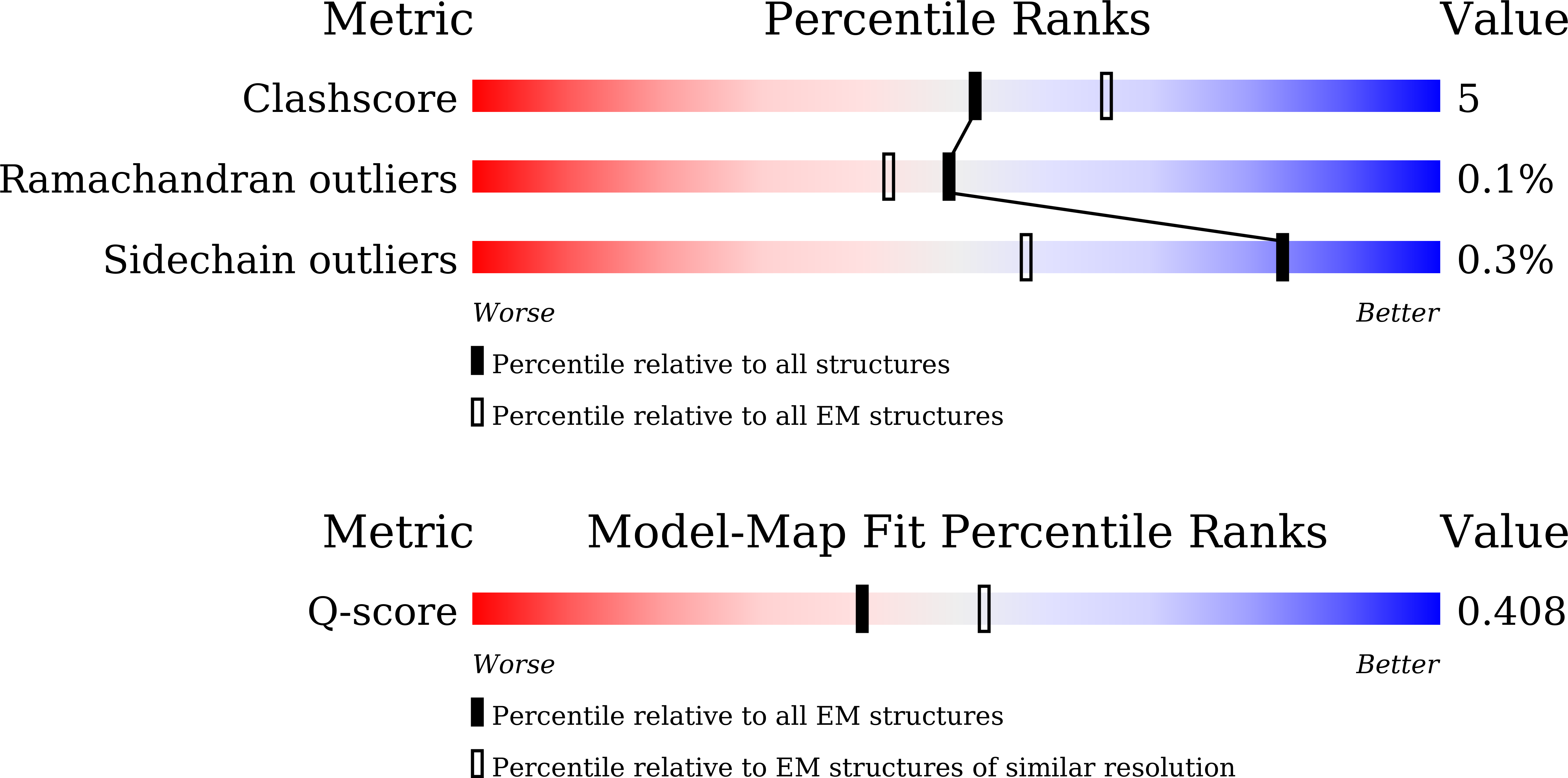
Macromolecular Entities
Structures with similar UniProt ID
Protein Blast
Polymer Type:polypeptide(L)
Molecule:26S proteasome regulatory sub
Gene (Uniprot):PSMC2
Chain IDs:A
Chain Length:433
Number of Molecules:1
Biological Source:Homo sapiens
Structures with similar UniProt ID
Protein Blast
Polymer Type:polypeptide(L)
Molecule:26S proteasome regulatory sub
Gene (Uniprot):PSMC1
Chain IDs:B
Chain Length:440
Number of Molecules:1
Biological Source:Homo sapiens
Structures with similar UniProt ID
Protein Blast
Polymer Type:polypeptide(L)
Molecule:26S proteasome regulatory sub
Gene (Uniprot):PSMC5
Chain IDs:C
Chain Length:406
Number of Molecules:1
Biological Source:Homo sapiens
Structures with similar UniProt ID
Protein Blast
Polymer Type:polypeptide(L)
Molecule:26S proteasome regulatory sub
Gene (Uniprot):PSMC4
Chain IDs:D
Chain Length:418
Number of Molecules:1
Biological Source:Homo sapiens
Structures with similar UniProt ID
Protein Blast
Polymer Type:polypeptide(L)
Molecule:26S proteasome regulatory sub
Gene (Uniprot):PSMC6
Chain IDs:E
Chain Length:389
Number of Molecules:1
Biological Source:Homo sapiens
Structures with similar UniProt ID
Protein Blast
Polymer Type:polypeptide(L)
Molecule:26S proteasome regulatory sub
Gene (Uniprot):PSMC3
Chain IDs:F
Chain Length:439
Number of Molecules:1
Biological Source:Homo sapiens
Structures with similar UniProt ID
Protein Blast
Polymer Type:polypeptide(L)
Molecule:Proteasome subunit alpha type
Gene (Uniprot):PSMA6
Chain IDs:G, U (auth: g)
Chain Length:246
Number of Molecules:2
Biological Source:Homo sapiens
Structures with similar UniProt ID
Protein Blast
Polymer Type:polypeptide(L)
Molecule:Proteasome subunit alpha type
Gene (Uniprot):PSMA2
Chain IDs:H, V (auth: h)
Chain Length:234
Number of Molecules:2
Biological Source:Homo sapiens
Structures with similar UniProt ID
Protein Blast
Polymer Type:polypeptide(L)
Molecule:Proteasome subunit alpha type
Gene (Uniprot):PSMA4
Chain IDs:I, W (auth: i)
Chain Length:261
Number of Molecules:2
Biological Source:Homo sapiens
Structures with similar UniProt ID
Protein Blast
Polymer Type:polypeptide(L)
Molecule:Proteasome subunit alpha type
Gene (Uniprot):PSMA7
Chain IDs:J, X (auth: j)
Chain Length:248
Number of Molecules:2
Biological Source:Homo sapiens
Structures with similar UniProt ID
Protein Blast
Polymer Type:polypeptide(L)
Molecule:Proteasome subunit alpha type
Gene (Uniprot):PSMA5
Chain IDs:K, Y (auth: k)
Chain Length:241
Number of Molecules:2
Biological Source:Homo sapiens
Structures with similar UniProt ID
Protein Blast
Polymer Type:polypeptide(L)
Molecule:Isoform Long of Proteasome su
Gene (Uniprot):PSMA1
Chain IDs:L, Z (auth: l)
Chain Length:269
Number of Molecules:2
Biological Source:Homo sapiens
Structures with similar UniProt ID
Protein Blast
Polymer Type:polypeptide(L)
Molecule:Proteasome subunit alpha type
Gene (Uniprot):PSMA3
Chain IDs:M, AA (auth: m)
Chain Length:255
Number of Molecules:2
Biological Source:Homo sapiens
Structures with similar UniProt ID
Protein Blast
Polymer Type:polypeptide(L)
Molecule:Proteasome subunit beta type-
Gene (Uniprot):PSMB6
Chain IDs:N, BA (auth: n)
Chain Length:239
Number of Molecules:2
Biological Source:Homo sapiens
Structures with similar UniProt ID
Protein Blast
Polymer Type:polypeptide(L)
Molecule:Proteasome subunit beta type-
Gene (Uniprot):PSMB7
Chain IDs:O, CA (auth: o)
Chain Length:277
Number of Molecules:2
Biological Source:Homo sapiens
Structures with similar UniProt ID
Protein Blast
Polymer Type:polypeptide(L)
Molecule:Proteasome subunit beta type-
Gene (Uniprot):PSMB3
Chain IDs:P, DA (auth: p)
Chain Length:205
Number of Molecules:2
Biological Source:Homo sapiens
Structures with similar UniProt ID
Protein Blast
Polymer Type:polypeptide(L)
Molecule:Proteasome subunit beta type-
Gene (Uniprot):PSMB2
Chain IDs:Q, EA (auth: q)
Chain Length:201
Number of Molecules:2
Biological Source:Homo sapiens
Structures with similar UniProt ID
Protein Blast
Polymer Type:polypeptide(L)
Molecule:Proteasome subunit beta type-
Gene (Uniprot):PSMB5
Chain IDs:R, FA (auth: r)
Chain Length:263
Number of Molecules:2
Biological Source:Homo sapiens
Structures with similar UniProt ID
Protein Blast
Polymer Type:polypeptide(L)
Molecule:Proteasome subunit beta type-
Gene (Uniprot):PSMB1
Chain IDs:S, GA (auth: s)
Chain Length:241
Number of Molecules:2
Biological Source:Homo sapiens
Structures with similar UniProt ID
Protein Blast
Polymer Type:polypeptide(L)
Molecule:Proteasome subunit beta type-
Gene (Uniprot):PSMB4
Chain IDs:T, HA (auth: t)
Chain Length:264
Number of Molecules:2
Biological Source:Homo sapiens
Primary Citation
Rapaprotin, an Endopeptidase-Activated Proteasome Inhibitor that Induces 26S Disassembly.
Angew.Chem.Int.Ed.Engl. 64 e202500288 e202500288 (2025)
PMID: 40960209 DOI: 10.1002/anie.202500288

Abstact

The 19S regulatory particle (RP) associates with the 20S core particle (CP) to form the 26S proteasome, an evolutionarily conserved holoenzyme that plays key roles in both physiological and pathological processes. Proteasome inhibitors that target the catalytic subunits within the 20S have proven to be valuable research tools and therapeutics for various cancers. Herein we report the discovery of rapaprotin, a 26S proteasome assembly inhibitor from our natural product-inspired hybrid macrocycle rapafucin library. Rapaprotin induces apoptosis in both myeloma and leukemia cell lines. Genome-wide CRISPR-Cas9 screen identified a cytosolic enzyme, prolyl endopeptidase (PREP) that is required for the pro-apoptotic activity of rapaprotin. Further mechanistic studies revealed that rapaprotin acts as a molecular transformer, changing from an inactive cyclic form into an active linear form, rapaprotin-L, upon PREP cleavage, to block 26S proteasome activity. Time-resolved cryogenic electron microscopy (cryo-EM) revealed that rapaprotin-L induces dissociation of the 19S RP from the 26S holoenzyme, which was verified in cells. Furthermore, rapaprotin exhibits a marked synergistic effect with FDA-approved proteasome inhibitors and resensitizes drug-resistant multiple myeloma cells from patients to bortezomib. Taken together, these results suggest that rapaprotin is a new chemical tool to probe the dynamics of the 26S proteasome assembly and a promising anticancer drug lead.

Legend

Protein

Chemical

Disease

Primary Citation of related structures
Feedback Form
Name
Email
Institute
Feedback