

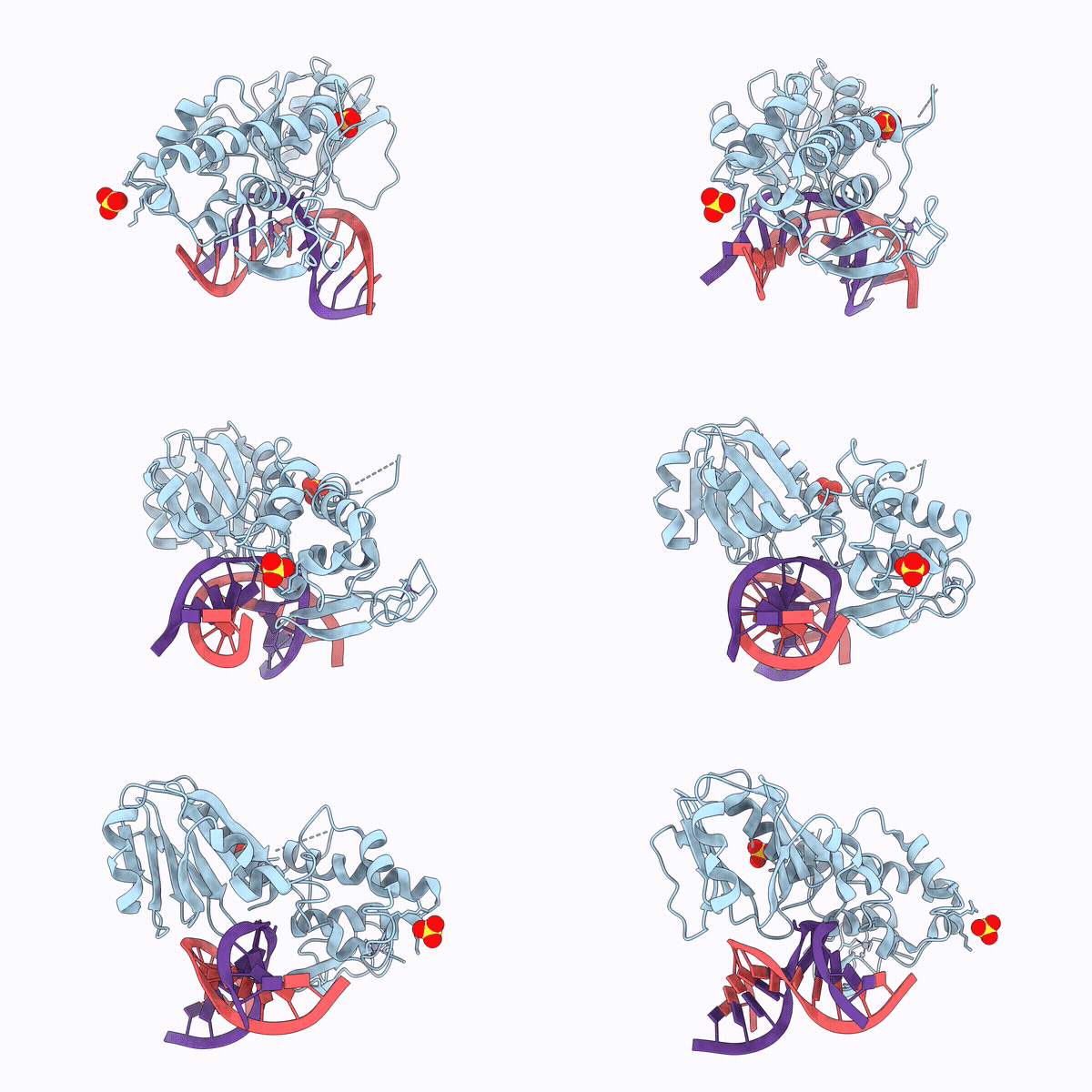
9VR4 image
Deposition Date 2025-07-06
Release Date 2026-10-07
Last Version Date 2026-10-14
Entry Detail
PDB ID:
9VR4
Keywords:
Title:
Trapped reaction intermediate of the DNA Repair Enzyme Endonuclease VIII with DNA containing T opposite the crosslink
Biological Source:
Source Organism(s):
Expression System(s):
Method Details:
Experimental Method:
Resolution:
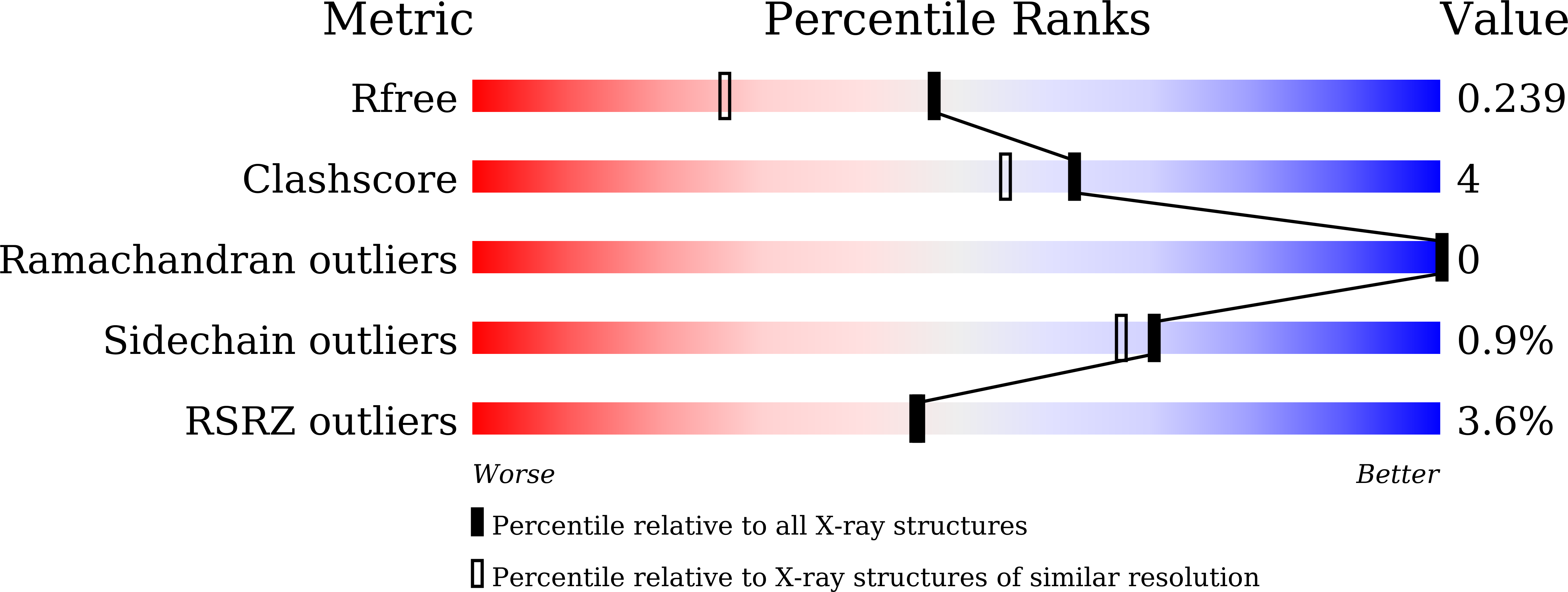
1.80 Å
R-Value Free:
0.23
R-Value Work:
0.20
R-Value Observed:
0.20
Space Group:
P 43 2 2
Macromolecular Entities
Polymer Type:polypeptide(L)
Molecule:Endonuclease 8
Gene (Uniprot):nei
Chain IDs:A
Chain Length:262
Number of Molecules:1
Biological Source:Escherichia coli BL21
Polymer Type:polydeoxyribonucleotide
Molecule:DNA (5'-D(*GP*GP*CP*TP*TP*CP*
Chain IDs:B
Chain Length:13
Number of Molecules:1
Biological Source:synthetic construct
Polymer Type:polydeoxyribonucleotide
Molecule:DNA (5'-D(*CP*CP*AP*GP*GP*AP*
Chain IDs:C
Chain Length:13
Number of Molecules:1
Biological Source:synthetic construct
Primary Citation
Unique structural mode for opposite-base tolerance in endonuclease VIII.
DNA Repair (Amst) 167 103962 103962 (2026)
PMID: 42804861 DOI: 10.1016/j.dnarep.2026.103962

Abstact

Endonuclease VIII (Nei) is a DNA repair enzyme with broad substrate specificity for oxidative lesions, excising damaged bases paired with any normal base. The structural basis for this opposite-base tolerance is unknown, since only the structure of the Nei-DNA complex with A opposite the lesion had been determined. Here we address this question by solving crystal structures of Escherichia coli Nei conjugates with DNA duplexes containing C, G, or T opposite the lesion. While estranged purine bases are recognized by Nei via a non-specific hydrogen bond to N3, pyrimidine bases undergo a 180 degrees rotation into the syn conformation. In this unique orientation, their Watson-Crick edge faces the major groove, forming no specific contacts with Nei. Substrates with 5-hydroxyuracil opposite T analogs carrying bulky C5-substitutions are cleaved by Nei less efficiently, consistent with the intrahelical location of the C5-C6 edge of the estranged pyrimidine bases. We have also identified several hydrogen bond networks within the Nei molecule that may facilitate accommodation of different DNA structures and stabilize the catalytic conformation of the enzyme. The mechanism of opposite-base tolerance through pyrimidine flipping is unprecedented among DNA glycosylases and may allow Nei to recognize a wide spectrum of oxidative lesions.

Legend

Protein

Chemical

Disease

Primary Citation of related structures
Feedback Form
Name
Email
Institute
Feedback