

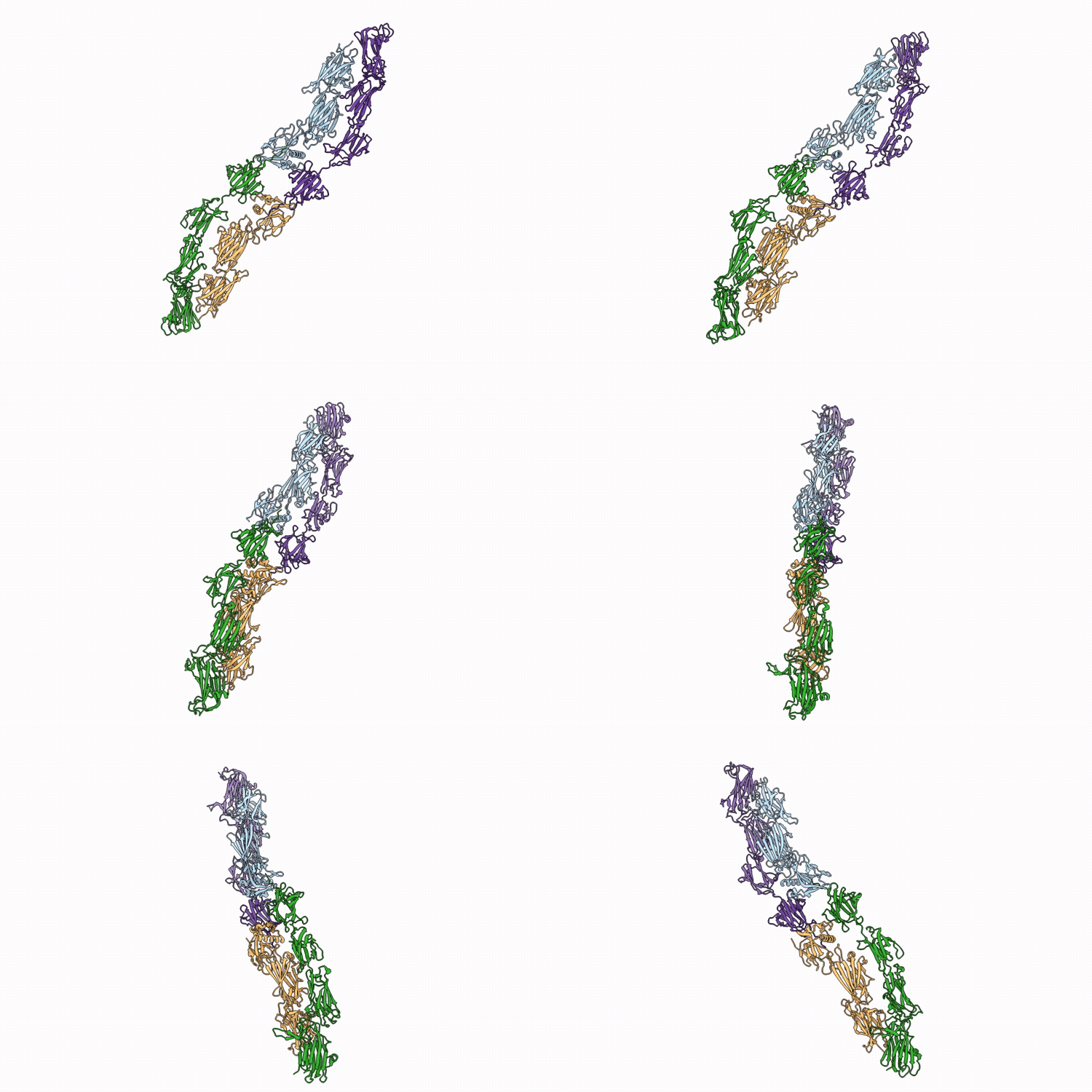
9VO4 image
Deposition Date 2025-07-01
Release Date 2026-07-01
Last Version Date 2026-09-23
Entry Detail
PDB ID:
9VO4
Title:
X-ray structure of Clostridium perfringens pili CppB-CppA covalent complex
Biological Source:
Source Organism(s):
Expression System(s):
Method Details:
Experimental Method:
Resolution:
3.31 Å
R-Value Free:
0.28
R-Value Work:
0.25
R-Value Observed:
0.25
Space Group:
P 1 21 1
Macromolecular Entities
Polymer Type:polypeptide(L)
Molecule:Probable surface protein
Gene (Uniprot):CPE0156
Chain IDs:A, C
Chain Length:453
Number of Molecules:2
Biological Source:Clostridium perfringens str. 13
Polymer Type:polypeptide(L)
Molecule:SpaA-like prealbumin fold dom
Gene (Uniprot):CPE0155
Chain IDs:B, D
Chain Length:657
Number of Molecules:2
Biological Source:Clostridium perfringens str. 13
Ligand Molecules
Primary Citation
Dynamic motion of bacterial surface pili based on structural analyses of covalently linked complexes formed by tip and shaft pili proteins from Clostridium perfringens.
Febs J. ? ? ? (2026)
PMID: 42740687 DOI: 10.1111/febs.70722

Abstact

The pathogenesis and infectivity of Gram-positive bacteria are mediated by many surface proteins covalently attached to the bacterial cell wall. Pili are types of surface appendages that play important roles in the initial adhesion of bacterial cells to host tissues and bacterial colonization. The Gram-positive bacterium Clostridium perfringens (C. perfringens), one of the pathogenic clostridial species causing gas gangrene and food poisoning, has sortase-mediated pili composed of shaft/major pilin A (CppA) and tip/minor pilin B (CppB). The pilus shaft is formed by covalent polymerization of CppA, and CppB is covalently attached to the tip of the shaft involved in adhesion to the host cell. The formation of covalent bonds between CppB and CppA, as well as between CppA and CppA, is catalyzed by class C sortase (CpSrtC), a member of the cysteine transpeptidase family. Since pili consistently have CppB at their tip, CpSrtC is the enzyme that preferentially catalyzes the attachment of CppB (tip) to CppA (shaft) rather than polymerization of CppAs by an unknown mechanism. We determined the structures of complexes formed by covalently linking CppB and CppA by X-ray crystallography and cryo-EM analysis. The complexes have an elongated structure in which beta-sandwich folded domains are sequentially arranged, and an amide bond between Thr688 of CppB and Lys174 of CppA was clearly identified. The determined structures allowed us to construct a three-dimensional structure model with dynamic motion of C. perfringens pili, and proposed new insights into the mechanism by which CppB is preferentially attached to CppA.

Legend

Protein

Chemical

Disease

Primary Citation of related structures
Feedback Form
Name
Email
Institute
Feedback