

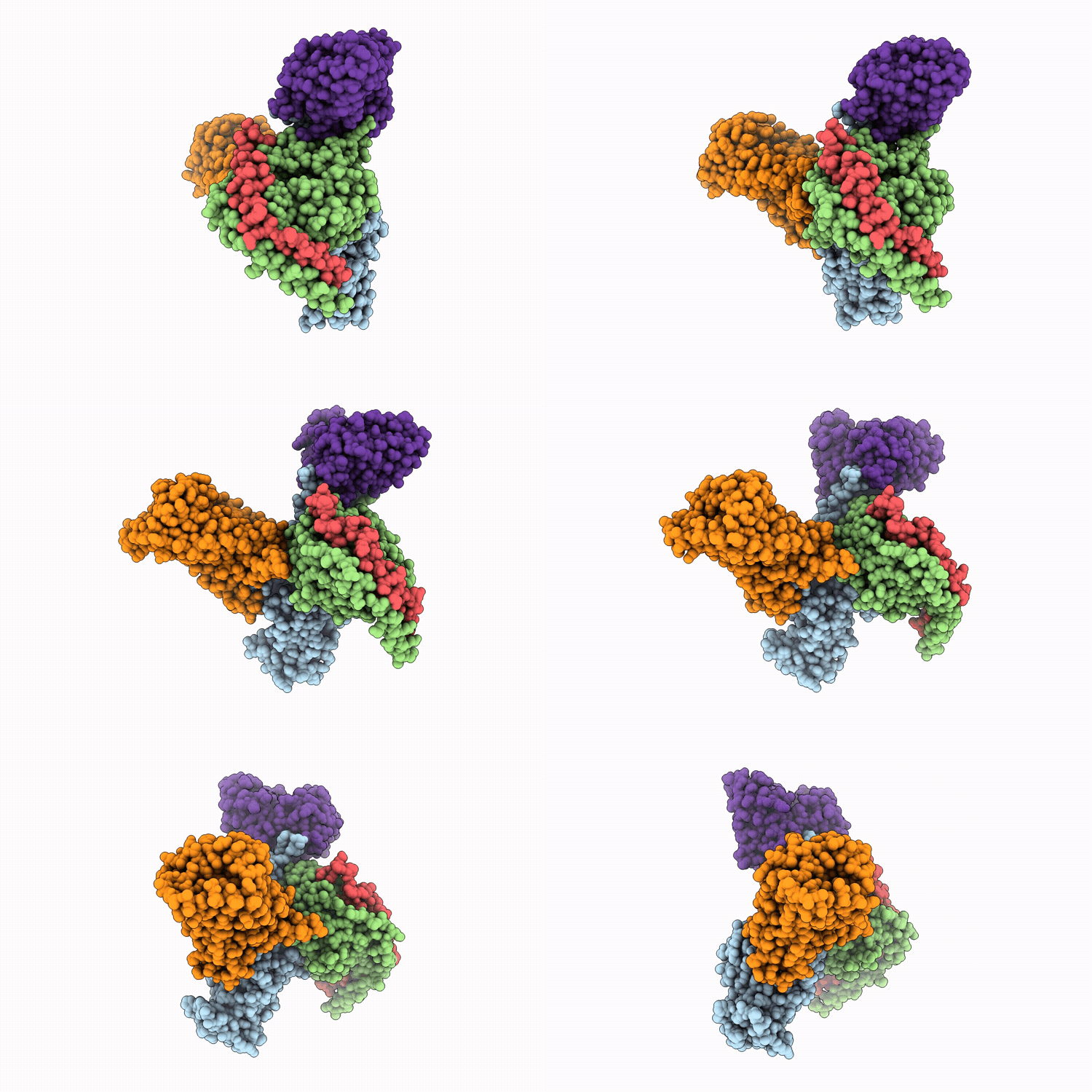
9VO2 image
Deposition Date 2025-07-01
Release Date 2026-03-18
Last Version Date 2026-04-15
Entry Detail
PDB ID:
9VO2
Title:
Cryo-EM structure of the OXGR1(CA)-Gq complex
Biological Source:
Source Organism(s):
Expression System(s):
Method Details:
Experimental Method:
Resolution:
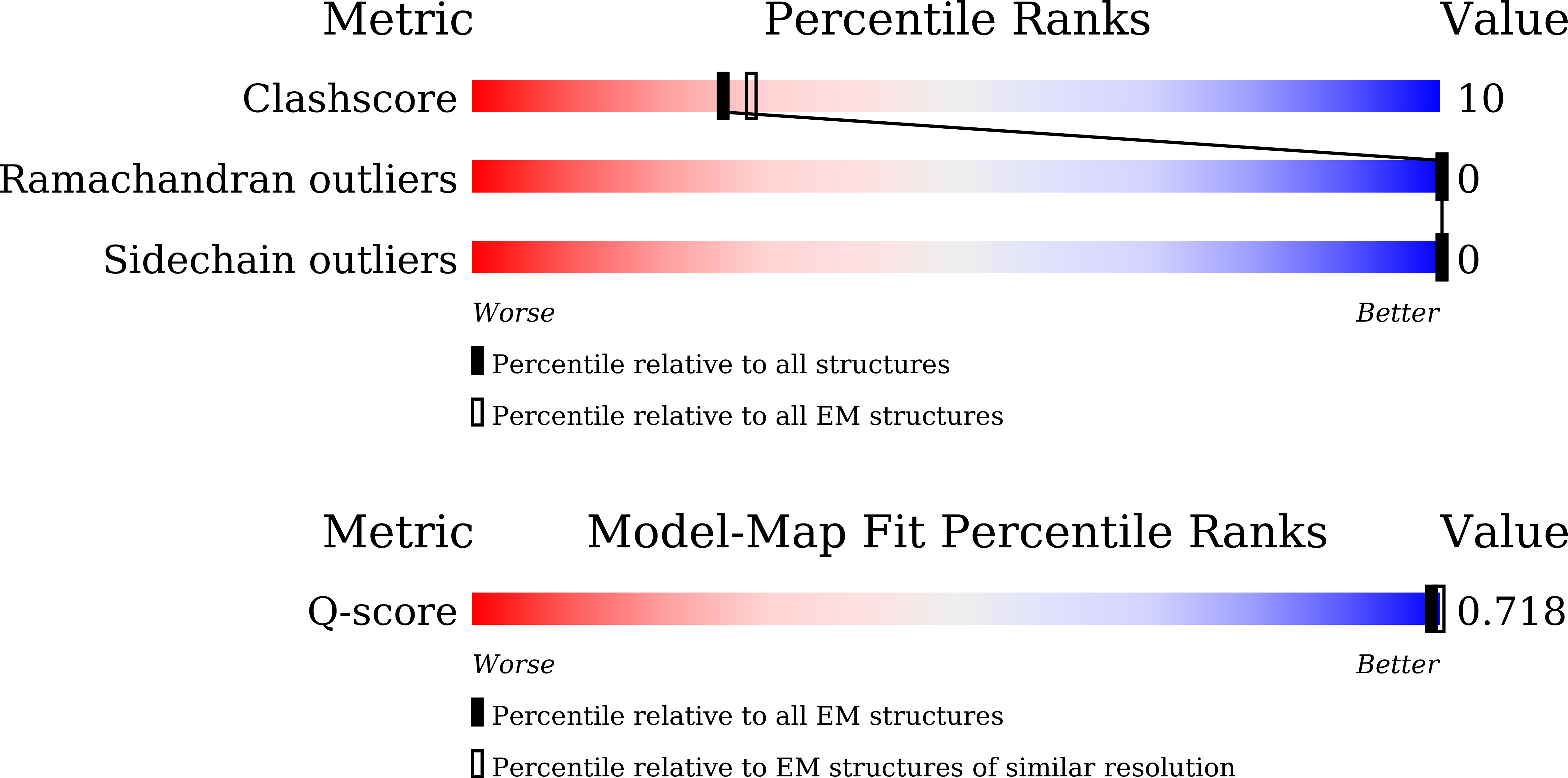
2.70 Å
Aggregation State:
PARTICLE
Reconstruction Method:
SINGLE PARTICLE
Macromolecular Entities
Protein Blast
Polymer Type:polypeptide(L)
Molecule:Guanine nucleotide-binding pr
Chain IDs:A
Chain Length:370
Number of Molecules:1
Biological Source:Homo sapiens
Structures with similar UniProt ID
Protein Blast
Polymer Type:polypeptide(L)
Molecule:Guanine nucleotide-binding pr
Gene (Uniprot):GNB1
Chain IDs:B
Chain Length:338
Number of Molecules:1
Biological Source:Homo sapiens
Structures with similar UniProt ID
Protein Blast
Polymer Type:polypeptide(L)
Molecule:Guanine nucleotide-binding pr
Gene (Uniprot):GNG2
Chain IDs:C (auth: G)
Chain Length:59
Number of Molecules:1
Biological Source:Homo sapiens
Structures with similar UniProt ID
Protein Blast
Polymer Type:polypeptide(L)
Molecule:2-oxoglutarate receptor 1
Gene (Uniprot):OXGR1
Chain IDs:D (auth: R)
Chain Length:337
Number of Molecules:1
Biological Source:Homo sapiens
Protein Blast
Polymer Type:polypeptide(L)
Molecule:scFv16
Chain IDs:E (auth: S)
Chain Length:285
Number of Molecules:1
Biological Source:synthetic construct
Ligand Molecules
Primary Citation
Metabolite-gated vascular contractility switch: OXGR1 activation mechanism enables agonist therapy for rosacea erythema.
Cell 189 1990 2006.e30 (2026)
PMID: 41791372 DOI: 10.1016/j.cell.2026.01.036

Abstact

Rosacea, an inflammatory skin disorder, poses a dilemma owing to limited effectiveness of treatments for pathological vasodilation-mediated erythema. Here, we identify oxoglutaric acid (alpha-KG) as a rosacea-associated metabolite elevated in patients and correlated with erythema severity. Exogenous alpha-KG administration ameliorates rosacea-like manifestations in murine models. Mechanistically, alpha-KG activates OXGR1, a vascular smooth muscle cell (VSMC)-enriched G protein-coupled receptor (GPCR) to induce Gq signaling and enhance MYL9 phosphorylation, promoting VSMC contraction and limiting vasodilation. Cryo-electron microscopy (cryo-EM) structures of OXGR1-Gq complexes bound to alpha-KG or itaconate reveal a specific bipartite-acid pocket recognizing its endogenous agonist and an activation mechanism distinct from classical GPCRs. Building on these structures, we developed A-1, a synthetic selective OXGR1 agonist that mitigates erythema and inflammation with efficacy comparable to first-line therapy while offering enhanced safety in rosacea-like models. These findings link a metabolite to vascular dysfunction and nominate OXGR1 agonism for precision treatment of erythema and vascular disorders.

Legend

Protein

Chemical

Disease

Primary Citation of related structures
Feedback Form
Name
Email
Institute
Feedback