

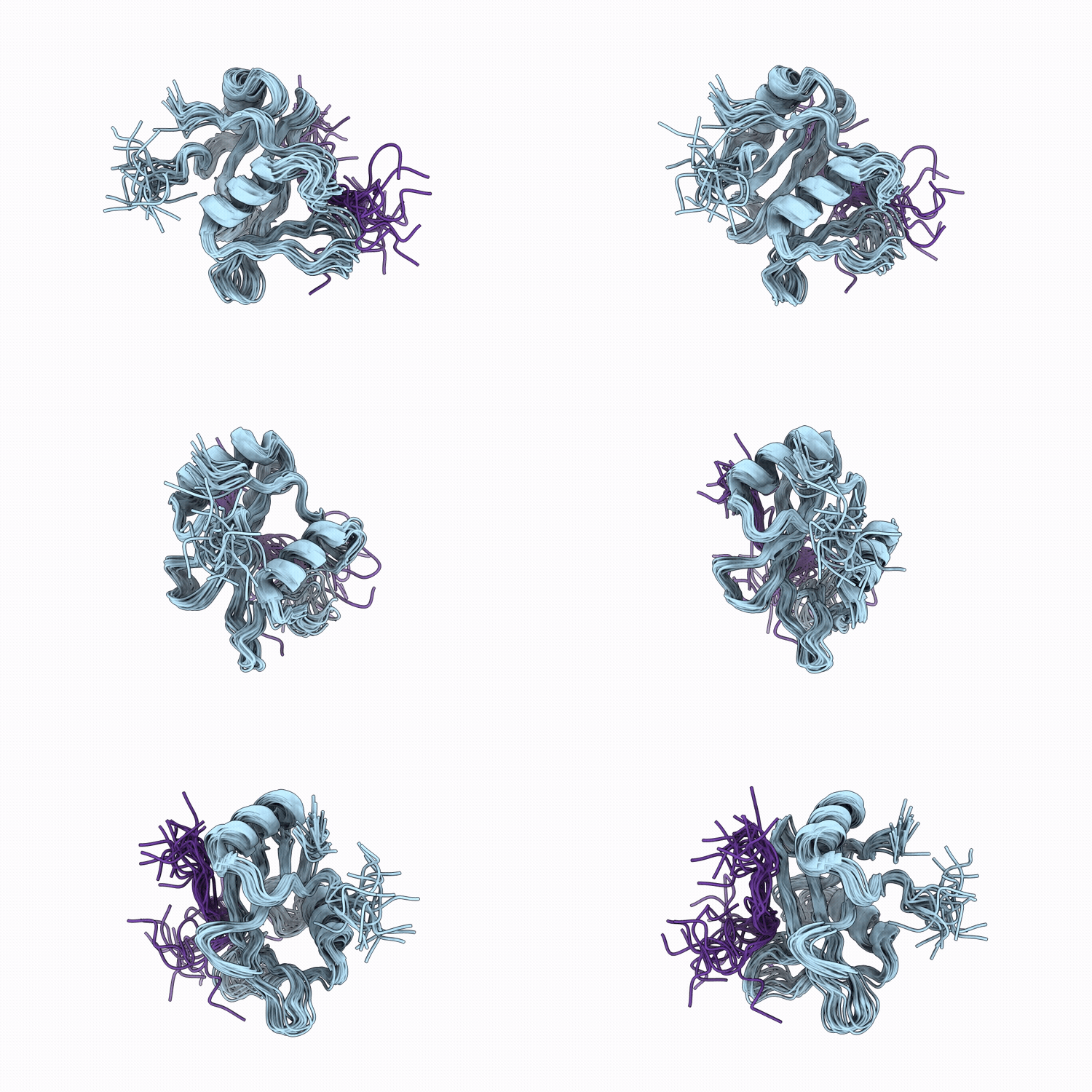
9VJL image
Deposition Date 2025-06-20
Release Date 2026-03-25
Last Version Date 2026-03-25
Entry Detail
PDB ID:
9VJL
Keywords:
Title:
Phosphorylation dependent recognition of RIPK1 by phosphatidylinositol 3,4,5-trisphosphate 5-phosphatase 1
Biological Source:
Source Organism(s):
Mus musculus (Taxon ID: 10090)
Expression System(s):
Method Details:
Experimental Method:
Conformers Calculated:
200
Conformers Submitted:
20
Selection Criteria:
structures with the lowest energy

Macromolecular Entities
Structures with similar UniProt ID
Protein Blast
Polymer Type:polypeptide(L)
Molecule:Phosphatidylinositol 3,4,5-tr
Gene (Uniprot):Inpp5d
Chain IDs:A
Chain Length:106
Number of Molecules:1
Biological Source:Mus musculus
Structures with similar UniProt ID
Protein Blast
Polymer Type:polypeptide(L)
Molecule:Receptor-interacting serine/t
Gene (Uniprot):Ripk1
Chain IDs:B
Chain Length:16
Number of Molecules:1
Biological Source:Mus musculus
Modified Residue
Compound ID Chain ID Parent Comp ID Details 2D Image
PTR B TYR modified residue
Ligand Molecules
Primary Citation
Repression of RIPK1 kinase by INPP5D inhibits expression of diverse proinflammatory mediators and late-onset Alzheimer's disease risk factors.
Immunity 59 419 437.e11 (2026)
PMID: 41633359 DOI: 10.1016/j.immuni.2026.01.014

Abstact

Genome-wide association studies strongly implicate neuroinflammation in late-onset Alzheimer's disease (LOAD). Genetic risk loci for LOAD are enriched for genes expressed in microglia, but the relationship among microglial LOAD risk genes has been unclear. We found that the N-terminal SH2 domain of INPP5D, an important LOAD risk gene, directly interacted with the cell death regulator RIPK1 at p-Y383 to suppress RIPK1 kinase activation. Microglial INPP5D deficiency cell-autonomously promoted RIPK1-mediated transcriptional induction of diverse LOAD risk genes, proinflammatory cytokines, complements, and ROS mediators, as well as proinflammatory signaling mediators such as Toll-like receptors (TLRs), MyD88, Nlrp3, gasdermin D, and Zbp1. RIPK1-regulated microglial transcriptomic signatures were found in microglial subtypes implicated in human Alzheimer's disease (AD) pathogenesis. Furthermore, microglial INPP5D deficiency promoted aging-dependent RIPK1-mediated development of neuronal TDP-43 pathology, neuronal loss, and motor dysfunction in a non-cell-autonomous manner. Our data suggest that INPP5D functions as an intracellular rheostat in regulating RIPK1-mediated neuroinflammation for promoting aging-related neurodegenerative diseases, including LOAD and AD-amyotrophic lateral sclerosis comorbidity.

Legend

Protein

Chemical

Disease

Primary Citation of related structures
Feedback Form
Name
Email
Institute
Feedback