

9VJJ image
Deposition Date 2025-06-20
Release Date 2026-02-04
Last Version Date 2026-03-18
Entry Detail
PDB ID:
9VJJ
Keywords:
Title:
Crystal Structure of human Latent TGF-beta1 in complex with SOF10
Biological Source:
Source Organism(s):
Homo sapiens (Taxon ID: 9606)
Expression System(s):
Method Details:
Experimental Method:
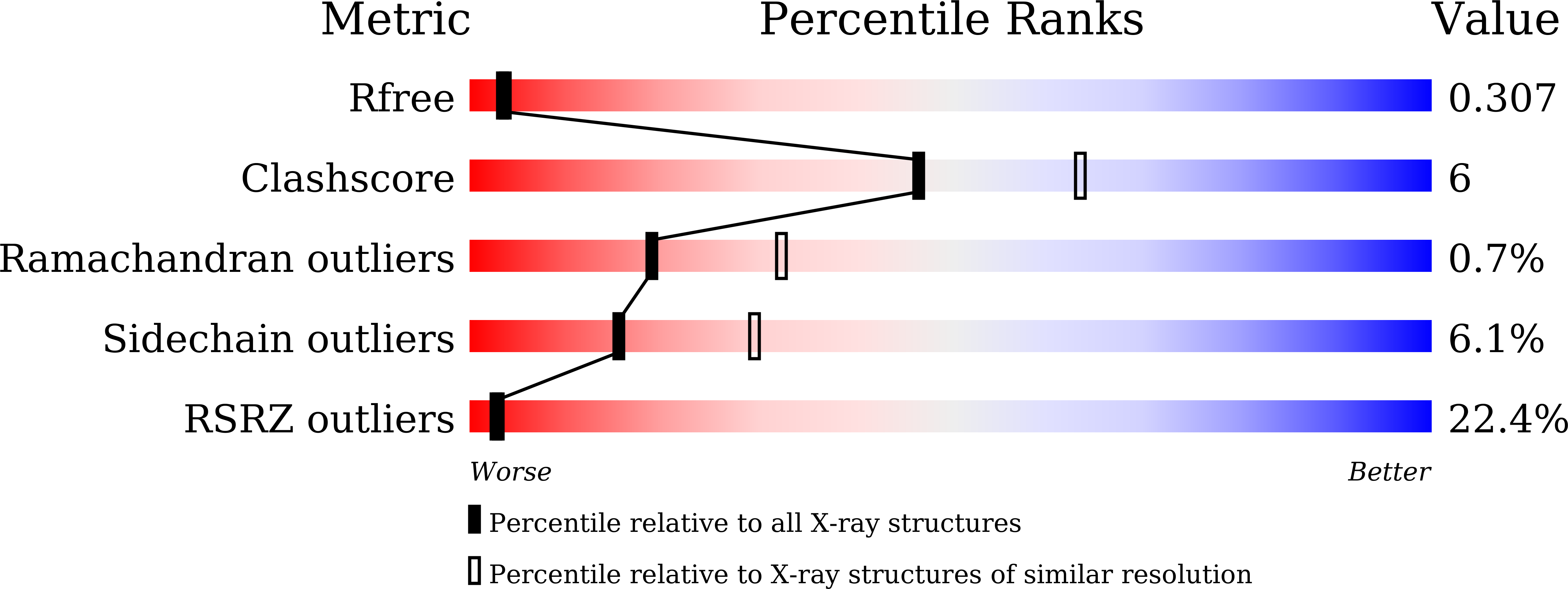
Resolution:
2.48 Å
R-Value Free:
0.30
R-Value Work:
0.28
R-Value Observed:
0.28
Space Group:
C 1 2 1
Macromolecular Entities
Structures with similar UniProt ID
Protein Blast
Polymer Type:polypeptide(L)
Molecule:Transforming growth factor be
Gene (Uniprot):TGFB1
Mutagens:C33S
Chain IDs:A, B
Chain Length:369
Number of Molecules:2
Biological Source:Homo sapiens
Protein Blast
Polymer Type:polypeptide(L)
Molecule:SOF10 Fab heavy chain
Chain IDs:C (auth: H), D (auth: I)
Chain Length:227
Number of Molecules:2
Biological Source:Homo sapiens
Protein Blast
Polymer Type:polypeptide(L)
Molecule:SOF10 Fab light chain
Chain IDs:E (auth: L), F (auth: M)
Chain Length:215
Number of Molecules:2
Biological Source:Homo sapiens
Primary Citation
Selective blockade of latent TGF-beta 1 activation suppresses tissue fibrosis with good safety.
Commun Med (Lond) 6 ? ? (2026)
PMID: 41606188 DOI: 10.1038/s43856-026-01408-w

Abstact

BACKGROUND: Fibrosis is a hallmark of organ failure observed after chronic epithelial injury and inflammation. The transforming growth factor beta (TGF-beta) is the master regulator of fibrogenesis, so blockade of the TGF-beta pathway is a potential treatment strategy for fibrosis; however, the therapeutic potential of pan-TGF-beta blockade is limited by side effects. METHODS: We generated SOF10, a humanized antibody that targets latent TGF-beta1 and selectively blocks protease- and integrin alphavbeta8-mediated latent TGF-beta1 activation. We conducted gene expression and histological analyses in nonalcoholic steatohepatitis (NASH)/liver fibrosis and renal interstitial fibrosis models. We also evaluated the combination effect of SOF10 with an immune checkpoint inhibitor in a syngeneic mouse model and performed safety studies in mice and monkeys. RESULTS: Here we show that SOF10 reduces fibrosis in NASH/liver fibrosis and renal interstitial fibrosis models and improves renal function in a chronic kidney disease model. Furthermore, the combination of SOF10 with an anti-PD-L1 antibody decreases tumor growth in a syngeneic mouse model. SOF10 demonstrates safety in both mice and monkeys. CONCLUSIONS: Selective blockade of latent TGF-beta1 activation represents a promising approach for treating a broad range of fibrotic diseases and cancers. By specifically targeting TGF-beta1, SOF10 may offer a safer and more effective therapeutic option compared to non-selective TGF-beta inhibitors. This strategy has the potential to transform the treatment paradigm for fibrosis-related conditions.

Legend

Protein

Chemical

Disease

Primary Citation of related structures
Feedback Form
Name
Email
Institute
Feedback