

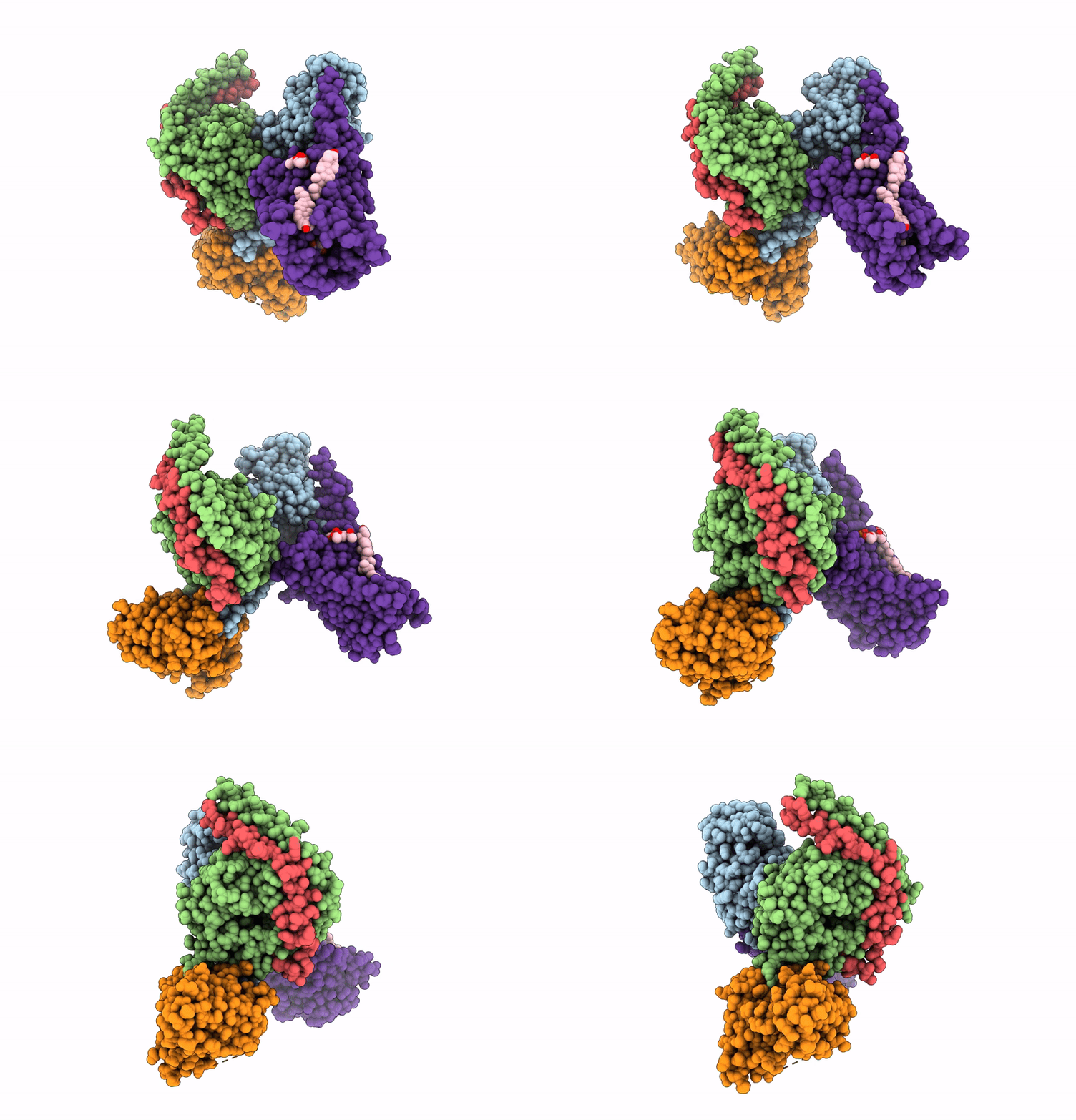
9VJF image
Deposition Date 2025-06-19
Release Date 2025-11-12
Last Version Date 2026-04-01
Entry Detail
PDB ID:
9VJF
Title:
Cryo-EM structure of 5-HT1AR-Gi3 in complex with buspirone
Biological Source:
Source Organism(s):
Homo sapiens (Taxon ID: 9606)
Mus musculus (Taxon ID: 10090)
Expression System(s):
Method Details:
Experimental Method:
Resolution:
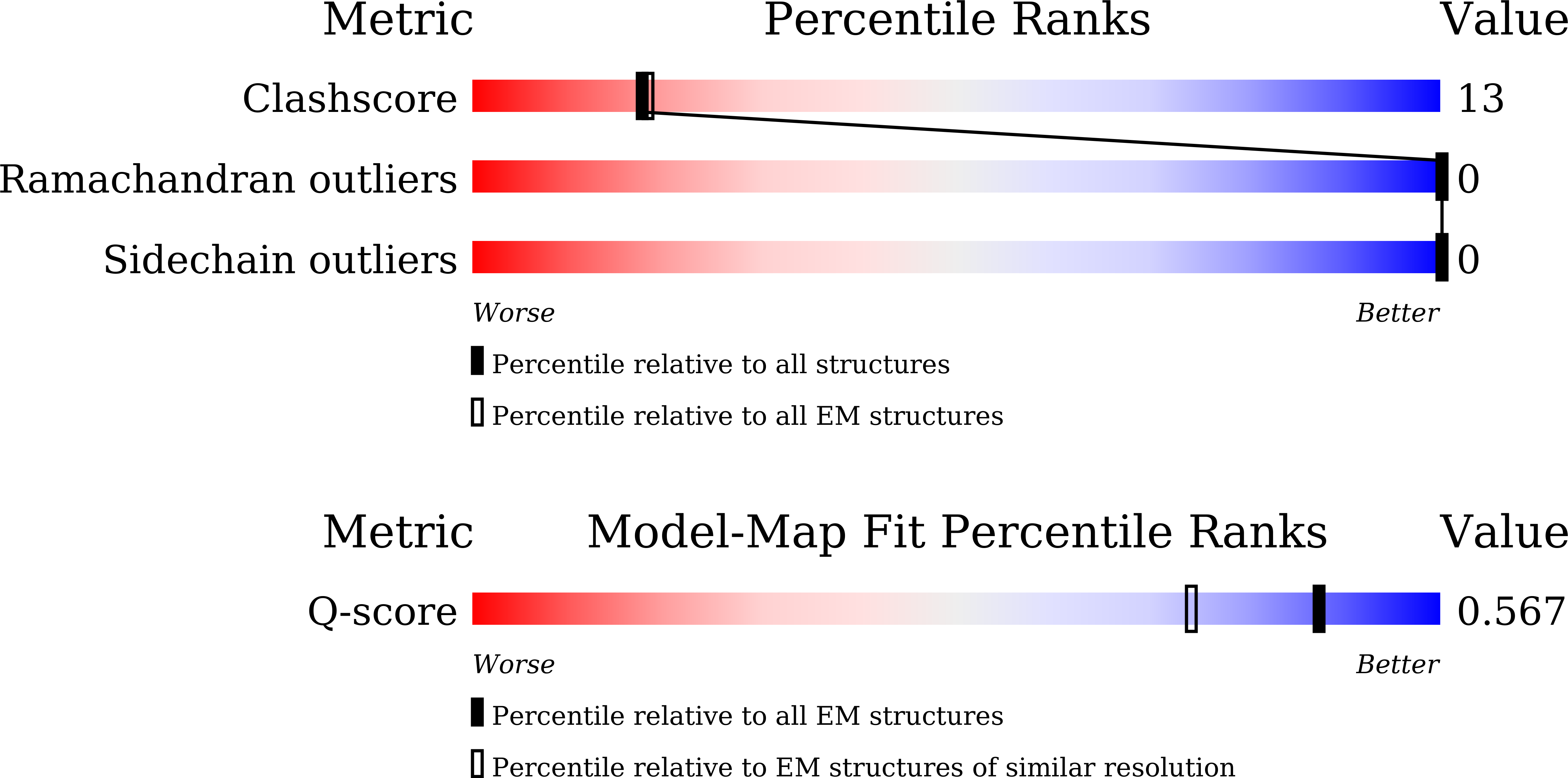
2.70 Å
Aggregation State:
PARTICLE
Reconstruction Method:
SINGLE PARTICLE
Macromolecular Entities
Structures with similar UniProt ID
Protein Blast
Polymer Type:polypeptide(L)
Molecule:Guanine nucleotide-binding pr
Gene (Uniprot):GNAI3
Chain IDs:A (auth: B)
Chain Length:354
Number of Molecules:1
Biological Source:Homo sapiens
Structures with similar UniProt ID
Protein Blast
Polymer Type:polypeptide(L)
Molecule:Guanine nucleotide-binding pr
Gene (Uniprot):GNB1
Chain IDs:B (auth: C)
Chain Length:358
Number of Molecules:1
Biological Source:Homo sapiens
Structures with similar UniProt ID
Protein Blast
Polymer Type:polypeptide(L)
Molecule:Guanine nucleotide-binding pr
Gene (Uniprot):GNG2
Chain IDs:C (auth: D)
Chain Length:71
Number of Molecules:1
Biological Source:Homo sapiens
Protein Blast
Polymer Type:polypeptide(L)
Molecule:scFv16
Chain IDs:D (auth: E)
Chain Length:251
Number of Molecules:1
Biological Source:Mus musculus
Protein Blast
Polymer Type:polypeptide(L)
Molecule:Soluble cytochrome b562,5-hyd
Gene (Uniprot):HTR1A, cybC
Chain IDs:E (auth: R)
Chain Length:549
Number of Molecules:1
Biological Source:Homo sapiens
Primary Citation
Pathway-selective 5-HT 1A R agonist as a rapid antidepressant strategy.
Cell 188 7222 7237.e24 (2025)
PMID: 41232528 DOI: 10.1016/j.cell.2025.10.022

Abstact

Presynaptic 5-HT(1A)R autoreceptors predominantly signal through G(i3) protein, mediating feedback inhibition that hampers the therapeutic efficacy of conventional antidepressants. By contrast, postsynaptic heteroreceptors mainly couple to G(o), which promotes antidepressant responses. However, selectively activating heteroreceptors while bypassing the negative feedback induced by autoreceptors remains a significant challenge. Here, we characterized the G(i/o) subtype signaling profiles of 5-HT(1A)R and determined its structures in complex with six agonists and three distinct G(i/o) family proteins: G(oA), G(i3), and G(z). Combined with functional analysis, we elucidated the mechanisms underlying diverse agonist recognition modes and G(i/o) subtype signaling selectivity of 5-HT(1A)R. Furthermore, we designed a pathway-selective agonist, TMU4142, which exhibits high G(oA) activity while minimizing G(i3) activation. Remarkably, TMU4142 demonstrated rapid antidepressant-like effects in a mouse model of depression. Collectively, these findings suggest that distinguishing heteroreceptors from autoreceptors based on their distinct downstream G(i/o) signaling pathways could be a promising strategy to develop fast-acting antidepressants.

Legend

Protein

Chemical

Disease

Primary Citation of related structures
Feedback Form
Name
Email
Institute
Feedback