

9VII image
Deposition Date 2025-06-18
Release Date 2026-06-24
Last Version Date 2026-06-24
Entry Detail
PDB ID:
9VII
Keywords:
Title:
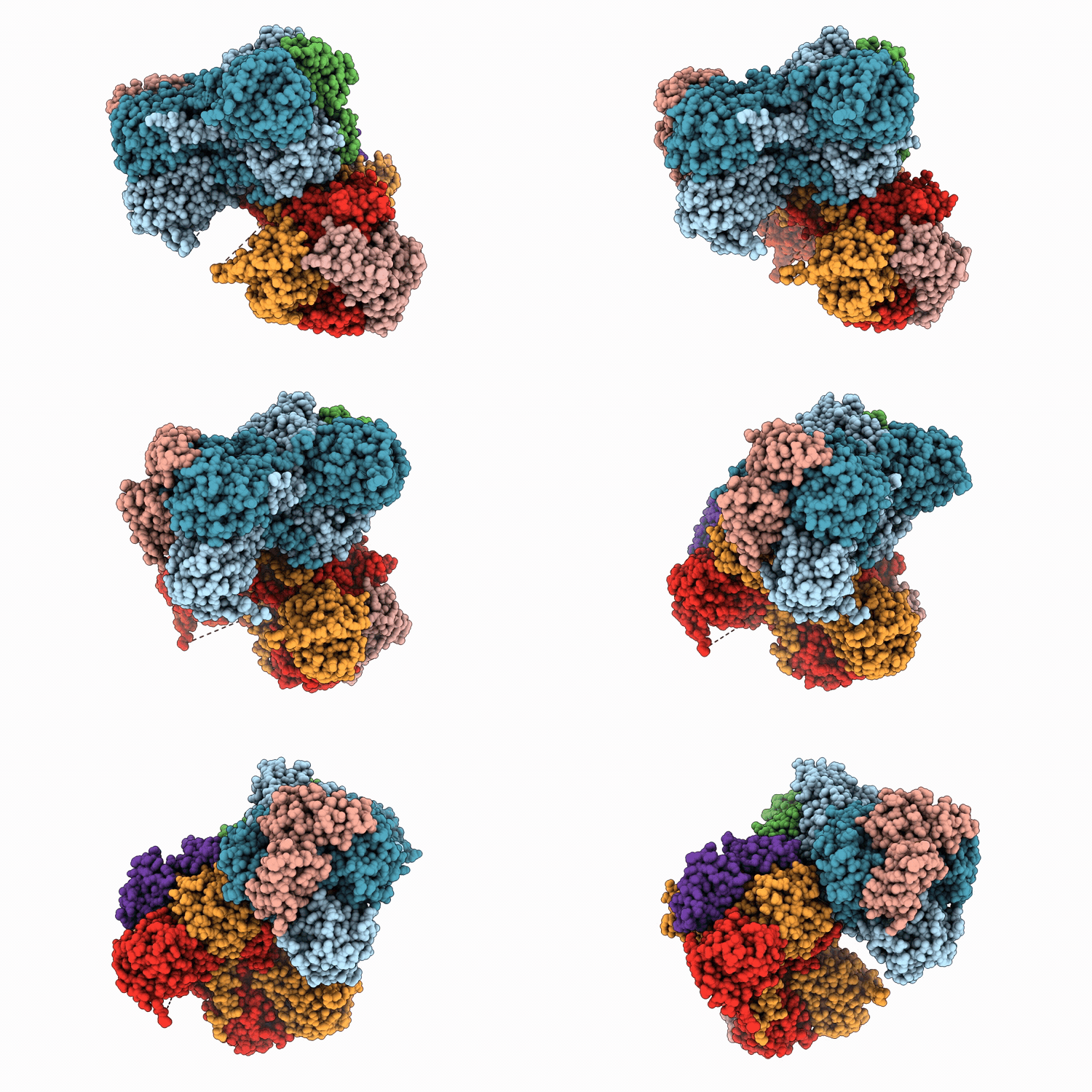
Crystal structure of fused glycerol dehydratase A177M variant
Biological Source:
Source Organism(s):
Expression System(s):
Method Details:
Experimental Method:
Resolution:
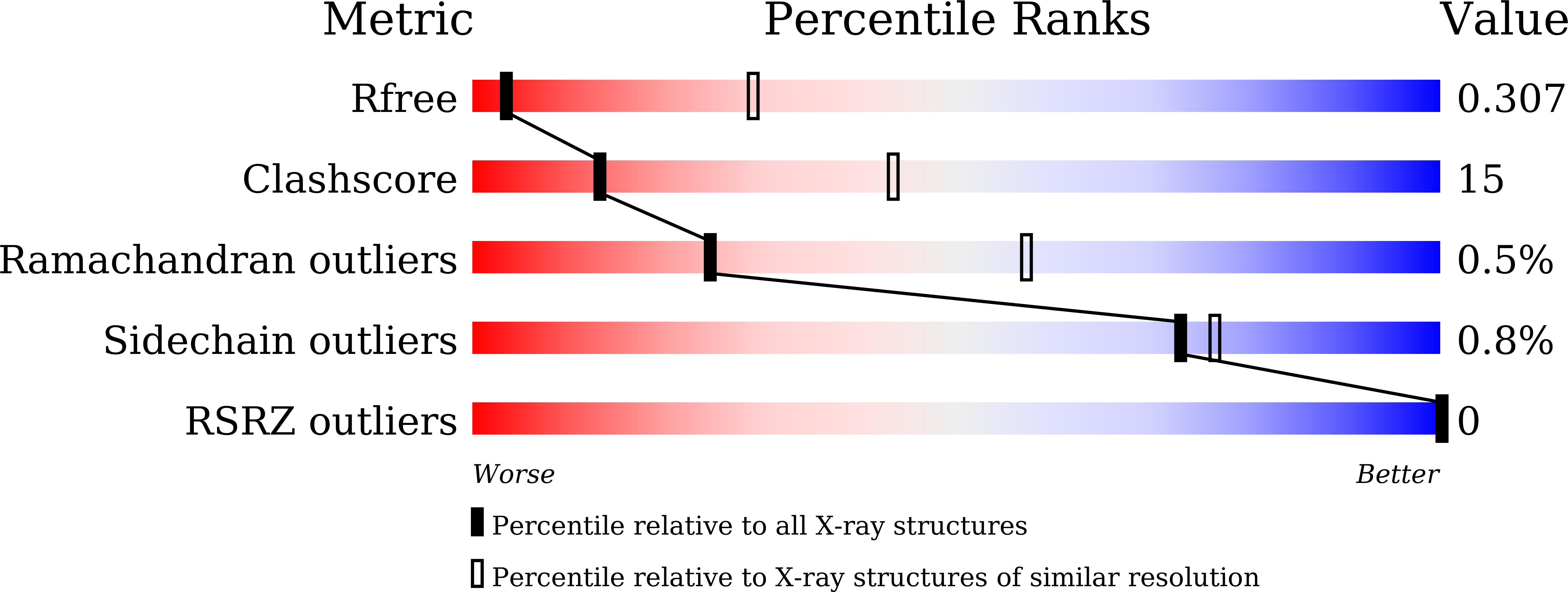
3.56 Å
R-Value Free:
0.30
R-Value Work:
0.25
R-Value Observed:
0.26
Space Group:
I 21 21 21
Macromolecular Entities
Protein Blast
Polymer Type:polypeptide(L)
Molecule:Glycerol dehydrase alpha subu
Gene (Uniprot):gldB, dhaB1
Mutagens:A177M
Chain IDs:A (auth: B), B (auth: C), E (auth: G), F (auth: H)
Chain Length:754
Number of Molecules:4
Biological Source:Klebsiella pneumoniae
Structures with similar UniProt ID
Protein Blast
Polymer Type:polypeptide(L)
Molecule:Glycerol dehydrase gamma subu
Gene (Uniprot):dhaB3
Chain IDs:C (auth: D), D (auth: E), G (auth: I), H (auth: J)
Chain Length:141
Number of Molecules:4
Biological Source:Klebsiella pneumoniae
Ligand Molecules
Primary Citation
Engineering the alpha- and beta-subunit interface of a coenzyme B 12 -dependent glycerol dehydratase for enhancing its resistance to inactivation.
Bioresour Technol 442 133733 133733 (2026)
PMID: 41319883 DOI: 10.1016/j.biortech.2025.133733

Abstact

Glycerol dehydratase (GDHt) enables bioconversion of glycerol to valuable chemicals, but its industrial use is hindered by rapid loss of the adenosylcobalamin (AdoCbl) cofactor (coenzyme B(12)) through both oxygen- and mechanism-based inactivation. To overcome this limitation, we reinforced the AdoCbl-binding interface of Klebsiella pneumoniae GDHt by fusing its alpha and beta subunits with a five-residue linker (fGDHt) and then introducing interface mutations. Fusion alone doubled the oxygen-inactivation half-life without affecting catalytic efficiency. Structural and computational analyses of interface residues, followed by experimental screening, yielded three stabilizing substitutions-alpha-A177M, beta-L113W, and beta-M158W. Pairwise combinations of these mutations yielded double variants whose oxygen-inactivation half-lives increased by up to 24-fold. Enzyme-coupled reactions to convert glycerol into 3-hydroxypropionic acid (3-HP) confirmed that engineered fGDHt variants maintained catalytic activity for longer periods, implying protection against both inactivation modes. In recombinant Escherichia coli strains producing 3-HP, the alpha-A177M/beta-M158W variant matched wild-type titers while operating with 25-fold less AdoCbl. Crystal structures reveal that the mutations tighten inter-subunit packing and, in the case of alpha-A177M, partly occlude an O(2)-access tunnel to the cofactor. These results have established alpha-beta interface engineering as a strategy for engineering more robust GDHts.

Legend

Protein

Chemical

Disease

Primary Citation of related structures
Feedback Form
Name
Email
Institute
Feedback