

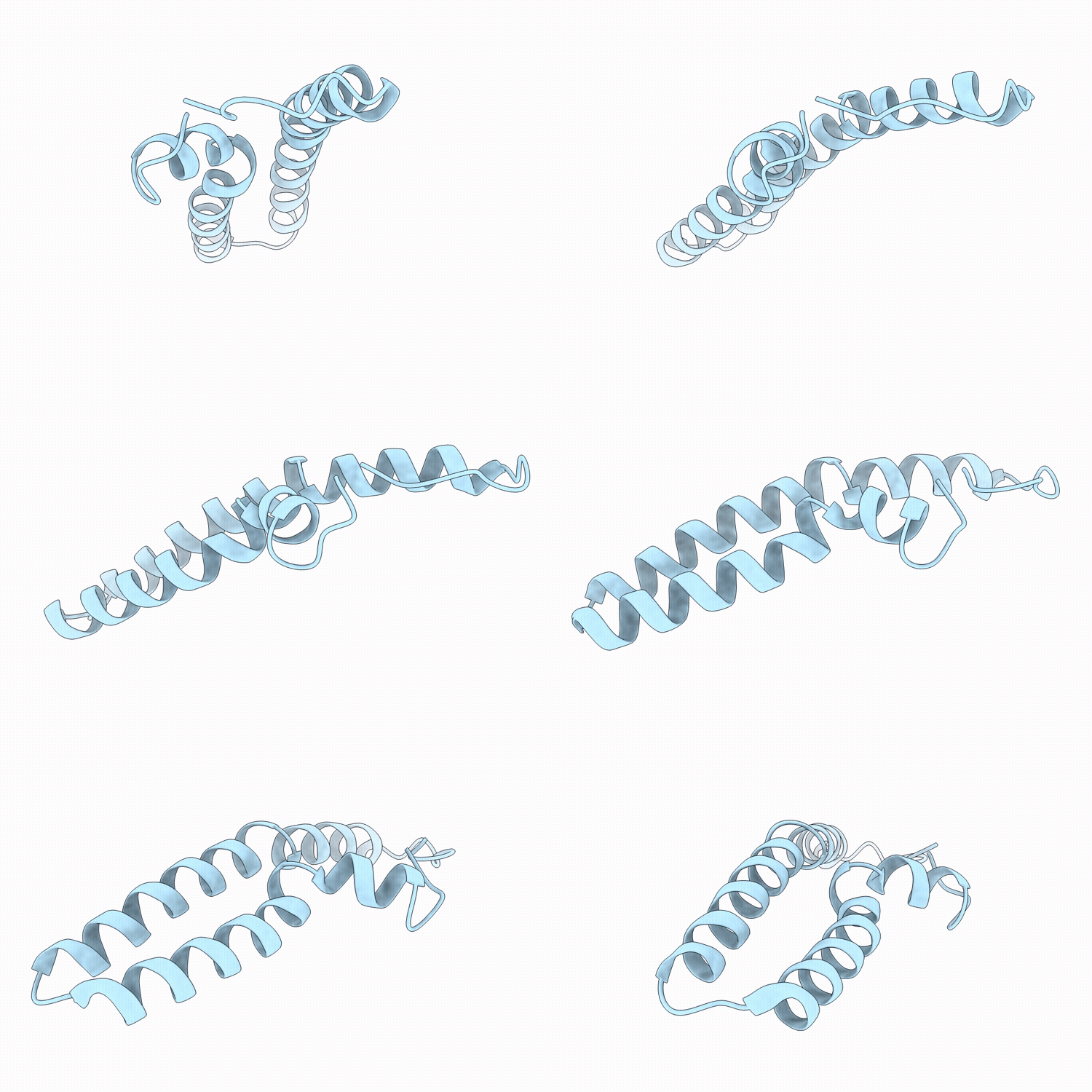
9VF4 image
Deposition Date 2025-06-10
Release Date 2026-05-27
Last Version Date 2026-07-01
Entry Detail
PDB ID:
9VF4
Keywords:
Title:
CryoEM structure of phospholipid-independent cyclised RP4 pilus
Biological Source:
Source Organism(s):
Escherichia coli (Taxon ID: 562)
Expression System(s):
Method Details:
Experimental Method:
Resolution:
2.74 Å
Aggregation State:
FILAMENT
Reconstruction Method:
HELICAL
Macromolecular Entities
Polymer Type:polypeptide(L)
Molecule:TrbC/VIRB2 family protein
Gene (Uniprot):p482-1_00154, p492-9_00169
Chain IDs:A (auth: c)
Chain Length:78
Number of Molecules:1
Biological Source:Escherichia coli
Ligand Molecules
Primary Citation
Phospholipid-independent biogenesis and function of the RP4 conjugation pilus.
Nat Commun ? ? ? (2026)
PMID: 42310306 DOI: 10.1038/s41467-026-74409-x

Abstact

Bacterial conjugation, the process of horizontal gene transfer between bacteria, is initiated by mating pair formation (MPF) via a conjugative pilus. Conjugation of the IncP RP4 plasmid is mediated by short mating pili. Here, we report the cryo-EM structure of the RP4 pilus at 2.74 A resolution. Uniquely, both the structural and quantitative mass spectral analyses revealed that the cyclic TrbC pilin subunit is not lipidated. Consistently, an E. coli pgsA mutant lacking phosphatidylglycerol (PG) can serve as a donor of RP4 but not of F- (pKpQIL), H- (R27) or W- (R388) pili, whose biogenesis and DNA transfer is PG-dependent. RP4 is the first example of a lipid-independent functional mating pilus. This discovery suggests that an amphipathic lipid moiety is not universally essential for the biogenesis of conjugative pili and MPF, providing an alternative model for their assembly and function. These data expand our understanding of the diverse bacterial mechanisms employ to transfer genetic material.

Legend

Protein

Chemical

Disease

Primary Citation of related structures
Feedback Form
Name
Email
Institute
Feedback