

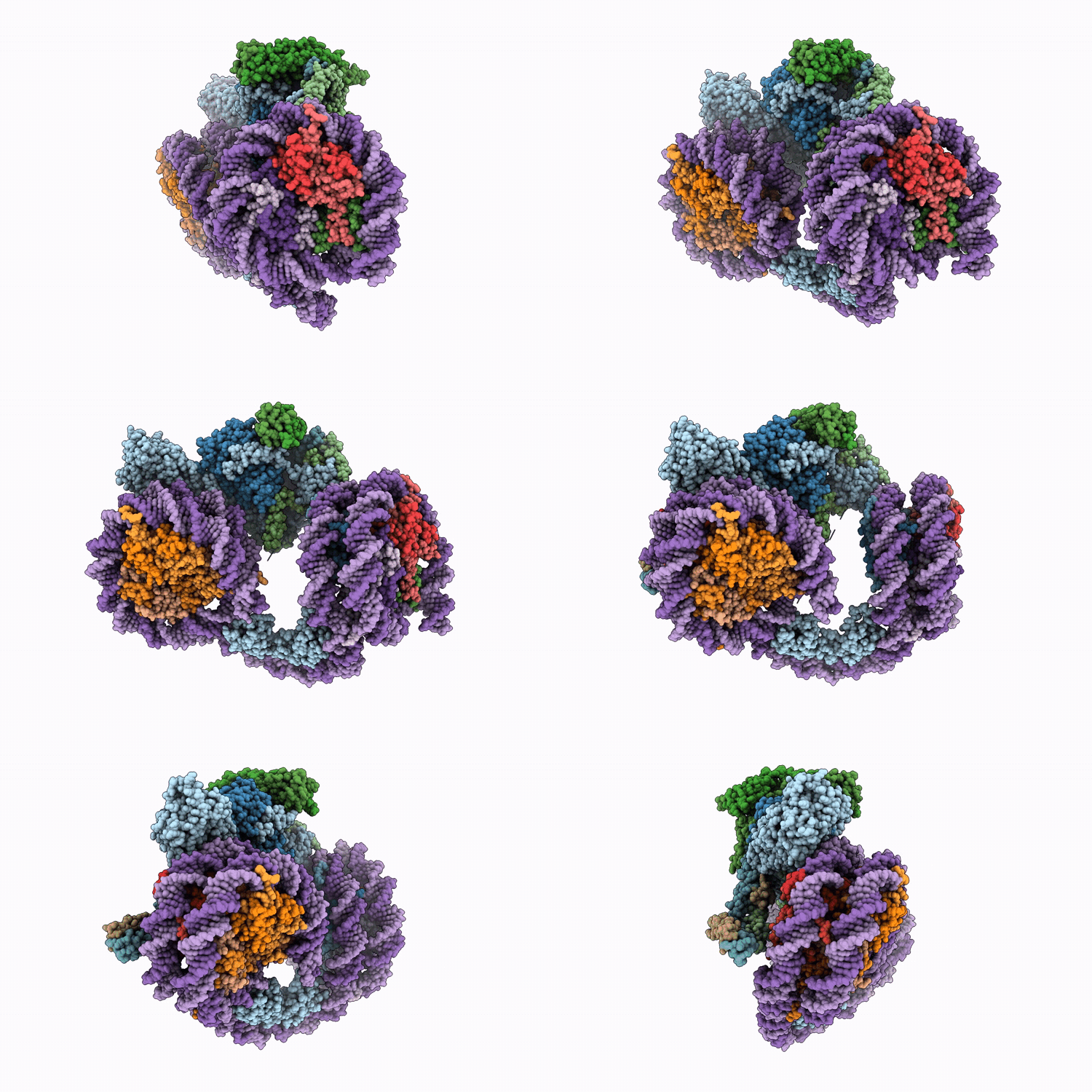
9V2W image
Deposition Date 2025-05-21
Release Date 2026-05-27
Last Version Date 2026-06-03
Entry Detail
PDB ID:
9V2W
Title:
Cryo-EM structure of the histone deacetylase complex Rpd3L in complex with di-nucleosome
Biological Source:
Source Organism(s):
Expression System(s):
Method Details:
Experimental Method:
Resolution:
3.40 Å
Aggregation State:
PARTICLE
Reconstruction Method:
SINGLE PARTICLE
Macromolecular Entities
Structures with similar UniProt ID
Protein Blast
Polymer Type:polypeptide(L)
Molecule:Transcriptional regulatory pr
Gene (Uniprot):SIN3
Chain IDs:A
Chain Length:1096
Number of Molecules:1
Biological Source:Saccharomyces cerevisiae S288C
Structures with similar UniProt ID
Protein Blast
Polymer Type:polypeptide(L)
Molecule:Histone H2A
Gene (Uniprot):LOC494591
Chain IDs:B, M, O, S
Chain Length:107
Number of Molecules:4
Biological Source:Xenopus laevis
Structures with similar UniProt ID
Protein Blast
Polymer Type:polypeptide(L)
Molecule:Histone deacetylase RPD3
Gene (Uniprot):RPD3
Chain IDs:C
Chain Length:378
Number of Molecules:1
Biological Source:Saccharomyces cerevisiae S288C
Structures with similar UniProt ID
Protein Blast
Polymer Type:polypeptide(L)
Molecule:Histone H2B
Gene (Uniprot):LOC108704302
Chain IDs:D, N, P, T
Chain Length:93
Number of Molecules:4
Biological Source:Xenopus laevis
Structures with similar UniProt ID
Protein Blast
Polymer Type:polypeptide(L)
Molecule:Transcriptional regulatory pr
Gene (Uniprot):DEP1
Chain IDs:E
Chain Length:119
Number of Molecules:1
Biological Source:Saccharomyces cerevisiae S288C
Structures with similar UniProt ID
Protein Blast
Polymer Type:polypeptide(L)
Molecule:Transcriptional regulatory pr
Gene (Uniprot):SDS3
Chain IDs:F
Chain Length:311
Number of Molecules:1
Biological Source:Saccharomyces cerevisiae S288C
Structures with similar UniProt ID
Protein Blast
Polymer Type:polypeptide(L)
Molecule:Transcriptional regulatory pr
Gene (Uniprot):SAP30
Chain IDs:G
Chain Length:119
Number of Molecules:1
Biological Source:Saccharomyces cerevisiae S288C
Structures with similar UniProt ID
Protein Blast
Polymer Type:polypeptide(L)
Molecule:Histone H3
Gene (Uniprot):LOC121398065
Chain IDs:H, Q, U, W
Chain Length:98
Number of Molecules:4
Biological Source:Xenopus laevis
Structures with similar UniProt ID
Protein Blast
Polymer Type:polypeptide(L)
Molecule:Transcriptional regulatory pr
Gene (Uniprot):PHO23
Chain IDs:I
Chain Length:105
Number of Molecules:1
Biological Source:Saccharomyces cerevisiae S288C
Structures with similar UniProt ID
Protein Blast
Polymer Type:polypeptide(L)
Molecule:Transcriptional regulatory pr
Gene (Uniprot):RXT2
Chain IDs:J
Chain Length:206
Number of Molecules:1
Biological Source:Saccharomyces cerevisiae S288C
Structures with similar UniProt ID
Protein Blast
Polymer Type:polypeptide(L)
Molecule:Histone deacetylase complex s
Gene (Uniprot):CTI6
Chain IDs:K
Chain Length:249
Number of Molecules:1
Biological Source:Saccharomyces cerevisiae S288C
Structures with similar UniProt ID
Protein Blast
Polymer Type:polypeptide(L)
Molecule:Histone H4
Chain IDs:L, R, V, X (auth: Z)
Chain Length:79
Number of Molecules:4
Biological Source:Xenopus laevis
Polymer Type:polydeoxyribonucleotide
Molecule:DNA (329-MER)
Chain IDs:Y (auth: X)
Chain Length:329
Number of Molecules:1
Biological Source:synthetic construct
Polymer Type:polydeoxyribonucleotide
Molecule:DNA (329-MER)
Chain IDs:Z (auth: Y)
Chain Length:329
Number of Molecules:1
Biological Source:synthetic construct
Ligand Molecules
Primary Citation
Chromatin context-dependent deacetylation by the asymmetric Rpd3L.
Nucleic Acids Res. 54 ? ? (2026)
PMID: 42152683 DOI: 10.1093/nar/gkag443

Abstact

The regulation of gene expression requires precise control of chromatin-associated complexes that respond to diverse structural and epigenetic cues. The Rpd3 Large (Rpd3L) complex is a Sin3 histone deacetylase complex (HDAC) that dynamically adapt to chromatin states to reinforce transcriptional silencing, yet the mechanisms governing the catalytic activation in chromatin context-dependent manner remain unclear. Here we present the cryo-electron microscopy structure of Rpd3L bound to both mono- and di-nucleosome substrate at near-atomic resolution, uncovering a substrate-guided allosteric activation mechanism. Rpd3L adopts an asymmetric architecture, in which the proximal catalytic module anchors the first nucleosome, while the Sin3 PAH domains engage linker DNA to reposition a second nucleosome. This spatial configuration brings the distal catalytic module into proximity with chromatin and unlocks its latent deacetylase activity. Biochemical and mass spectrometry analyses confirm that dual nucleosome engagement selectively enhances Rpd3L activity and broadens substrate specificity. Together, these findings establish a hierarchical mechanism by which Rpd3L interprets histone modifications and nucleosome organization to modulate its enzymatic output at promoter regions. Our study provides a framework for understanding higher-order chromatin repression mechanisms by chromatin-regulation complexes and co-repressors.

Legend

Protein

Chemical

Disease

Primary Citation of related structures
Feedback Form
Name
Email
Institute
Feedback