

9UXL image
Deposition Date 2025-05-14
Release Date 2026-03-25
Last Version Date 2026-03-25
Entry Detail
PDB ID:
9UXL
Title:
type II Lamassu, LmuACB from Vibrio cholerae O1 El
Biological Source:
Source Organism(s):
Vibrio cholerae (Taxon ID: 666)
Expression System(s):
Method Details:
Experimental Method:
Resolution:
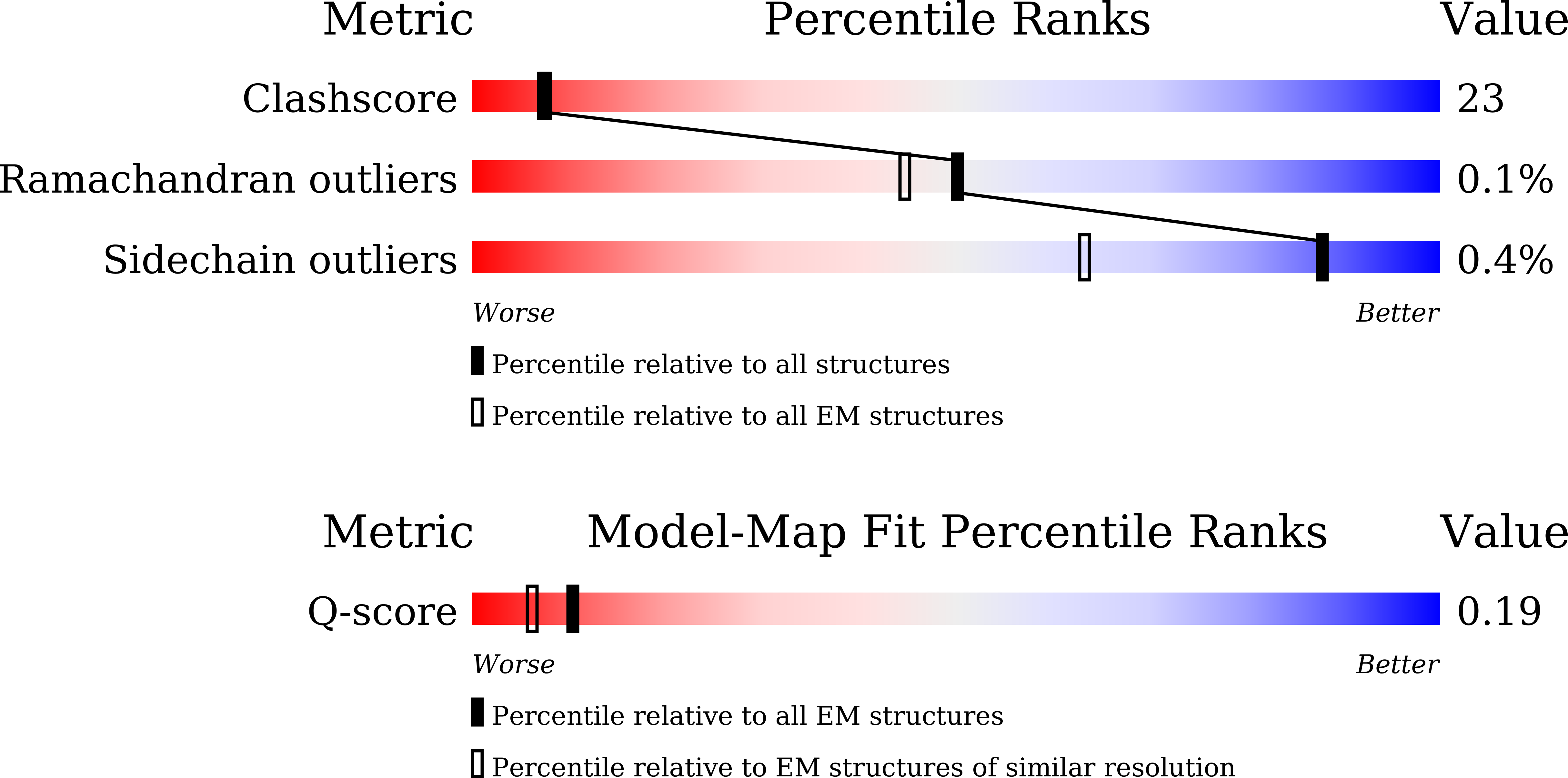
4.07 Å
Aggregation State:
PARTICLE
Reconstruction Method:
SINGLE PARTICLE
Macromolecular Entities
Structures with similar UniProt ID
Protein Blast
Polymer Type:polypeptide(L)
Molecule:DUF3732 domain-containing pro
Gene (Uniprot):D6U24_12495, ERS013200_03521, ERS013201_03641, KIN13_15860, VC_0490
Chain IDs:A, C (auth: F)
Chain Length:655
Number of Molecules:2
Biological Source:Vibrio cholerae
Structures with similar UniProt ID
Protein Blast
Polymer Type:polypeptide(L)
Molecule:ABC-three component systems C
Gene (Uniprot):D6U24_12485, ERS013200_03523, ERS013201_03639, KIN13_15850, VC_0492
Chain IDs:D (auth: C)
Chain Length:388
Number of Molecules:1
Biological Source:Vibrio cholerae
Structures with similar UniProt ID
Protein Blast
Polymer Type:polypeptide(L)
Molecule:Lamassu C
Chain IDs:B (auth: D)
Chain Length:172
Number of Molecules:1
Biological Source:Vibrio cholerae
Ligand Molecules
Primary Citation
Structural insights into type-I and type-II Lamassu antiphage systems.
Nat.Chem.Biol. ? ? ? (2026)
PMID: 41482579 DOI: 10.1038/s41589-025-02102-z

Abstact

Bacteria have developed a variety of immune systems to combat phage infections. The Lamassu system is a prokaryotic immune system with a core conserved structural maintenance of chromosomes (SMC) superfamily protein LmuB and diverse effectors named LmuA, whose mechanism remains unclear. Here we present a series of cryo-electron microscopy structures of the type-I Lamassu complex from Bacillus cellulasensis and the type-II Lamassu complex from Vibrio cholerae, both in apo and dsDNA-bound states, revealing an unexpected stoichiometry and topological architecture distinct from canonical SMC complexes. Combined structural and biochemical analyses show how the nuclease effector LmuA is sequestered in an inactive monomeric form within the Lamassu complex and, upon sensing foreign DNA ends, dissociates and assembles into an active tetramer capable of DNA cleavage. Our findings elucidate the mechanism by which Lamassu systems detect viral replication and implement antiphage defense, highlighting the roles of SMC proteins in prokaryotic immunity.

Legend

Protein

Chemical

Disease

Primary Citation of related structures
Feedback Form
Name
Email
Institute
Feedback