

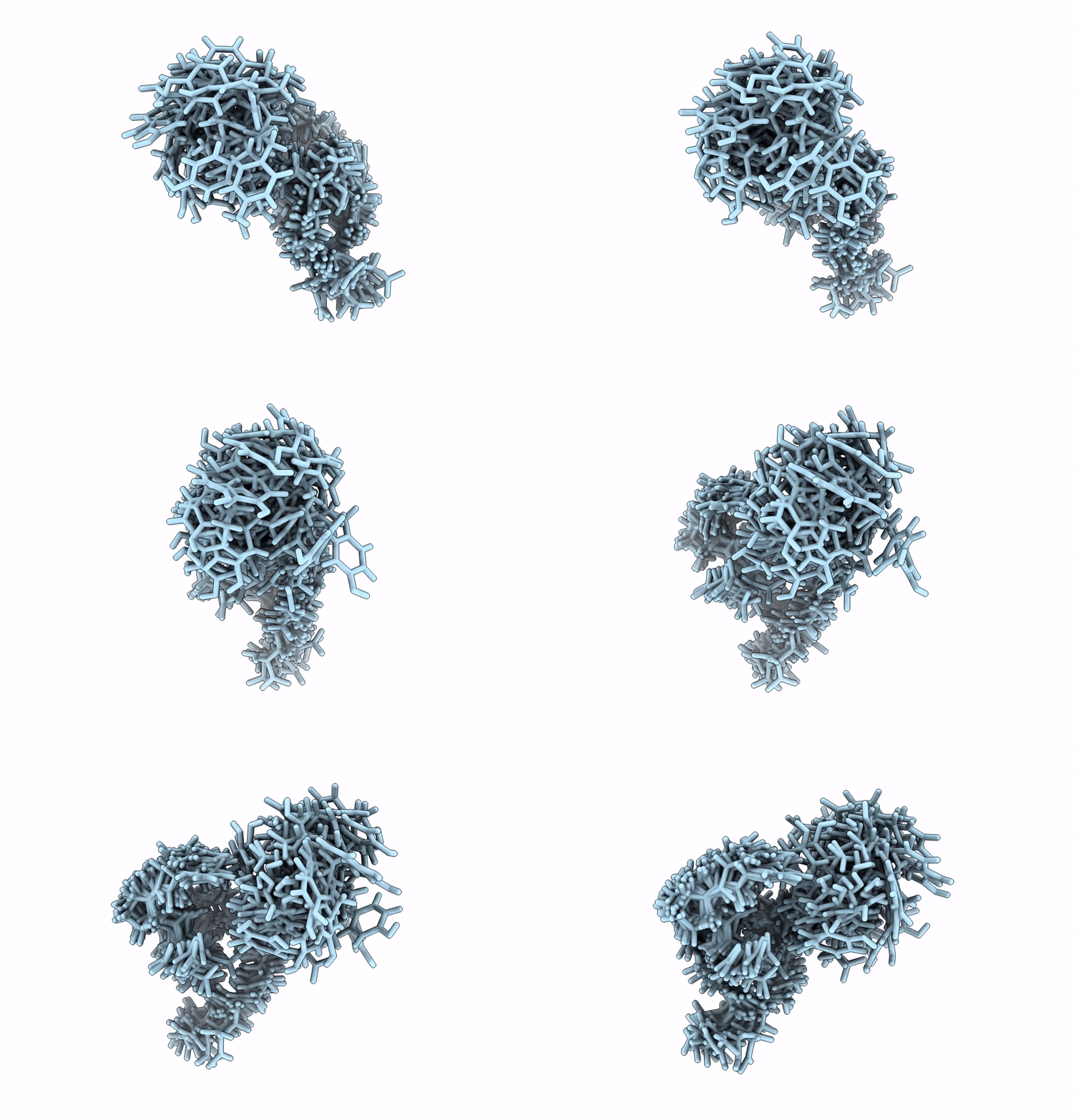
9UV5 image
Deposition Date 2025-05-09
Release Date 2025-05-28
Last Version Date 2026-06-17
Entry Detail
PDB ID:
9UV5
Title:
ligament intra-crystalline peptide (LICP)
Biological Source:
Source Organism(s):
Method Details:
Experimental Method:
Conformers Calculated:
200
Conformers Submitted:
20
Selection Criteria:
structures with the least restraint violations

Macromolecular Entities
Protein Blast
Polymer Type:polypeptide(L)
Molecule:PCA-PRO-ASP-HIS-GLU-GLY-THR-T
Chain IDs:A
Chain Length:10
Number of Molecules:1
Biological Source:Pinctada fucata
Ligand Molecules
Primary Citation
Elucidation of the aragonite nanofiber formation mechanism of LICP contained in the hinge ligament of Pinctada fucata.
Proc.Natl.Acad.Sci.USA 123 e2522686123 e2522686123 (2026)
PMID: 41945435 DOI: 10.1073/pnas.2522686123

Abstact

The hinge ligament of bivalves exhibits remarkable flexibility and compressive strength due to its composite structure of aragonite nanofibers embedded in an organic matrix. While these nanofibers are crucial for shell mechanics, the molecular mechanisms underlying their formation remain unclear. We investigated the function of a 10-residue intracrystalline peptide, ligament intracrystalline peptide (LICP), in regulating aragonite crystal growth. Using a solution-state NMR technique optimized for biomineral systems with dispersive calcium carbonate particles, we showed that LICP adopted a planar, elongated conformation in binding to aragonite. This structure features a coplanar arrangement of carboxyl and aromatic side chains-particularly tyrosines-that enables selective interaction with the aragonite 110. Saturation transfer difference NMR and dose-dependent structural analyses confirmed that this conformational change is triggered by solid-phase contact, rather than free calcium ions. Molecular dynamics simulations revealed enhanced binding stability of LICP to the 110 surface through multiple carboxyl and aromatic residues. Furthermore, in vitro crystallization assays showed that LICP promoted elongation of aragonite crystals along the c-axis, consistent with its selective surface binding. These findings demonstrated that conformational plasticity in short, disordered peptides enabled specific recognition of crystal faces and directed modulation of mineral growth. LICP serves as a minimal yet powerful model for exploring protein-mineral interfaces, offering broader insights into the structural principles by which intrinsically disordered peptides function in solid-phase biological systems.

Legend

Protein

Chemical

Disease

Primary Citation of related structures
Feedback Form
Name
Email
Institute
Feedback