

9UPR image
Deposition Date 2025-04-28
Release Date 2026-05-06
Last Version Date 2026-06-10
Entry Detail
PDB ID:
9UPR
Keywords:
Title:
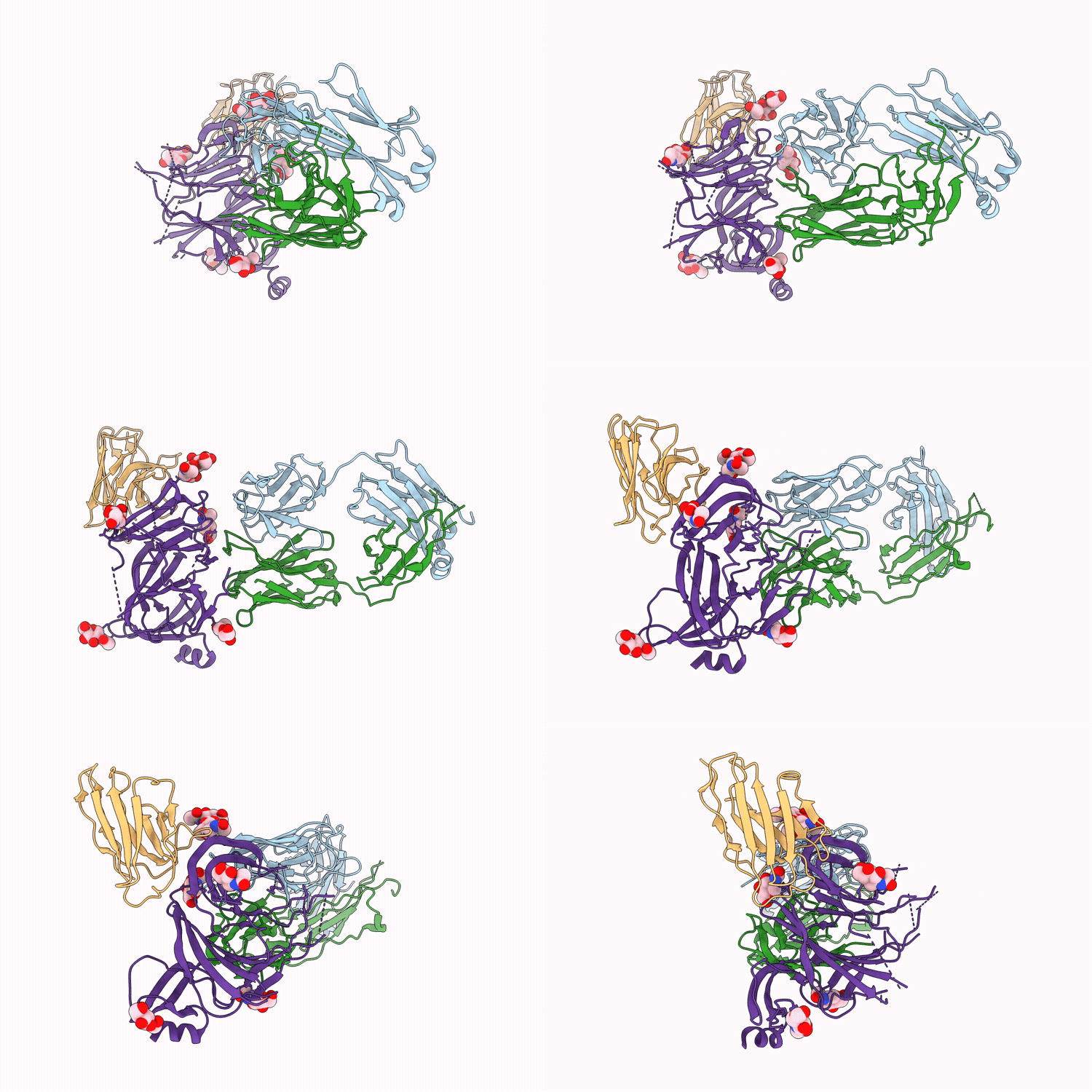
Cryo-EM structure of the N-terminal domain of Omicron BA.1 in complex with nanobody N103 and S2L20 Fab
Biological Source:
Source Organism(s):
Expression System(s):
Method Details:
Experimental Method:
Resolution:
2.77 Å
Aggregation State:
PARTICLE
Reconstruction Method:
SINGLE PARTICLE
Macromolecular Entities
Protein Blast
Polymer Type:polypeptide(L)
Molecule:S2L20 light chain
Chain IDs:A
Chain Length:236
Number of Molecules:1
Biological Source:Homo sapiens
Protein Blast
Polymer Type:polypeptide(L)
Molecule:S2L20 heavy chain
Chain IDs:B
Chain Length:473
Number of Molecules:1
Biological Source:Homo sapiens
Protein Blast
Polymer Type:polypeptide(L)
Molecule:nanobody N103
Chain IDs:C (auth: E)
Chain Length:122
Number of Molecules:1
Biological Source:Vicugna pacos
Structures with similar UniProt ID
Protein Blast
Polymer Type:polypeptide(L)
Molecule:Spike glycoprotein
Gene (Uniprot):S
Chain IDs:D (auth: F)
Chain Length:306
Number of Molecules:1
Biological Source:Severe acute respiratory syndrome coronavirus 2
Ligand Molecules
Primary Citation
From weak but broad to potent and universal: A trispecific antibody against conserved SARS-CoV-2 spike epitopes.
Mol.Ther. ? ? ? (2026)
PMID: 42186224 DOI: 10.1016/j.ymthe.2026.05.012

Abstact

Most neutralizing antibodies against severe acute respiratory syndrome coronavirus 2 target the receptor-binding domain (RBD). However, due to high immune pressure, the RBD accumulates mutations, thus significantly reduce antibody efficacy against emerging variants/subvariants. Although some RBD-targeting antibodies bind conserved epitopes, they usually exhibit weak-to-moderate neutralization. Similarly, antibodies against the N-terminal domain (NTD) or S2 subunit often retain broad binding but generally lack potent neutralization. To address this, we initially identified the broadly reactive nanobody, N103, which exhibited weak neutralizing potency. Structural and functional analyses revealed that N103 targets a conserved NTD epitope and triggers S1 subunit shedding, thereby destabilizing the spike trimer through an allosteric mechanism. Leveraging this insight, we engineered a trispecific antibody combining N103 with antibodies targeting the conserved RBD and S2 epitopes. This design synergistically integrated their distinct binding profiles and mechanisms, achieving potent and broad neutralization against both pseudoviruses and authentic viruses, including the immune-evasive BA.2.86 subvariant. Furthermore, challenge studies in human angiotensin-converting enzyme 2 knock-in mice demonstrated robust in vivo protection. Our findings highlight a cooperative multi-target strategy in which antibodies with limited individual potency can collectively achieve broad and potent neutralization through rational design. This approach provides a promising framework for next-generation antibody therapeutics.

Legend

Protein

Chemical

Disease

Primary Citation of related structures
Feedback Form
Name
Email
Institute
Feedback