

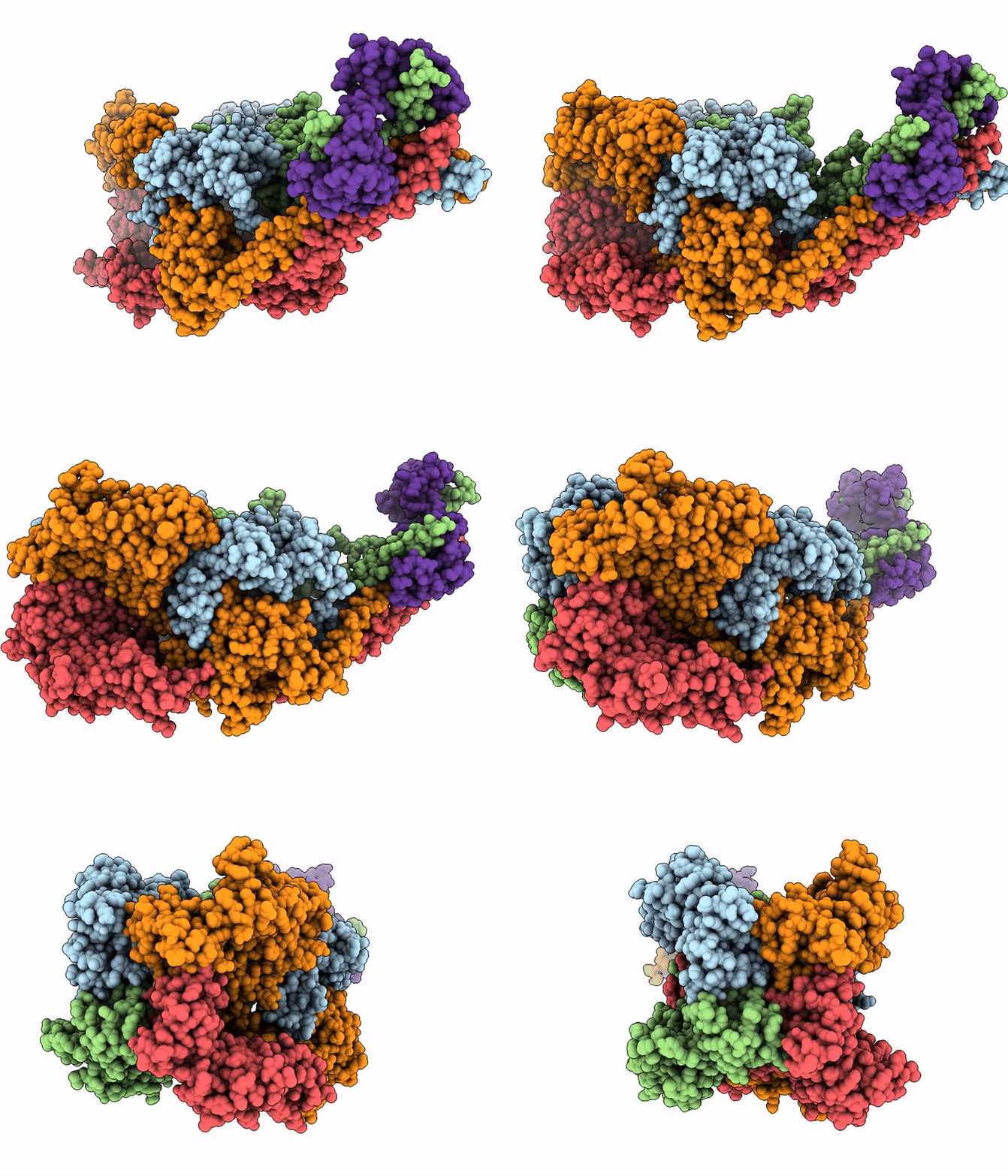
9UPG image
Deposition Date 2025-04-28
Release Date 2025-09-24
Last Version Date 2026-04-08
Entry Detail
PDB ID:
9UPG
Title:
Cryo-EM structure of human olfactory CNGA2/A4/B1 in CaM-bound closed state
Biological Source:
Source Organism(s):
Homo sapiens (Taxon ID: 9606)
Expression System(s):
Method Details:
Experimental Method:
Resolution:
2.87 Å
Aggregation State:
PARTICLE
Reconstruction Method:
SINGLE PARTICLE
Macromolecular Entities
Structures with similar UniProt ID
Protein Blast
Polymer Type:polypeptide(L)
Molecule:Cyclic nucleotide-gated chann
Gene (Uniprot):CNGA2
Chain IDs:A, C
Chain Length:664
Number of Molecules:2
Biological Source:Homo sapiens
Structures with similar UniProt ID
Protein Blast
Polymer Type:polypeptide(L)
Molecule:Cyclic nucleotide-gated chann
Gene (Uniprot):CNGB1
Chain IDs:D (auth: B)
Chain Length:1251
Number of Molecules:1
Biological Source:Homo sapiens
Structures with similar UniProt ID
Protein Blast
Polymer Type:polypeptide(L)
Molecule:Cyclic nucleotide-gated chann
Gene (Uniprot):CNGA4
Chain IDs:B (auth: D)
Chain Length:575
Number of Molecules:1
Biological Source:Homo sapiens
Structures with similar UniProt ID
Protein Blast
Polymer Type:polypeptide(L)
Molecule:Calmodulin-1
Gene (Uniprot):CALM1
Chain IDs:E (auth: H)
Chain Length:149
Number of Molecules:1
Biological Source:Homo sapiens
Ligand Molecules
Primary Citation
Structural mechanisms of assembly, gating, and calmodulin modulation of human olfactory CNG channel.
Nat Commun 16 9380 9380 (2025)
PMID: 41131016 DOI: 10.1038/s41467-025-64436-5

Abstact

Mammalian cyclic nucleotide-gated (CNG) channels play crucial roles in visual and olfactory signal transduction. In olfactory sensory neurons, the native CNG channel functions as a heterotetramer consisting of CNGA2, CNGA4, and CNGB1b subunits and is activated by cAMP. Calmodulin (CaM) modulates the activity of the olfactory CNG channel, enabling rapid adaptation to odorants. Here we present cryo-EM structures of the native human olfactory CNGA2/A4/B1b channel in both CaM-bound closed and cAMP-bound open states, elucidating the molecular basis of the 2:1:1 subunit stoichiometry in channel assembly and the asymmetrical channel gating upon cAMP activation. Combining structural and functional analyses with AlphaFold prediction, we define two distinct CaM binding sites (CaM1 and CaM2) on the N- and C-terminal regions of CNGB1b, respectively, shedding light on the molecular mechanism of Ca(2+)/CaM-mediated rapid inhibition of the native olfactory CNG channel.

Legend

Protein

Chemical

Disease

Primary Citation of related structures
Feedback Form
Name
Email
Institute
Feedback