

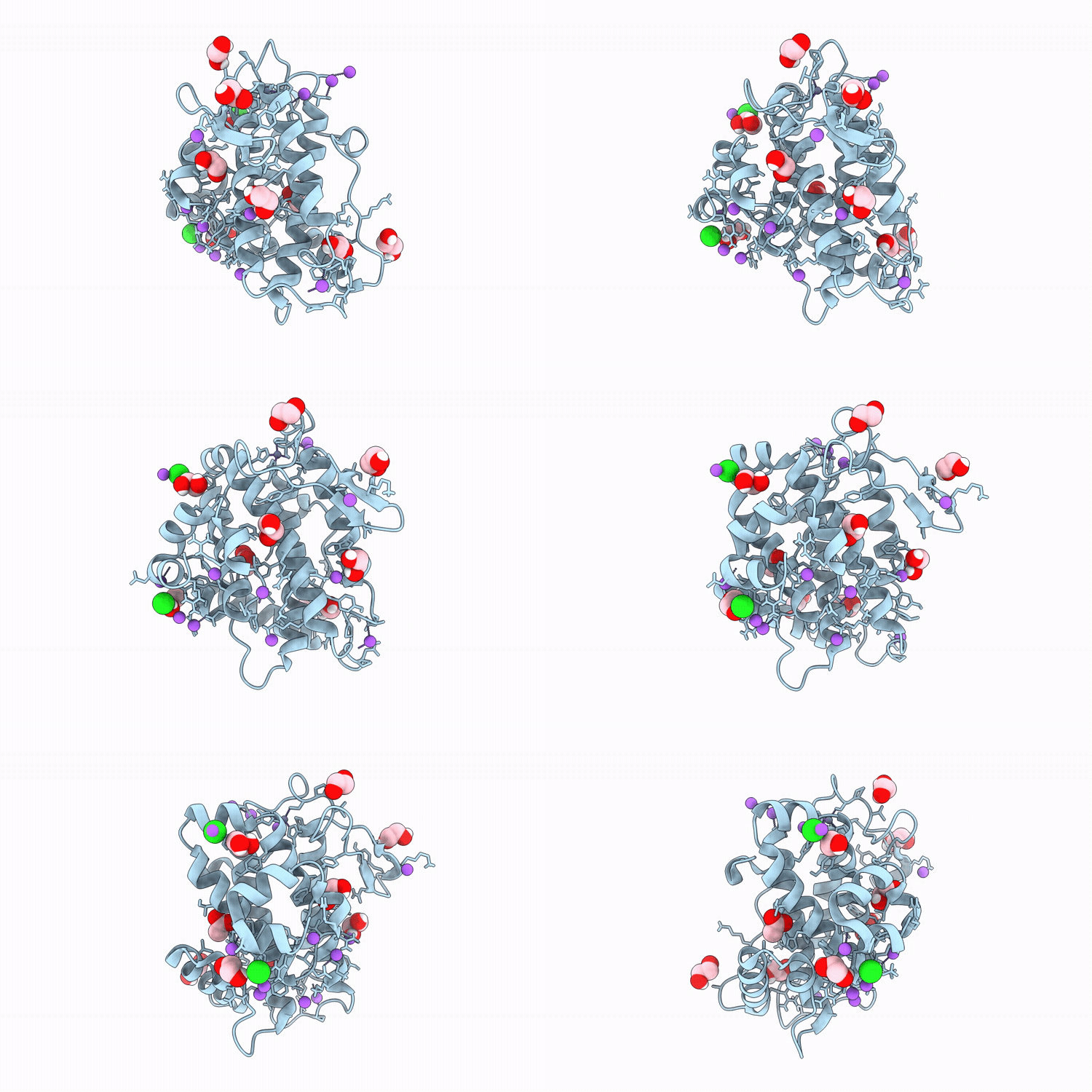
9UO7 image
Deposition Date 2025-04-25
Release Date 2026-04-01
Last Version Date 2026-04-01
Entry Detail
PDB ID:
9UO7
Keywords:
Title:
L. donovani Cell cycle associated protein MOB1
Biological Source:
Source Organism(s):
Expression System(s):
Method Details:
Experimental Method:
Resolution:
1.30 Å
R-Value Free:
0.19
R-Value Work:
0.17
R-Value Observed:
0.18
Space Group:
P 1 21 1

Macromolecular Entities
Structures with similar UniProt ID
Protein Blast
Polymer Type:polypeptide(L)
Molecule:Cell cycle associated protein
Gene (Uniprot):LDBPK_060990, LdCL_060015000, LDHU3_06.1130
Mutagens:E220D
Chain IDs:A
Chain Length:223
Number of Molecules:1
Biological Source:Leishmania donovani
Primary Citation
Crystal structure of the cell-cycle regulatory monopolar spindle one binder (LdMOB1) protein: Identification of potential distinct phosphorylation sites.
Int. J. Biol. Macromol. 344 150395 150395 (2026)
PMID: 41577278 DOI: 10.1016/j.ijbiomac.2026.150395

Abstact

Monopolar spindle One Binder (MOB1) proteins, recently identified as tumor suppressors, are essential regulators of the cell cycle, ensuring proper chromosome segregation and ploidy maintenance during mitotic exit and transition to cytokinesis. MOB1 also works as an adaptor protein for upstream Mammalian sterile 20-like kinase (MST1/2) and downstream Large Tumor Suppressor (LATS1) kinases in the Hippo pathway. Evolutionarily conserved, MOB proteins show differences in their N-terminal region and phosphorylation sites. Here, we describe the crystal structure of Leishmania donovani MOB1 (LdMOB1) elucidated at 1.3 A. LdMOB1 adopts a compact, globular conformation, with its core architecture similar to its homologs with a conformational variability in its N- and C-termini. Phosphorylation assays of native and T14A mutant LdMOB1 revealed that LdMOB1 undergoes reversible phosphorylation. Our results suggest that the potential phosphorylation sites are Ser 167 and Thr 170, distinct from the Thr 12 and Thr 35 in human MOB1. Computational protein-protein interaction studies confirm the plausibility of the identified phosphorylation sites.

Legend

Protein

Chemical

Disease

Primary Citation of related structures
Feedback Form
Name
Email
Institute
Feedback